
You trade Bitcoin or Ethereum from your phone in Mumbai, Bangalore, or Delhi. You hit 'sell,' and suddenly ₹1,000 disappears from a ₹1,00,000 transaction. It’s not a hack. It’s not a fee spike. It is the 1% TDS on crypto transactions mandated by the Indian government. Since July 2022, this rule has changed how every Indian investor handles Virtual Digital Assets (VDAs). If you are trading crypto in India, understanding this mechanism is no longer optional-it is survival.
The confusion around this tax is massive. Many traders think it applies to every single click. Others believe they can avoid it by moving coins between their own wallets. The reality is more nuanced. This guide breaks down exactly who pays, when it kicks in, and how to handle the paperwork without losing your mind-or your money.
What Is the 1% TDS on Crypto?
Tax Deducted at Source (TDS) is a collection mechanism used by the Income Tax Department of India. Under Section 194S of the Income Tax Act, 1961, any person making a payment for the transfer of VDAs must deduct 1% tax before handing over the funds. The goal, as stated by Finance Minister Nirmala Sitharaman during the 2022 Union Budget, is simple: track the flow of money into and out of crypto assets.
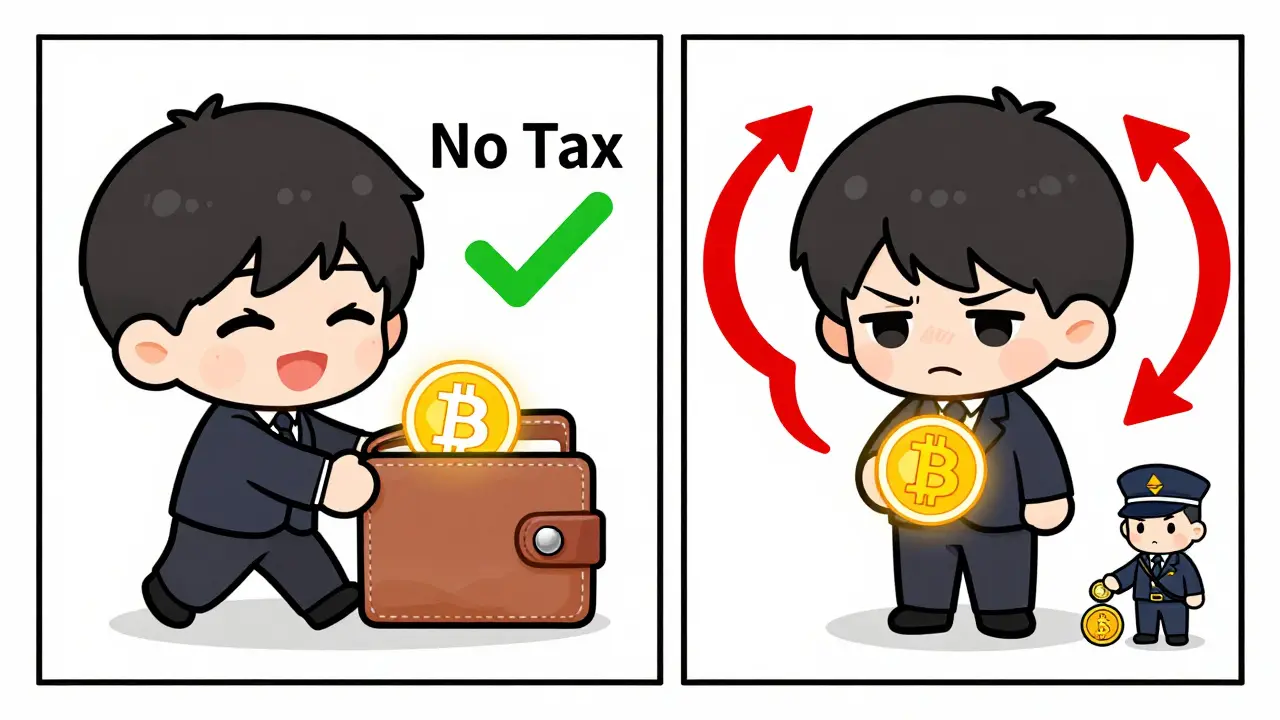
Here is the critical distinction most people miss. TDS applies to a "transfer." The Income Tax Department defines a transfer as a change of ownership. This includes selling crypto for INR, trading one crypto for another (like swapping BTC for ETH), or spending crypto to buy goods. It does not apply if you move funds from your personal Wallet A to your personal Wallet B. No ownership change means no tax event.
| Action | TDS Applicable? | Reason |
|---|---|---|
| Sell BTC for INR | Yes | Change of ownership (Asset → Fiat) |
| Swap ETH for USDT | Yes | Change of ownership (Asset → Asset) |
| Buy NFT with Crypto | Yes | Change of ownership (Asset → Goods) |
| Move BTC to Cold Wallet | No | No change of ownership |
| Receive Staking Rewards | No* | Not a transfer (until sold/traded) |
Who Pays and When Does It Kick In?
The 1% rate sounds small until you look at the thresholds. The government uses a two-tier system based on your taxpayer status. This is where most errors happen. You need to know which bucket you fall into.
Bucket 1: Specified Persons This category includes individuals and Hindu Undivided Families (HUFs) who are not liable for a tax audit under Section 44AB in the previous financial year. For these users, the 1% TDS only triggers if your total crypto transactions exceed ₹50,000 in a single financial year. If you stay below ₹50,000 annually, you pay zero TDS.
Bucket 2: All Other Taxpayers This includes companies, firms, LLPs, and individuals who are liable for a tax audit. For them, the threshold is much lower: ₹10,000 per financial year. Once your cumulative transactions cross ₹10,000, every subsequent rupee attracts 1% TDS.
If you fail to file your income tax returns for the past two years and had TDS deducted exceeding ₹50,000 annually, Section 206AB kicks in. This punitive measure raises the TDS rate to 5%. It is a harsh penalty designed to force compliance with basic filing obligations.
The Hidden Cost: Crypto-to-Crypto Swaps
This is the part that hurts high-frequency traders the most. When you swap one cryptocurrency for another-say, selling Bitcoin to buy Solana-the platform treats it as a sale followed by a purchase. Both legs of the transaction involve a "transfer."
In many cases, especially on peer-to-peer (P2P) platforms or certain decentralized exchanges, both the buyer and the seller may be required to deduct TDS. This creates an effective deduction of 2% on the transaction value. If you are day trading, this eats into your capital rapidly. Imagine executing ten trades of ₹1,00,000 each in a month. That is ₹20,000 in TDS alone, just to move positions. This friction has led some traders to reduce frequency or move to offshore platforms, though that carries its own legal risks.
How Exchanges Handle It vs. P2P Trading
Your experience depends heavily on where you trade. Major Indian exchanges like CoinDCX, WazirX, and ZebPay have automated this process. When you sell, the platform deducts the 1% automatically before crediting your bank account. You see less money hit your wallet, but the compliance burden is off your shoulders. These platforms also file Form 26QE on your behalf.
P2P trading and international exchanges are different beasts. If you use Binance or Kraken, they do not know about Indian Section 194S. If you engage in P2P trades where you receive INR directly from a counterparty, you become the deductor. You must:
- Deduct 1% from the payment received.
- Obtain the PAN card of the seller.
- File Form 26QE within 30 days of the end of the month.
- Issue a TDS certificate to the seller within 15 days.
This manual workflow is why 89% of active P2P traders reported developing workarounds, such as splitting transactions to stay below thresholds. However, splitting transactions intentionally to evade TDS is considered tax evasion and can lead to penalties under the Prevention of Money Laundering Act (PMLA).
The Double Taxation Reality
TDS is not your final tax bill. It is an advance payment. India taxes crypto gains at a flat 30% under Section 115BBH, plus a 4% health and education cess. You cannot offset losses from other sources against crypto profits. So, if you made ₹1,00,000 profit:
• You pay 30% tax = ₹30,000.
• Add 4% cess = ₹1,200.
• Total tax liability = ₹31,200.
• Less TDS already paid = ₹1,000 (assuming ₹1L turnover).
• Balance due = ₹30,200.
Furthermore, since July 2025, an 18% GST applies to exchange services. While this doesn’t increase your direct tax liability, it increases your transaction costs. A layered taxation structure makes Indian crypto trading significantly more expensive than in jurisdictions like Singapore or Germany.

Common Mistakes and How to Avoid Them
Based on data from ClearTax and user forums, here are the top pitfalls:
- Misunderstanding the Threshold: Thinking the ₹50,000 limit is per transaction. It is annual cumulative. One large trade triggers it immediately.
- Ignoring P2P Liability: Believing that because an app didn’t deduct TDS, you don’t owe it. In P2P, you are responsible.
- Filing Errors: Incorrect PAN validation leads to rejected filings. Always verify the counterparty’s PAN before initiating large transfers.
- Delayed Credits: Form 26AS updates often lag by 30-90 days. Do not panic if you don’t see the credit immediately; check again after a month.
To stay compliant, keep detailed records of every transaction timestamp, counterparty details, and valuation method used for non-fiat trades. The Institute of Chartered Accountants of India (ICAI) recommends maintaining a dedicated ledger for VDA movements.
Future Outlook: What Changes Are Coming?
The regulatory landscape is shifting. The proposed Digital Asset Bill 2025 aims to replace the current patchwork with a centralized transaction registry. There are also rumors of threshold revisions, potentially raising the individual limit to ₹1,00,000 to ease the burden on retail investors. Additionally, the National Payments Corporation of India (NPCI) is piloting an Account Aggregation Framework that could auto-report crypto transactions to tax authorities by early 2026.
For now, the 1% TDS remains a strict enforcement tool. It has successfully increased transaction reporting by 43% since 2022. While critics argue it stifles innovation, the government views it as essential for tracking capital flows in an otherwise opaque market. As you navigate this space, remember: transparency protects you. Keep your books clean, report accurately, and consult a CA specializing in crypto taxes before filing your return.
Is the 1% TDS applicable if I hold crypto for more than a year?
Yes. Unlike capital gains tax rates which may vary by holding period, the 1% TDS under Section 194S applies to all transfers of Virtual Digital Assets regardless of how long you held them. It is a transaction-based tax, not an income-based tax.
Do I pay TDS when I buy crypto?
Technically, the deductor is the person making the payment. In most exchange scenarios, the platform handles the deduction on the sale side. However, in crypto-to-crypto swaps, both parties might incur TDS depending on the platform's interpretation of "payment." Always check your specific exchange's policy.
What happens if I forget to deduct TDS in a P2P transaction?
You are liable for interest and penalties under Section 276C of the Income Tax Act. The penalty can range from the amount of TDS not deducted to the full amount itself, plus monthly interest of 1% until payment is made. It is crucial to rectify this immediately upon discovery.
Can I claim the 1% TDS as a credit against my 30% capital gains tax?
Yes. The TDS is an advance payment of your tax liability. When you file your Income Tax Return (ITR), you declare the TDS paid via Form 26AS. This amount is credited against your final tax dues calculated under Section 115BBH.
Does TDS apply to staking rewards?
No, receiving staking rewards is not considered a "transfer" under Section 194S. TDS only applies when you sell, trade, or spend those rewards. However, the receipt of staking rewards is taxable as "Income from Other Sources" at your slab rate.