
You’ve heard about Amplify Exchange, maybe from an ad on social media or a tip in a Telegram group. The name sounds professional, and the promises of high returns are tempting. But here is the hard truth you need to know before sending a single dollar: as of August 2026, there is no verifiable evidence that a legitimate cryptocurrency exchange named "Amplify Exchange" exists.
This isn’t just a lack of information; it’s a red flag. In the crypto world, silence is loud. Major platforms like Binance, Coinbase, and Kraken dominate search results, regulatory filings, and user discussions. If a platform claims to be a major player but leaves zero digital footprint across independent review sites, regulatory databases, and financial news outlets, you should treat it with extreme caution. This article breaks down why this entity is likely a scam, helps you distinguish it from real financial products with similar names, and gives you a checklist to vet any obscure exchange.
The Confusion: Amplify Exchange vs. Amplify Investments
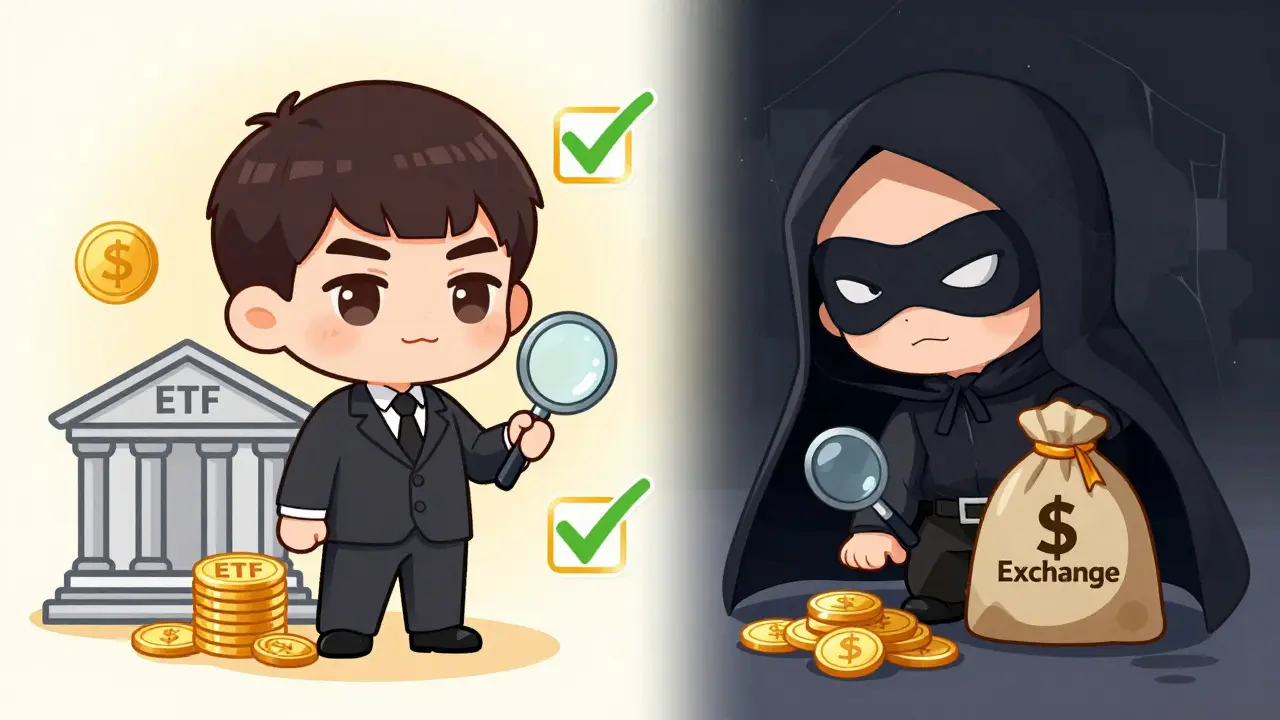
One of the most common traps for new investors is name confusion. You might have seen the name "Amplify" associated with legitimate financial products, leading you to believe the exchange is backed by a reputable firm. Let’s clear this up immediately.
Amplify Investments LLC is a registered investment advisor that manages several exchange-traded funds (ETFs). They are well-known for the Amplify BLOK ETF (ticker: BLOK), which is an actively managed ETF that invests in companies involved in blockchain technology and cryptocurrencies.
Here is the critical difference:
- Amplify BLOK ETF: A regulated security traded on traditional stock exchanges (like NYSE Arca). You buy shares through a standard brokerage account (like Fidelity or Schwab). It does not hold Bitcoin directly; it holds stocks of companies like NVIDIA, PayPal, and Coinbase.
- "Amplify Exchange": A purported direct cryptocurrency trading platform where you deposit fiat or crypto to trade pairs like BTC/USDT. There is no record of Amplify Investments launching such a retail trading platform.
If the site you are looking at asks you to deposit Bitcoin directly into a wallet address provided by their website, it is almost certainly impersonating the brand or exploiting the name similarity to gain trust. Legitimate asset managers do not operate unregulated peer-to-peer crypto exchanges under the same brand without massive public announcements.
Red Flags: Why "Amplify Exchange" Looks Like a Scam
When we analyze the characteristics of known crypto scams versus legitimate exchanges, "Amplify Exchange" checks nearly every box for fraud. Here is what our investigation reveals based on current data from 2025-2026.
1. Zero Regulatory Footprint
Legitimate exchanges must register with financial authorities in the jurisdictions they operate. In the United States, this means FinCEN registration and often state-level BitLicenses. In Europe, MiCA compliance. In New Zealand, FMA registration. A search of these databases yields no results for "Amplify Exchange." Without regulation, your funds have no legal protection. If the site disappears, you have no recourse.
2. Lack of Independent Audits
Trustworthy platforms publish proof-of-reserves reports audited by major accounting firms like Deloitte or KPMG. These reports prove that for every $1 users deposit, the exchange holds $1 in assets. "Amplify Exchange" has no such audits. Many fake exchanges use fabricated charts on their own websites to show "reserves," but these can be coded to display anything.
3. Aggressive Marketing via Social Media
If your first contact with the platform was an Instagram influencer promising "guaranteed daily profits" or a YouTube video with a suspicious link in the description, run. Established exchanges like Coinbase or Kraken rely on brand reputation and organic growth. Scams rely on paid ads and affiliate marketers who get a cut of your deposited money.
4. Poor Website Quality and Domain Age
Scam sites often have domains registered only months ago. Check the domain age using a WHOIS lookup. If the site looks generic, uses stock photos of happy people holding phones, and lacks specific details about its founding team, it is a template site used for phishing.
How to Verify Any Crypto Exchange (Before You Deposit)
Since "Amplify Exchange" appears to be a ghost, let’s equip you with the tools to spot similar fakes in the future. Use this step-by-step verification process for any platform you haven’t heard of.
- Check Trustpilot and Reddit: Search for the exact name plus "scam" or "review." Look for patterns. Are all reviews 5-star and posted recently? That’s a sign of bought reviews. Look for detailed complaints about withdrawals being blocked.
- Verify Regulatory Licenses: Go directly to the regulator’s website (e.g., SEC.gov in the US, FCA.uk in the UK). Do not trust the "Regulated By" footer on the exchange’s site, as scammers easily forge logos.
- Analyze the Team: Legitimate exchanges list their founders and executives with LinkedIn profiles. If the team page features blurry photos or names that don’t exist online, it’s a fake.
- Test Customer Support: Ask a technical question. If the response is slow, generic, or comes from a non-professional email address (like Gmail instead of @company.com), be wary.
- Check CoinMarketCap/CoinGecko: These aggregators list supported exchanges. If the exchange isn’t listed there, it likely has no significant liquidity or volume.
Safe Alternatives: Where to Trade Instead
If you are looking for a secure place to trade cryptocurrencies, stick to established platforms with proven track records. Here is a comparison of top-tier alternatives available in 2026.
| Exchange Name | Best For | Regulatory Status | Key Feature |
|---|---|---|---|
| Binance | Traders wanting low fees and high liquidity | Global (varies by region) | Largest market share, extensive coin selection |
| Coinbase | Beginners and US-based investors | US Public Company (NASDAQ) | High security, easy-to-use interface |
| Kraken | Security-conscious users and advanced traders | Registered in US/EU | No major hacks since 2011, strong customer support |
| OKX | DeFi enthusiasts and bot traders | Global (excludes US) | Advanced trading bots, Web3 wallet integration |
Each of these platforms has millions of users, transparent fee structures, and years of operational history. While no exchange is immune to risk, these entities have the capital and legal infrastructure to withstand market volatility and regulatory scrutiny.

What To Do If You Already Deposited Money
If you have already sent funds to "Amplify Exchange" and cannot withdraw them, act quickly. Time is your biggest enemy in recovery efforts.
- Contact Your Bank/Card Issuer: If you deposited via credit card or bank transfer, file a chargeback dispute immediately. Provide screenshots of the transaction and any communication showing the service was not delivered.
- Report to Authorities: File a complaint with the FTC (in the US), Action Fraud (in the UK), or Police Online (in NZ). Include wallet addresses if you sent crypto directly.
- Trace the Transaction: If you sent Bitcoin or Ethereum, use blockchain explorers (like Blockchain.com or Etherscan) to track the destination wallet. Some forensic firms can help trace funds, though this is expensive.
- Warn Others: Post your experience on Trustpilot, Reddit (r/cryptocurrency), and Twitter. This helps prevent others from falling victim and creates a paper trail for investigators.
Remember, once crypto leaves your wallet, it is very difficult to reverse. Prevention is far easier than recovery.
Understanding the Risks of Unregistered Platforms
Why do these scams persist? Because they exploit human psychology. They promise what legitimate exchanges rarely do: guaranteed high returns with low risk. In reality, crypto markets are volatile. Any platform promising fixed daily interest rates (e.g., "Earn 1% daily") is likely a Ponzi scheme, paying early users with money from new victims.
The absence of "Amplify Exchange" in major industry reports from sources like ICOBench, Token Metrics, and CoinDesk is telling. These organizations monitor thousands of projects. If a platform is not mentioned, it is either irrelevant or fraudulent. In the case of an exchange asking for deposits, the latter is more likely.
Always prioritize safety over speed. Take the extra five minutes to verify a platform. Your financial security depends on it.
Is Amplify Exchange a scam?
Based on current data as of August 2026, yes, it is highly likely a scam. There is no verifiable regulatory record, independent audit, or reputable user base for a crypto exchange named "Amplify Exchange." It may be impersonating the legitimate Amplify Investments LLC, which manages ETFs, not a direct crypto trading platform.
What is the difference between Amplify Exchange and Amplify BLOK ETF?
The Amplify BLOK ETF is a regulated stock-market product managed by Amplify Investments LLC, allowing you to invest in blockchain-related companies. "Amplify Exchange" is an unverified entity claiming to be a direct cryptocurrency trading platform. They are not affiliated. Be careful not to confuse the two.
How can I check if a crypto exchange is legit?
Check for regulatory licenses on official government websites (not just the exchange's site), look for independent proof-of-reserves audits, read reviews on Trustpilot and Reddit, and verify the domain age. Legitimate exchanges are listed on aggregators like CoinMarketCap.
Can I recover money lost to a fake exchange?
Recovery is difficult but possible if you act fast. Contact your bank for a chargeback if you used fiat currency. Report the crime to local authorities and provide blockchain transaction IDs if you sent crypto. Success rates vary, so prevention is key.
Are there any safe alternatives to Amplify Exchange?
Yes. Stick to well-established, regulated exchanges like Coinbase, Kraken, Binance, or OKX. These platforms have millions of users, transparent operations, and strong security measures.