
Bybit isn’t just another crypto exchange. If you’re trading Bitcoin futures, Ethereum options, or leveraged tokens, it’s one of the few platforms that actually keeps up when the market moves fast. Founded in 2018, Bybit has grown into a powerhouse for derivatives trading, handling over $18.7 billion in daily volume as of late 2025. But is it right for you? Let’s cut through the hype and look at what really matters: speed, safety, fees, and whether you can actually use it where you live.
What Makes Bybit Different?
Most exchanges try to be everything to everyone. Bybit doesn’t. It focuses on one thing: making derivatives trading fast, reliable, and powerful. While Binance leads in overall volume and Coinbase wins for beginners, Bybit dominates in the derivatives space. It holds about 18.3% of the global crypto derivatives market - second only to OKX. That means deeper liquidity, tighter spreads, and fewer slippage issues when you’re trading large positions. Its matching engine processes 100,000 orders per second with sub-millisecond latency. Independent tests from CryptoQuant in August 2025 confirmed an average execution time of just 0.8ms during high volatility - compared to the industry average of 2.3ms. During Bitcoin’s 30% drop in August 2025, while other exchanges froze or delayed orders, Bybit kept running. Traders on Reddit’s r/Bybit reported zero lag when others were stuck with 10-second delays. The platform integrates TradingView directly into its interface, so you can use advanced charting tools without switching apps. It also supports MetaTrader-5, something few centralized exchanges offer. If you’re used to professional trading terminals, this feels familiar.Trading Products: Spot, Futures, and P2P
Bybit offers three main ways to trade:- Spot trading: Over 500 cryptocurrency pairs, including crypto-to-crypto and crypto-to-stablecoins like USDT and USDC. Base fees are 0.10% for both makers and takers.
- Derivatives trading: Perpetual contracts and futures on major coins like BTC, ETH, SOL, and DOGE. Leverage goes up to 100x on most pairs, though some sources claim 200x on select assets. This is where Bybit shines - deep order books and low slippage make it ideal for active traders.
- Fiat-to-crypto via P2P: Buy and sell crypto using over 75 fiat currencies, including EUR, AUD, GBP, and INR. Supports 300+ cryptocurrencies, making it one of the most flexible P2P platforms available.
There’s no direct bank deposit option. You need to buy crypto on another exchange first, then transfer it to Bybit. That’s a downside if you’re new and want to start with a credit card.
Fees: Competitive, But With a Catch
Bybit’s fee structure is straightforward, but it rewards volume and token use:- Spot trading: 0.10% maker, 0.10% taker. If you hold MNT (Bybit’s native token), you can cut that down to as low as 0.075% - a 25% discount.
- Futures trading: 0.01% maker, 0.055% taker. That’s lower than Bitget’s 0.06% taker fee and competitive with OKX.
There’s a tiered system based on your 30-day trading volume and MNT holdings. If you trade over $1 million per month, you drop to 0.02% taker fees on futures. For active traders, this adds up fast.
Compared to Coinbase (0.05%-0.60% depending on payment method) or Kraken (0.16%-0.26% spot), Bybit is cheaper - especially for futures. But you’re not getting a simple, all-in-one experience like you would on Coinbase.

Security: A Major Setback - And a Strong Recovery
In February 2025, Bybit suffered what Coin Bureau called “the largest hack in crypto history” at the time. Hackers stole $1.2 billion in user funds. It was a massive blow. But here’s what happened next: Bybit covered every single loss from its own reserves. All users got their money back within 72 hours. That’s rare. Afterward, they didn’t just patch the hole - they rebuilt. They boosted cold storage to 95% of user assets. They launched a real-time public Proof-of-Reserves dashboard using Merkle Trees so anyone can verify holdings. They also increased their Secure Asset Fund for Users (SAFU) to $100 million. Their security stack includes:- Multi-signature wallets
- SSL encryption
- Two-factor authentication (2FA)
- Anti-phishing codes
Hacken’s September 2025 audit confirmed these measures are properly implemented. But here’s the catch: their Proof-of-Reserves reports aren’t independently verified. That means you’re trusting their data - not a third party. For many, that’s enough. For others, it’s a red flag.
Usability: Great for Pros, Tough for Beginners
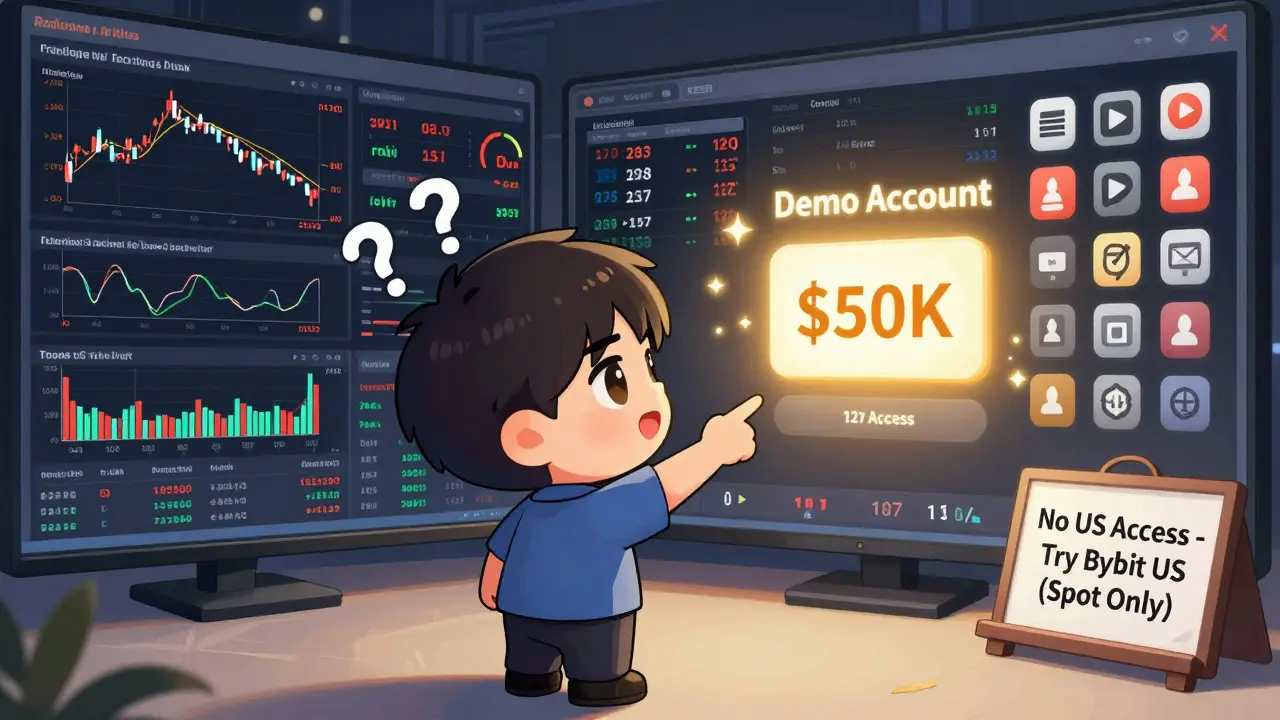
Bybit’s interface looks clean, but it’s packed with tools. If you’ve traded before, you’ll feel right at home. If you’re new, you might feel overwhelmed. The mobile app scores 4.7/5 across iOS and Android with over 5 million downloads. Users love the charting tools, risk management features, and how fast orders execute. But beginners often struggle with concepts like funding rates, liquidation prices, and leverage settings. MindMathMoney’s testing found new users needed 3-5 hours just to understand basic spot trading. Derivatives? That’s another 1-2 hours of learning. They offer a demo account with $50,000 in virtual funds. That’s huge. It’s the best way to learn without risking real money. Their academy has 127 video tutorials and 87 written guides - far more than most exchanges.Customer Support and Verification
Verification is three-tiered:- Level 1: Email only. $50 daily withdrawal limit.
- Level 2: ID verification. $20,000 daily limit. Most users complete this in under 24 hours.
- Level 3: Advanced verification (proof of address, source of funds). $100,000 daily limit.
Support is available 24/7 via live chat. Trustpilot data shows an average response time of 1.7 minutes during peak hours. No phone support, though. That’s standard for crypto exchanges, but it’s still a limitation if you’re in a time crunch.
Where You Can’t Use Bybit
This is critical: Bybit is blocked in several major markets. You can’t use it if you’re in:- United States
- United Kingdom
- Canada
- Singapore
- Australia (restricted)
- Several other countries with strict crypto regulations
Bybit US exists as a separate entity, but it only offers spot trading - no futures, no leverage. If you’re in the U.S. and want derivatives, you’re out of luck.
Bybit operates under licenses in Dubai (VARA), Abu Dhabi (ADGM), and Estonia (FIU). That’s why it’s available in Europe, Asia, and Latin America. But if you’re in a regulated country, you’re not getting access - and trying to bypass it with a VPN risks account suspension.
Who Is Bybit For?
Bybit isn’t for everyone. It’s built for traders who:- Understand leverage, funding rates, and liquidation risk
- Trade frequently, especially derivatives
- Value speed and low fees over simplicity
- Are outside the U.S., U.K., Canada, or Singapore
If you’re a beginner looking to buy Bitcoin and hold it, use Coinbase or Kraken. If you’re an active trader who wants to scalp BTC/USDT with 50x leverage, Bybit is one of the best options on the planet.
Its strengths - speed, liquidity, derivatives depth - are unmatched in its niche. Its weaknesses - regulatory restrictions, steep learning curve, past security breach - are real. But if you’re in a supported region and you know what you’re doing, Bybit delivers.
What’s Next for Bybit?
Bybit’s roadmap for 2026 includes:- Launch of the Bybit Card in 15 new European markets (Q2 2026)
- Integration with TradFi systems for multi-asset trading
- Expansion of TradeGPT, its AI trading assistant
Industry analysts at Messari predict 22% user growth in 2026 - slower than the market average, but still solid. Their long-term viability hinges on one thing: staying ahead in derivatives. And right now, they’re winning.
Is Bybit safe to use in 2026?
Yes, but with caveats. After the $1.2 billion hack in February 2025, Bybit fully reimbursed all users and strengthened its security. It now stores 95% of assets in cold storage, uses multi-signature wallets, and offers a public Proof-of-Reserves dashboard. However, these reports aren’t independently audited, so you’re trusting their transparency. For most users outside restricted countries, it’s considered safe - especially compared to lesser-known exchanges.
Can I trade Bitcoin futures on Bybit?
Yes. Bybit is one of the top platforms for Bitcoin futures and perpetual contracts. Leverage goes up to 100x on BTC/USDT, with some pairs offering even higher. Its matching engine handles high-volume trades with sub-millisecond latency, making it ideal for active traders. Fees start at 0.01% for makers and 0.055% for takers.
Does Bybit work in the United States?
No, not fully. Bybit is blocked in the U.S. due to CFTC regulations. There’s a separate platform called Bybit US, but it only offers spot trading - no leverage, no futures, no derivatives. If you’re in the U.S. and want to trade futures, you’ll need to use a U.S.-licensed exchange like Bitfinex or Kraken Pro.
What are Bybit’s trading fees?
Spot trading: 0.10% maker, 0.10% taker. Futures trading: 0.01% maker, 0.055% taker. You can reduce spot fees by up to 25% if you hold MNT, Bybit’s native token. High-volume traders (over $1M/month) get even lower fees. Compared to competitors like Bitget or Kraken, Bybit’s futures fees are among the lowest.
How do I deposit money into Bybit?
You can’t deposit fiat directly via bank transfer or credit card. Instead, use the P2P marketplace to buy crypto with over 75 fiat currencies, or transfer crypto from another exchange. Once you have crypto, send it to your Bybit deposit address. This makes it less beginner-friendly than exchanges like Coinbase or Kraken, which offer direct fiat on-ramps.
Is Bybit better than Binance or Coinbase?
It depends on what you need. Binance has higher overall volume and more coins, but its interface is cluttered. Coinbase is simple and regulated, but expensive and limited in derivatives. Bybit beats both in derivatives trading speed, liquidity, and fees - if you’re experienced and outside restricted countries. For beginners or U.S. users, Coinbase is safer. For advanced traders in Asia or Europe, Bybit is often the best choice.



Bharat Kunduri
January 13, 2026 AT 20:31Rod Petrik
January 14, 2026 AT 22:13Chris O'Carroll
January 15, 2026 AT 20:06Tony Loneman
January 17, 2026 AT 06:46Liza Tait-Bailey
January 18, 2026 AT 21:35Kelly Post
January 19, 2026 AT 00:05Ashlea Zirk
January 20, 2026 AT 07:23Pramod Sharma
January 20, 2026 AT 23:55Christina Shrader
January 22, 2026 AT 01:01myrna stovel
January 23, 2026 AT 09:16Sarah Baker
January 25, 2026 AT 03:12Chidimma Okafor
January 27, 2026 AT 02:06Bryan Muñoz
January 28, 2026 AT 05:26Chris Evans
January 29, 2026 AT 15:52Andre Suico
January 29, 2026 AT 18:48Alexandra Heller
January 30, 2026 AT 08:11Shaun Beckford
January 31, 2026 AT 22:52nathan yeung
February 1, 2026 AT 20:50ASHISH SINGH
February 3, 2026 AT 08:50Vinod Dalavai
February 3, 2026 AT 13:34Pat G
February 4, 2026 AT 00:07