Imagine waking up to find your hard-earned rubles frozen in a digital wallet you can’t access. No support tickets get answered, no withdrawals process, and the exchange’s website simply vanishes overnight. For thousands of Russians in early 2025, this wasn't a hypothetical nightmare-it was reality following the massive takedown of Garantex. If you are holding cryptocurrency or planning to trade, choosing the wrong platform isn't just an inconvenience; it can lead to criminal charges under Article 193.1 of the Russian Criminal Code or total loss of capital due to international sanctions.
The Current Regulatory Landscape for Russian Crypto Users
Understanding why certain exchanges are dangerous requires looking at the dual pressure Russia faces. Domestically, the Bank of Russia maintains strict control over financial infrastructure. While owning crypto is legal under Federal Law No. 114-FZ, using it for domestic payments remains prohibited. Internationally, Western sanctions have created a minefield. The U.S. Treasury Department’s Office of Foreign Assets Control (OFAC) has designated several platforms as high-risk for facilitating illicit finance. When you use these sanctioned exchanges, you aren't just risking a technical glitch; you are stepping into a zone where banks may block your transfers and law enforcement may view your transactions with suspicion.
In late 2024 and early 2025, Russian security services intensified raids on "droppers"-individuals who move money through complex layers to evade detection. These operations targeted exchange operators who failed to comply with Rosfinmonitoring requirements. The result? Over $10 million and significant amounts of foreign currency were seized from platforms that looked convenient but lacked proper licensing. This crackdown signals a clear message: convenience often comes with hidden regulatory costs.
Why Garantex and Its Successors Are High-Risk
Garantex was once the go-to hub for many Russian traders. However, its designation by OFAC in April 2022 changed everything. It was flagged for enabling ransomware operations and facilitating transactions for Russian elites moving assets overseas. By March 2025, the U.S. Department of Justice had unsealed indictments showing Garantex facilitated over $500 million in illicit transactions. Chainalysis data confirmed that 68% of its volume was linked to darknet markets and ransomware variants.
When Garantex faced shutdown pressures, its team didn't disappear. They launched successor platforms like Grinex and Exved, often operating out of jurisdictions like the UAE or Georgia. Transparency International Russia documented how these entities used layered transaction schemes. Rubles would flow from a user’s bank account to offshore companies, convert to USDT, and then move abroad. While this bypassed some capital controls, it stripped users of legal protection. If Grinex freezes your account because of a compliance check, you have no recourse in Russian courts because the entity isn't fully licensed under the local experimental regime.
Red Flags: How to Spot a Dangerous Exchange
You don't need to be a forensic accountant to spot trouble. Most risky platforms share specific characteristics that prioritize speed over security. Here is what to look for:
- Minimal Verification: If an exchange only asks for a phone number or a passport photo, be cautious. Compliant platforms require rigorous Know Your Customer (KYC) checks, which can take days. Fast onboarding often means lax Anti-Money Laundering (AML) monitoring.
- Telegram-Based Operations: Platforms like MKAN Coin operate primarily via Telegram bots. While convenient, they lack the transparency and regulatory oversight of established exchanges. There is no public audit trail, and ownership structures are often opaque.
- Offshore Registration: Check the company registration. If the entity is registered in Kyrgyzstan, Thailand, or Hong Kong but targets Russian users exclusively, it likely operates outside the Russian reporting framework. This means their transactions don't appear in standard bank trails, raising red flags for tax authorities.
- No Local License: Verify if the exchange holds a license under Russia's "experimental legal regime." Only about 12% of the market consists of fully licensed platforms. If they claim to be "sanction-proof," ask for proof of their compliance status.
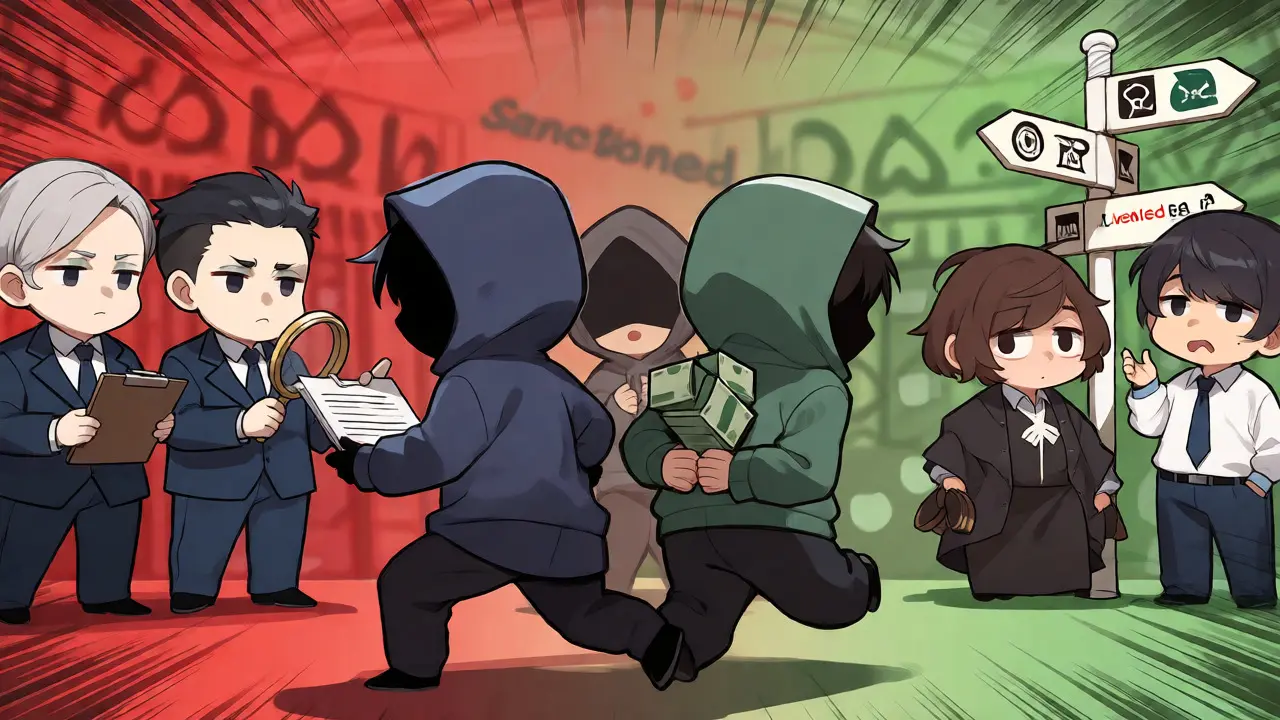
Comparison: Licensed vs. Unlicensed vs. Sanctioned Exchanges
To make a better decision, it helps to see how different types of platforms stack up against each other. The table below breaks down the key differences based on recent market analysis and regulatory data.
| Feature | Licensed (Experimental Regime) | Unlicensed Domestic | Sanctioned/High-Risk |
|---|---|---|---|
| Regulatory Status | Fully compliant with Rosfinmonitoring | Legal gray area, no license | Designated by OFAC/EU sanctions |
| User Verification | Strict KYC, 2-3 days wait | Moderate, variable quality | Minimal (phone/passport only) |
| Bank Transfer Safety | High, recognized by banks | Medium, occasional blocks | Low, high risk of freezing |
| Transaction Speed | Standard (slower due to checks) | Fast | Very Fast (lax AML) |
| Legal Recourse | Available via Russian courts | Limited/None | None (offshore entities) |
| Market Share | ~12% | ~23% | ~15% |
The Real Cost of Convenience: User Stories
Data tells one story, but personal experiences paint a clearer picture. On forums like Dvach and RuTracker, users report devastating losses. One trader, known as 'CryptoPatriot_88', lost 1.2 million rubles when Garantex accounts were frozen during the March 2025 takedown. He spent three weeks messaging customer support with zero response. Another common complaint involves Grinex, where Trustpilot reviews average just 1.2 stars. Users describe sudden account freezes without explanation, leaving them unable to withdraw funds after depositing rubles.
These aren't isolated incidents. A September 2025 survey by CryptoSfera found that 63% of Grinex users experienced account freezes. The psychological toll is significant, but the financial and legal implications are worse. Russian legal expert Denis Mayasov warns that police raids now target not just operators but users participating in sanction evasion. Transferring as little as 50,000 rubles through a sanctioned conduit like Exved has led to criminal investigations for some individuals.

Safe Alternatives and What to Look For
If you want to trade crypto without losing sleep, stick to platforms that play by the rules. Look for exchanges that submit transaction data directly to Rosfinmonitoring. These platforms might feel slower because they verify your identity thoroughly, but that friction is your safety net. They ensure that when you move money, it looks legitimate to both Russian banks and international regulators.
For those engaging in cross-border trade, consider using the official channels provided under the experimental legal regime. While these often require meeting "especially qualified investor" thresholds (minimum 6 million rubles in assets), they offer clarity. If you are a regular retail investor, prioritize domestic platforms with transparent ownership structures. Avoid any service that promises "anonymous" or "instant" international transfers without paperwork. In the current climate, paperwork is your friend.
Future Outlook: Will the Risk Decrease?
The trend is moving toward stricter enforcement. Industry analysts predict a 90% reduction in sanctioned platform usage among Russians by Q2 2026. Why? Because the combined pressure from domestic police raids and international sanctions is making these platforms too expensive to maintain. Sberbank’s Analytical Center estimates that 70-80% of current high-risk platforms will disappear by 2027.
However, decentralized alternatives like MKAN Coin will persist. They leverage Telegram’s encryption to stay under the radar. But remember, staying under the radar doesn't mean you are safe. It just means you are invisible until something goes wrong. And when it does, there is no one to call.
Is it illegal for Russians to use crypto exchanges?
No, owning and trading cryptocurrency is generally permitted under Federal Law No. 114-FZ. However, using crypto for domestic payments is prohibited, and using sanctioned exchanges can lead to legal issues regarding currency controls and anti-money laundering laws.
Why was Garantex sanctioned?
The U.S. Treasury's OFAC designated Garantex in April 2022 for facilitating illicit finance, including ransomware payments and transactions for Russian elites. It processed hundreds of millions in transactions linked to darknet markets.
What happens if my account is frozen on a sanctioned exchange?
You may lose access to your funds indefinitely. Since these platforms often operate through offshore entities with no local presence, you typically have no legal recourse in Russian courts. Customer support often becomes unresponsive.
Can I be fined for using a sanctioned exchange?
Yes. Draft bills in the State Duma propose fines up to 1 million rubles for first-time offenses involving sanctioned exchanges. Additionally, large-scale violations can lead to criminal charges under Article 193.1 of the Criminal Code.
How do I know if an exchange is licensed in Russia?
Check if the exchange operates under the "experimental legal regime" approved by the Ministry of Finance. Licensed exchanges will explicitly state their compliance with Rosfinmonitoring requirements and usually have higher verification standards.