
Imagine waking up one day realizing that moving your address could save you tens of thousands of dollars on your cryptocurrency portfolio. For high-net-worth investors and active traders, this isn't a fantasy-it's a strategic reality known as tax residency changes. But here is the catch: the window for easy optimization is closing fast. With new global reporting frameworks launching in 2027, the days of hiding assets in opaque jurisdictions are over. Today, it’s about navigating complex rules with precision.
The landscape shifted dramatically after the IRS classified cryptocurrency as property back in 2014. Since then, especially following Bitcoin’s surge past $20,000 in 2017, wealthy holders have sought legitimate ways to minimize liabilities. By Q4 2024, there were over 300,000 crypto millionaires globally, according to Henley & Partners' 2025 Crypto Wealth Report. This surge has driven intense interest in relocating to jurisdictions with favorable tax codes. However, regulatory scrutiny has tightened significantly. The IRS now requires exchanges to issue Form 1099-DA starting with the 2025 tax year, meaning every transaction is tracked. If you are considering a move, you need to understand not just where to go, but how to stay compliant.
Understanding Tax Residency vs. Citizenship
A common mistake people make is confusing citizenship with tax residency. You can be a U.S. citizen and still not be a U.S. tax resident if you meet specific physical presence tests and sever ties. Tax residency is determined by factors like physical presence, domicile connections, and tax treaties. For example, simply buying a second home abroad doesn’t automatically change your tax status. You must establish genuine ties.
Most countries use a "days present" rule. Typically, spending 183 days or more in a country within a tax year makes you a tax resident there. Some places, like the United Arab Emirates, require only 30 days annually. Others look at your center of vital interests-where your family lives, where you bank, and where you work. Understanding these definitions is crucial because dual residency can lead to being taxed twice unless a treaty exists between the two nations.
Top Jurisdictions for Crypto-Friendly Tax Residency
Not all low-tax countries are created equal. Some offer zero capital gains tax for casual investors but slap heavy rates on professional traders. Here is a breakdown of some of the most popular destinations as of 2026.
| Jurisdiction | Capital Gains Tax (Casual) | Business/Professional Trading Tax | Residency Requirement |
|---|---|---|---|
| Malta | 0% | Up to 35% | 183 days + accommodation proof |
| Malaysia | 0% | Up to 30% | 182 days per year |
| UAE (Dubai) | 0% | 0% (No personal income tax) | 30 days annual presence |
| Singapore | 0% | Up to 24% | 183 days physical presence |
| Puerto Rico (Act 22) | 0% | Varies | 183 days + renounce state residency |
Malta, often dubbed "Blockchain Island," enacted its Virtual Financial Assets Act in 2018. It offers 0% capital gains for occasional traders. However, if you trade frequently, the Malta Financial Services Authority may classify your activity as business income, taxing it up to 35%. The threshold for this classification is roughly €50,000 in annual turnover. Malaysia similarly offers 0% for casual investors but taxes frequent trading, mining, and staking as ordinary income up to 30%.
The United Arab Emirates, particularly Dubai, stands out because it has no personal income tax at all. The Virtual Assets Regulatory Authority (VARA), established in March 2022, provides a clear legal framework. You only need to be physically present for 30 days a year to claim tax residency. Singapore also boasts 0% capital gains tax, but the Inland Revenue Authority strictly monitors frequent trading, which can be taxed as business income up to 24%. Puerto Rico remains a unique option for U.S. citizens. Under Act 22, new residents who spend at least 183 days on the island pay 0% capital gains tax on crypto. However, you must renounce your U.S. state residency while keeping your citizenship.
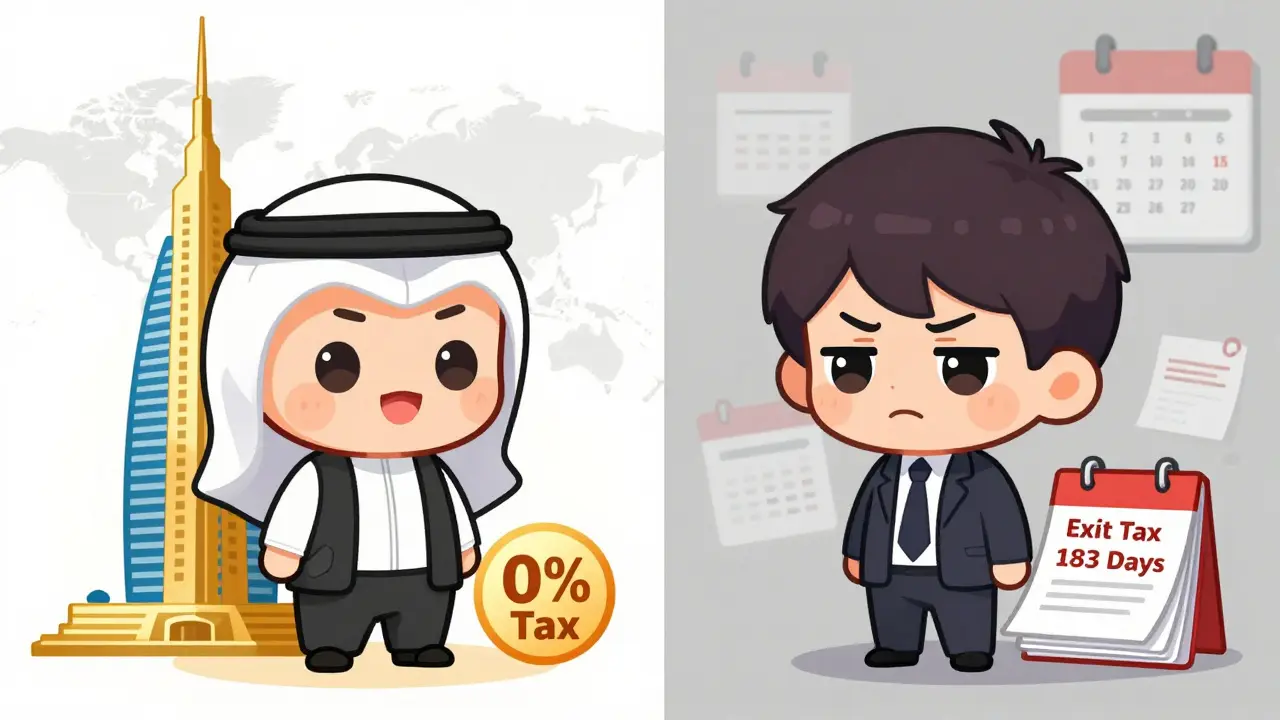
The Hidden Trap: Exit Taxes
Before you pack your bags, check if your current country charges an exit tax. Countries like France, Germany, Italy, and Spain impose taxes on unrealized capital gains when you leave. For instance, Germany applies a 25% exit tax on unrealized crypto gains exceeding €60,000. One user on Reddit reported losing €22,000 unexpectedly when moving from Germany to Portugal in 2024, despite having consulted a tax professional. These taxes can wipe out any future savings you hoped to achieve through relocation.
Implementation Steps: Making the Move Legal
Establishing genuine tax residency takes time and effort. It typically ranges from 6 to 18 months depending on the jurisdiction. Here is what you need to do:
- Secure Accommodation: Rent or buy a property. Utility bills in your name are essential proof.
- Open Local Bank Accounts: Most jurisdictions require local banking relationships to prove economic ties.
- Maintain Physical Presence: Track your days carefully. Use passport stamps, flight records, and hotel receipts. 73% of failed applications result from insufficient documentation of physical presence.
- Sever Old Ties: Cancel old memberships, close unused accounts, and notify authorities in your former residence.
- File Correct Forms: For U.S. expats, this includes Form 8854 for expatriation tax calculations.
The cost to establish residency varies widely. Professional services can range from $15,000 to $50,000. Some countries, like Portugal, previously offered Golden Visas requiring investments of €500,000 in real estate or €250,000 in cultural projects, though regulations changed in early 2025. Always budget for these upfront costs before calculating potential tax savings.

Regulatory Headwinds: What’s Coming in 2027?
The era of total secrecy is ending. The OECD’s Crypto-Asset Reporting Framework (CARF) will launch in 2027. This framework mandates automatic exchange of crypto transaction data between over 100 participating jurisdictions. Dr. James H. Anderson from Harvard Law School warned that this will significantly reduce the effectiveness of simple tax residency changes. Data sharing means your home country will know exactly what you earned abroad.
In the U.S., the IRS has intensified enforcement. Crypto-related tax enforcement actions increased by 637% from fiscal year 2020 to 2024. The introduction of Form 1099-DA means exchanges will report acquisition dates, cost basis, and proceeds for all transactions without a minimum threshold. PwC’s 2025 Global Crypto Tax Outlook suggests that while jurisdictional arbitrage remains viable through 2026, the window will narrow substantially after 2027. Only jurisdictions with constitutional prohibitions against capital gains taxes, like Singapore and the UAE, may maintain long-term advantages.
Practical Tips for Compliance
To avoid audits and penalties, keep meticulous records. As Robert E. McKenzie, JD, CPA, notes, swapping one cryptocurrency for another is treated as two transactions by the IRS: selling the first asset and buying the second. You must calculate the gain or loss for each swap. Use specialized software to track these events daily. Additionally, consult with a cross-border tax attorney specializing in crypto. Generic financial advisors often miss the nuances of international tax treaties and digital asset regulations.
Is changing tax residency legal?
Yes, changing tax residency is legal as long as you comply with the laws of both your former and new jurisdictions. It involves establishing genuine physical presence and economic ties in the new location. However, it is not legal to hide assets or evade taxes owed in your country of origin, especially if exit taxes apply.
Which country has the best crypto tax laws in 2026?
There is no single "best" country, as it depends on your trading volume and lifestyle. The UAE (Dubai) is top-tier for zero personal income and capital gains tax with minimal residency requirements. Singapore and Malaysia offer 0% capital gains for casual investors. Puerto Rico is excellent for U.S. citizens willing to relocate fully.
What is the OECD CARF and why does it matter?
The Crypto-Asset Reporting Framework (CARF) is an international agreement set to launch in 2027. It requires participating countries to automatically share crypto transaction data. This matters because it eliminates the ability to hide offshore crypto assets from your home country’s tax authorities, making compliance critical.
Do I have to pay exit taxes when leaving my country?
It depends on your current country of residence. Nations like Germany, France, and Spain impose exit taxes on unrealized capital gains when residents depart. You should consult a tax professional in your home country before initiating a move to calculate any potential liabilities.
How many days do I need to live in a new country to become a tax resident?
Most countries require 183 days of physical presence in a tax year. However, some, like the UAE, require only 30 days. Others consider your "center of vital interests," including where your family and primary bank accounts are located. Always verify the specific rules of your target jurisdiction.