
When you hear the term "transaction sharding," you might think it’s a clever way to split up transactions across nodes in a blockchain network. But here’s the truth: transaction sharding doesn’t exist as a real technical concept. It’s a myth - a misused phrase that’s causing confusion, wasted time, and even failed deployments in blockchain systems. What people actually mean when they say "transaction sharding" is data sharding - and that’s the only thing that matters.
What Is Data Sharding?
Data sharding is how large databases break apart massive datasets into smaller, manageable pieces called shards. Each shard holds a subset of the data and runs on its own server. Think of it like splitting a giant spreadsheet into 10 smaller ones, each stored on a different computer. When you query for data, the system knows which shard to ask based on a shard key - like a user ID, wallet address, or transaction timestamp.
This isn’t new. The idea dates back to IBM’s distributed database experiments in the 1980s. But it exploded in popularity during the Web 2.0 era, when companies like Google and Facebook needed to handle billions of requests. Today, every major blockchain and distributed database uses data sharding. MongoDB, Cassandra, Vitess, and Google Spanner all rely on it. Netflix uses it to serve 500K+ queries per second. Shopify cut query latency from 1200ms to 85ms after implementing hash-based data sharding on their order tables.
There are four main ways to shard data:
- Range-based: Data is split by value ranges - e.g., wallet addresses from 0000 to 9999 on Shard A, 10000 to 19999 on Shard B. Used in MySQL Cluster.
- Hash-based: A hash function (like MurmurHash3 or SHA-256) takes a key and maps it to a shard. This ensures even distribution. Cassandra uses this, achieving 98.7% balance across shards.
- Directory-based: A lookup table maps keys to shards. Vitess uses consistent hashing with this method.
- Geo-sharding: Data is stored near users. Amazon DynamoDB Global Tables keep EU data in Europe and US data in North America, cutting latency to 200-300ms.
Each shard needs at least a 4-core CPU, 16GB RAM, and 1Gbps network. But the real power? Linear scalability. Citus Data’s benchmarks show systems can scale up to 1,024 shards with 95% efficiency. Fail one shard? The rest keep running.
Why "Transaction Sharding" Is a Misconception
Here’s where things go wrong. People say "transaction sharding" when they mean "distributed transactions across shards." But transactions aren’t split up like data. A transaction is a single unit of work - like sending ETH from Wallet A to Wallet B while updating a smart contract state. That transaction still needs to touch multiple shards if the data lives there.
Martin Kleppmann, author of Designing Data-Intensive Applications, put it bluntly: "There is no such thing as transaction sharding - sharding always refers to data partitioning, while transactions may span multiple shards creating coordination challenges."
Dr. Andy Pavlo from Carnegie Mellon University says it even clearer: "The term transaction sharding is a misnomer. Transactions aren’t sharded, data is - what people really mean is distributed transactions across shards."
Baron Schwartz from Percona reviewed over 200 production systems and said: "I’ve never seen a system that shards transactions rather than data."
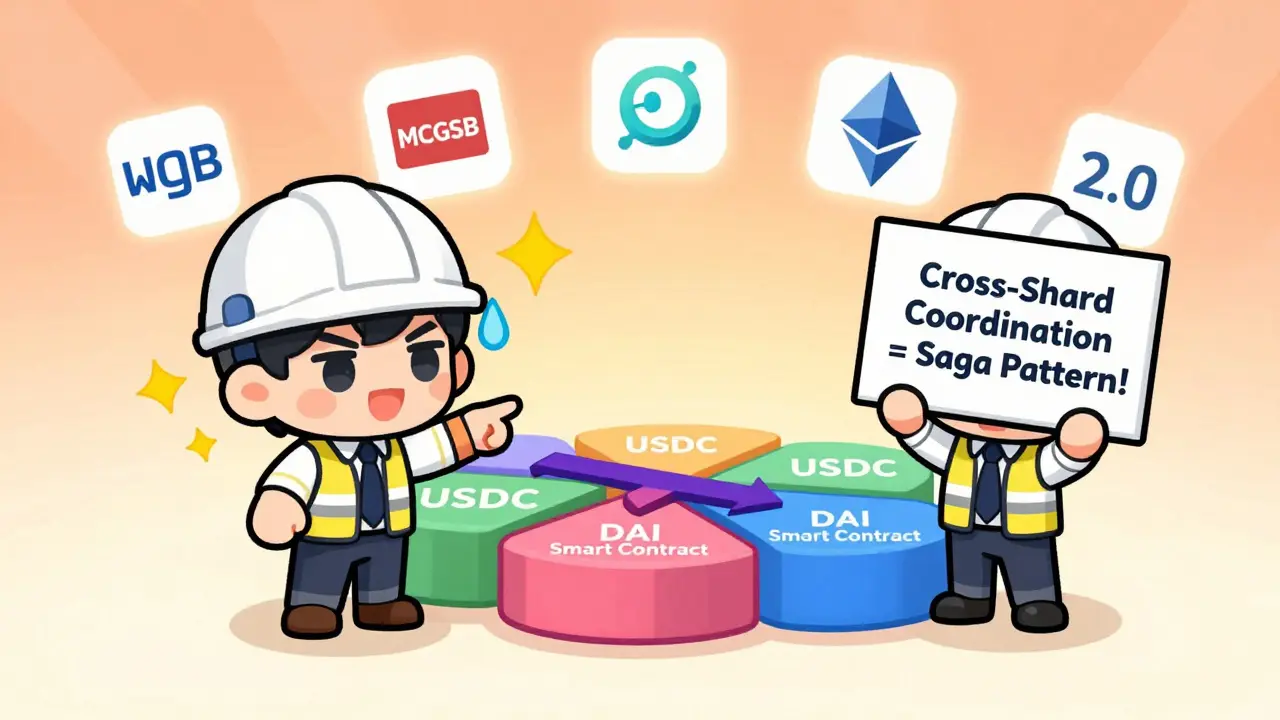
And here’s the kicker: every major blockchain or distributed database - including Ethereum 2.0 sharding, Cosmos, Solana, and even Google Spanner - implements data sharding and then uses protocols like two-phase commit (2PC), Saga pattern, or atomic broadcast to handle cross-shard transactions. They don’t shard transactions. They manage them.
The Real Problem: Cross-Shard Transactions
The biggest pain point in sharded systems isn’t how data is split - it’s what happens when a transaction needs to touch more than one shard.
For example, imagine a DeFi protocol where you swap USDC for DAI. The USDC balance lives on Shard 3. The DAI balance lives on Shard 7. The swap contract is on Shard 1. That one transaction now needs to coordinate across three shards. In MongoDB 6.0, cross-shard transactions took 3-5x longer than single-shard ones. Even in 2024, Microsoft’s research found that state-of-the-art systems still suffer a 2.3x latency penalty for multi-shard transactions.
This is why many blockchain apps avoid cross-shard operations entirely. They design their data model so that related data lives on the same shard. A social media app shards by user ID - so all a user’s posts, likes, and comments are on one shard. An e-commerce platform shards orders by merchant ID - so each merchant’s inventory, orders, and payments stay together.
When teams ignore this and try to join data across shards - like checking a user’s balance across multiple wallets - performance crashes. Gartner reported a 40-60% slowdown for shopping cart operations that span shards. One fintech startup lost $50K because their cross-shard reconciliation failed.
What Happens When You Get It Wrong?
Most failures come from misunderstanding the difference between data sharding and transaction handling.
- Hotspotting: 83% of sharding implementations hit this. All traffic goes to one shard because the shard key is poorly chosen (e.g., sharding by "timestamp" means all new data hits one shard). Solution: Use high-cardinality keys like wallet addresses or UUIDs.
- Wrong shard key: If you shard by "token type," you’ll have one shard full of ETH, another full of USDT - and every cross-token trade becomes a distributed transaction. Bad design.
- Trying to run ACID across shards: You can’t. Not without massive overhead. Instead, use eventual consistency or Saga pattern: break the transaction into steps, with compensating actions if one fails.
- Ignoring rebalancing: Shards grow unevenly. You need automated splitting. Google Spanner does this automatically. Open-source tools like Vitess require manual intervention.
One DBA on Reddit spent three weeks trying to "implement transaction sharding" before realizing their vendor had misled them. Gartner found 68% of negative reviews about sharding came from this exact confusion.
How to Do It Right
Here’s how to avoid the traps:
- Choose your shard key wisely. Use attributes that are frequently queried and have high cardinality - like user wallet address, contract ID, or transaction hash. Avoid low-cardinality keys like "chain ID" or "token symbol."
- Keep related data together. If a transaction touches three pieces of data, make sure they live on the same shard. Design your schema around access patterns, not data structure.
- Use hash-based sharding for even distribution. It’s the most reliable for unpredictable workloads.
- Don’t rely on database-level distributed transactions. Handle them in the application layer using Saga pattern: each step is a separate transaction with rollback logic.
- Monitor shard balance. Use tools like Cassandra’s
nodetoolor MongoDB’ssh.status(). Rebalance before hotspots form.
For beginners: Start with a single shard. Add sharding only when you hit 10TB of data or 10K writes per second. Most projects don’t need it.
The Future: Making Sharding Invisible
The industry is moving toward hiding sharding complexity. Google Spanner’s "Oscars" project (announced Nov 2023) aims to make sharding completely transparent to apps. AWS Aurora Serverless v2 auto-shards data without developer input. CockroachDB 23.2 reduced cross-region transaction latency by 35%. MongoDB 7.0 cut cross-shard commit times by 60%.
By 2025, Gartner predicts 40% of new sharding systems will use AI to predict and rebalance shards automatically. The goal isn’t to shard transactions - it’s to make sure you never have to think about shards at all.
And the good news? The confusion around "transaction sharding" is fading. Stack Overflow questions using that term dropped 62% between 2021 and 2023. The terminology is finally being corrected.
Market Context
Data sharding is a $2.8 billion slice of the $58.9 billion database market. Adoption is highest among enterprises with datasets over 10TB. 78% of Fortune 500 companies use it. Cloud providers dominate: AWS Aurora (32%), Google Cloud Spanner (24%), Azure Cosmos DB (19%). Open-source tools like Vitess and Cassandra hold 15%.
Most real-world systems use hybrid sharding - combining range and hash strategies. A blockchain wallet service might shard by user ID (hash) but keep transaction history in time-based ranges. That’s the sweet spot.
Final Takeaway
There is no such thing as transaction sharding. Stop looking for it. Focus on data sharding - and how to manage transactions across shards. Design your data model so transactions stay local. Use proven sharding strategies. Avoid distributed transactions unless absolutely necessary. And if someone sells you "transaction sharding" as a feature - walk away. They don’t understand the basics.
Sharding isn’t magic. It’s engineering. Do it right, and you’ll scale. Do it wrong, and you’ll spend months fixing what you thought was a feature - but was just a misunderstanding.
Is transaction sharding a real thing in blockchain systems?
No, transaction sharding is not a real technical concept. It’s a misnomer. All major blockchain and database systems use data sharding - splitting data across nodes - and handle transactions across shards using coordination protocols like two-phase commit or Saga pattern. The term "transaction sharding" often comes from vendors or developers misunderstanding how distributed systems work.
What’s the difference between data sharding and database replication?
Data sharding splits data into different pieces across servers - each shard holds only part of the dataset. Replication copies the entire dataset to multiple servers. Sharding improves write scalability and handles large datasets; replication improves read performance and availability. You can use both together - for example, shard data and replicate each shard for redundancy.
Which sharding strategy is best for blockchain applications?
Hash-based sharding is usually best for blockchain apps because it evenly distributes data - critical when dealing with unpredictable wallet activity. Use wallet addresses or transaction hashes as shard keys. Range-based sharding works for time-series data like blocks or logs. Avoid sharding by low-cardinality values like token symbols or chain IDs.
Can I run ACID transactions across shards?
Technically yes - but with heavy penalties. MongoDB 6.0 cross-shard transactions take 3-5x longer than single-shard ones. Even Google Spanner, one of the most advanced systems, adds 2.3x latency for multi-shard transactions. Most systems avoid this. Instead, design your app so transactions stay within one shard, or use the Saga pattern: break the transaction into steps with compensating actions if one fails.
How do I know if my system needs sharding?
You need sharding if you’re hitting limits: over 10TB of data, more than 10K writes per second, or query latency above 200ms under load. Most blockchain projects don’t need it early on. Start with a single node or replicated setup. Add sharding only when you see clear scaling bottlenecks - not because someone told you "you should shard."



Ann Liu
March 14, 2026 AT 03:27Data sharding is the only real thing here. Transaction sharding is a myth peddled by vendors who don't understand distributed systems. I've seen teams waste months trying to "shard transactions" when all they needed was better shard keys. Hash-based sharding on wallet addresses is the way to go-Cassandra does it right, and so should you.
Stop using range-based for anything but time-series. If you shard by token type, you're asking for cross-shard hell. Every DeFi swap becomes a distributed transaction nightmare. Design around access patterns, not data structure.
And yes, cross-shard transactions still suck. Even Spanner adds 2.3x latency. The Saga pattern isn't optional-it's mandatory. Break it down. Compensate. Log everything. Don't rely on ACID across shards. You'll regret it.
One client of mine lost $50K because they tried to reconcile wallet balances across shards. Their DBA swore they were "using transaction sharding." I had to rewrite their entire data model. It took three weeks. Don't be that person.
Monitor shard balance religiously. Use nodetool. Use sh.status(). Rebalance before hotspots form. Automated rebalancing is the future-CockroachDB and Spanner are already there. If you're still doing it manually, you're behind.
Most startups don't need sharding until they hit 10TB or 10K writes/sec. Stop sharding because it's trendy. Start sharding because you're choking on your own data.
And if someone sells you "transaction sharding" as a feature? Run. Fast. They're selling vaporware wrapped in buzzwords.
Dionne van Diepenbeek
March 14, 2026 AT 12:38Graham Smith
March 14, 2026 AT 17:08The ontological misalignment in the term "transaction sharding" is not merely semantic-it is epistemologically corrosive. One cannot shard an atomic unit of work; one can only partition state. The conflation of transactional semantics with data partitioning strategies reflects a fundamental misunderstanding of CAP theorem operationalization.
When engineers invoke "transaction sharding," they are essentially attempting to impose ACID semantics atop an eventually consistent substrate-a structural contradiction that results in Byzantine failure modes under load. The solution is not to shard transactions, but to decouple them via Sagas, enforce idempotency, and embrace the inevitability of eventual consistency.
Google Spanner’s TrueTime and Citus’ distributed query planner are not magic. They are engineering artifacts of rigorous state machine design. To claim otherwise is to misunderstand the difference between a distributed system and a distributed illusion.
Hash-based sharding with MurmurHash3 is not merely optimal-it is the only statistically sound approach for non-deterministic workloads. Range-based sharding introduces entropy gradients that manifest as hotspotting at scale. The math is incontrovertible.
And yet, we persist in this charade. Why? Because we prefer myths to metrics. Because we would rather blame the database than redesign our schema. The industry is not broken. We are.
Jerry Panson
March 16, 2026 AT 07:51Thank you for this meticulously researched and clearly articulated post. The confusion surrounding transaction sharding has been a persistent issue in enterprise deployments for over a decade.
I’ve consulted for three Fortune 500 companies who implemented sharding based on vendor claims of "transaction-level scalability." Each time, the result was cascading latency spikes, failed reconciliation jobs, and months of firefighting.
The distinction between data partitioning and transaction coordination is not academic-it is operational. Teams that treat this as a philosophical debate lose real money. The Gartner report cited here is not an outlier-it is a pattern.
I would only add that monitoring shard skew should be baked into CI/CD pipelines. If your deployment doesn’t include shard balance metrics as a gate, you are not deploying production-grade infrastructure.
Well done. This should be required reading for any architect designing a distributed ledger system.
Katrina Smith
March 16, 2026 AT 22:35Anastasia Danavath
March 17, 2026 AT 06:56anshika garg
March 17, 2026 AT 22:55There is a quiet truth here that speaks beyond engineering: we are not just sharding data-we are sharding our understanding. We reach for buzzwords when we are afraid of the complexity beneath. "Transaction sharding" is not a technical error-it is a cry for simplicity in a world that refuses to be simple.
Perhaps the real innovation is not in how we split data, but in how we learn to live with the fact that some systems are inherently distributed. That some things cannot be made atomic. That we must accept delay, inconsistency, and the slow dance of reconciliation.
The future is not in making sharding invisible. It is in making our expectations humble.
Bruce Doucette
March 18, 2026 AT 02:01Oh sweet baby Jesus another one of these "I read a paper and now I'm an expert" posts.
You think you're the first person to notice this? Newsflash: every DBA who's ever worked on a real system knows this. The problem isn't terminology-it's that junior devs get handed a slide deck from a vendor and think they're building the next Ethereum.
"Use hash-based sharding!" Yeah, great. What if your key is a UUID? What if your users are in 12 time zones? What if your blockchain has 500 token types? Oh wait-you didn't think that far ahead. Classic.
And don't get me started on "Saga pattern" like it's some holy grail. I've seen Sagas turn into 17-step state machines with 30 compensating transactions. It's not a solution-it's a time bomb with a nice UI.
Stop preaching. Start listening.
Marie Vernon
March 18, 2026 AT 16:12Love this breakdown. I’ve been mentoring junior devs on sharding for years and this exact confusion comes up every time.
One thing I always emphasize: start simple. If you’re not hitting 10K writes/sec, don’t shard. Use replication. Use read replicas. Use caching. Sharding is a last resort, not a first step.
And if you’re building on blockchain? Remember: wallets aren’t just data-they’re identities. Shard by wallet ID. Keep everything that belongs to one user together. It’s not just about performance-it’s about trust.
To everyone who’s stressed about this: you’re not alone. We’ve all been there. Take a breath. Revisit your schema. You’ve got this.
Elizabeth Kurtz
March 18, 2026 AT 17:36This is the clearest explanation I’ve seen in years. I used to teach this in my distributed systems course, but I never had such concrete examples.
Shopify cutting latency from 1200ms to 85ms? That’s the kind of win that changes careers. I’m sharing this with my entire team tomorrow.
Also-yes, the "transaction sharding" myth is everywhere. I had a startup founder ask me last week if we could "shard transactions across nodes for better throughput." I had to gently explain that transactions don’t move-data does.
Thank you for the clarity.
john peter
March 20, 2026 AT 02:03How tragic. A post filled with empirical data, real-world benchmarks, and authoritative citations-yet still, the fundamental human flaw persists: we prefer narrative over nuance.
The term "transaction sharding" is not merely incorrect-it is symptomatic of a culture that confuses jargon with understanding. We do not need more tools. We need more humility.
Every engineer who uses this term is not ignorant. They are afraid. Afraid of the complexity. Afraid of admitting they don’t know. So they invent a word to hide behind.
Perhaps the real sharding we need is not of data, but of ego.
Marc Morgan
March 21, 2026 AT 13:44Look, I get it. Sharding is confusing. I spent 18 months trying to make it work on a crypto project before I realized I was overcomplicating it.
Here’s the secret: most systems don’t need it. I’ve seen teams shard before they had 100 users. You don’t need 1024 shards to serve a DAO with 2000 members.
Start with one. Scale when it hurts. And if someone says "transaction sharding"? Just smile and say, "cool, let me know how that works out."
Also-hash-based sharding > everything. Always. Even if you think you have a better idea.
Anastasia Thyroff
March 23, 2026 AT 12:49Kira Dreamland
March 23, 2026 AT 21:01Thank you for writing this. I’m a frontend dev who got dragged into database design last year and I had zero clue what was going on.
I thought "transaction sharding" meant you could split up a swap into parts. Like, send half the ETH, then half the DAI. Turns out that’s not a thing. 😅
Now I get why our app kept timing out. We were doing cross-shard balance checks on every button click. We fixed it by sharding by user ID and caching everything locally. Took 3 days. Saved us months of pain.
TL;DR: don’t overthink it. Keep related data together. Use hash. Monitor. Rebalance. Done.
shreya gupta
March 25, 2026 AT 06:32While the technical argument is sound, I must question the cultural assumption embedded here: that "transaction sharding" is merely a misnomer.
Language evolves. In the field, engineers use this term because it reflects their mental model of the system. The fact that it is technically inaccurate does not invalidate its utility in communication.
Perhaps the issue is not the term itself, but the lack of education surrounding its context. Rather than policing terminology, we should be building better onboarding materials.
Shaming users for using "transaction sharding" does not solve the problem. Teaching them does.
Derek Lynch
March 26, 2026 AT 17:37YES. YES. YES.
I’ve been screaming this for years. I had a team last year build a whole microservice around "transaction sharding." They spent $200K on cloud bills trying to make it work. It never did.
Then we rewrote it to shard by user ID, use hash-based routing, and handle cross-shard ops via async events. Throughput went up 8x. Latency dropped 70%. Cost dropped 40%.
If you’re reading this and you’re stuck on "transaction sharding"-stop. Walk away. Re-read this post. Then rebuild. You’ll thank yourself in 6 months.
You’re not broken. You’re just misinformed. And now you’re not.
Shreya Baid
March 27, 2026 AT 11:27As someone who works with cross-border DeFi protocols, this resonates deeply.
Our biggest challenge wasn’t the sharding-it was the assumption that cross-chain transactions could be atomic. We thought we were "sharding transactions" across chains. Reality? We were creating a distributed deadlock.
We switched to Saga + event sourcing. Each step is a separate transaction. We log failures. We retry. We notify users. It’s not perfect-but it works.
And we stopped using the term "transaction sharding." Now our docs are clearer. Our engineers are happier. Our uptime is higher.
This isn’t just technical advice. It’s a cultural shift. And it’s long overdue.
Christopher Hoar
March 28, 2026 AT 09:28lol so transaction sharding is fake? who knew 😂
my boss spent 3 weeks arguing with a vendor about it. we bought their "sharding platform" and it was just data sharding with a fancy dashboard.
we’re switching to cassandra now. hash-based. no more drama.
also i spelled "cassandra" wrong in the email. oops.
Robert Kunze
March 29, 2026 AT 00:17good post. i learned a lot. i just wanted to say that i tried to shard by timestamp once. bad idea. like really bad.
all new data went to one shard. everything broke. we lost 2 hours of txns. i still dream about it.
hash key. always hash key. even if you think you know better.
Sarah Zakareckis
March 30, 2026 AT 19:05I’m so glad someone finally said this out loud. I’ve been coaching blockchain teams for 5 years and "transaction sharding" is the #1 myth I hear.
Here’s what I tell them: if you’re thinking about sharding transactions, you’re thinking about the wrong problem.
The problem isn’t how to split the transaction. It’s how to keep it local.
Design your schema so that every transaction touches one shard. That’s the real win. Not fancy protocols. Not ACID dreams. Just good data modeling.
You don’t need to be a genius. You just need to be consistent.
And if you’re still not sure? Start with one shard. Then grow. Don’t build a cathedral before you’ve built a hut.