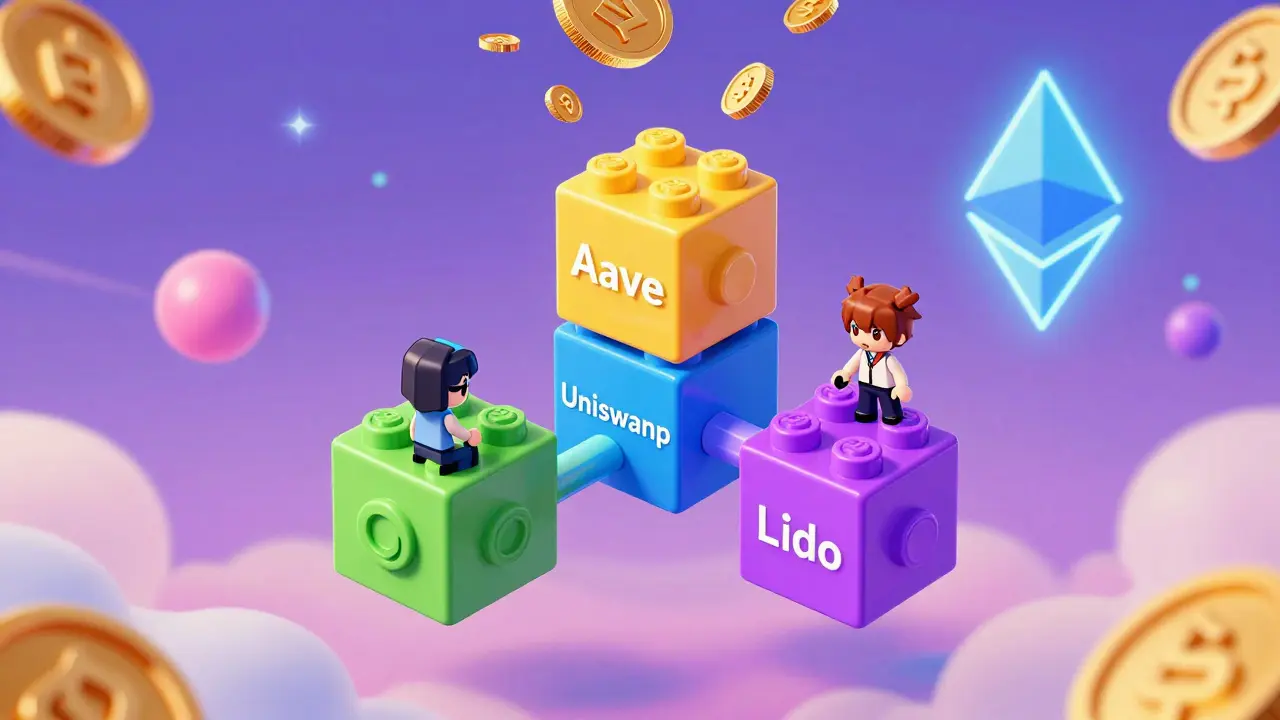
DeFi composability isn’t just a buzzword-it’s the engine behind the most powerful financial experiments on earth. Imagine being able to take a lending protocol, plug it into a decentralized exchange, then layer on automated staking and insurance-all without writing a single line of new code. That’s DeFi composability in action. By 2025, this modular architecture has moved from a developer’s dream to the backbone of over 83% of the top DeFi protocols by total value locked, according to DeFiLlama. And it’s changing how money moves, who controls it, and what’s even possible in finance.
What Exactly Is DeFi Composability?
At its core, DeFi composability means protocols can talk to each other like Lego blocks. A token from one protocol can be used as collateral in another. A liquidity pool from Uniswap can feed into a yield aggregator like Yearn. A staked ETH position from Lido can be borrowed against on Aave. Each piece works independently, but when stacked, they create something entirely new-without needing permission from anyone.
This isn’t how traditional finance works. In banks, integrating a new product takes months of legal reviews, API negotiations, and compliance checks. In DeFi, a developer can combine three existing protocols in a weekend. That speed is why Uniswap, Aave, and Curve Finance are the most reused building blocks in the ecosystem. They’re not just apps-they’re infrastructure.
The technical foundation? Standardized interfaces like ERC-20 for tokens and ERC-721 for NFTs. But now, newer standards like cross-chain message passing (e.g., LayerZero, Wormhole) are letting these blocks work across Ethereum, Solana, Base, and even Bitcoin L2s. The result? A $23.5 billion TVL in cross-chain composability protocols as of November 2025, per Rapid Innovation.
Why Composability Is Faster, Cheaper, and More Efficient
Composability cuts out the middleman-literally. When you use a single protocol, your capital sits idle in one place. With composability, that same dollar can earn yield in three places at once. Staked ETH earns rewards on Lido, gets used as collateral on Aave to borrow USDC, and that USDC then gets deposited into a yield-bearing vault on Curve. All of this happens in a single transaction flow.
That’s not just convenience-it’s capital efficiency. Pantera Capital’s 2025 analysis found that composability reduces transaction costs by 37% compared to isolated systems. Why? Because you’re reusing existing infrastructure instead of rebuilding it. And that’s why new financial products are being built in days, not months.
Compare that to centralized platforms like Coinbase. Their average time to launch a new financial product? 147 days. In DeFi, it’s 3 to 5 days. That’s the difference between a slow, regulated system and an open, permissionless one. Developers aren’t waiting for approval-they’re just coding. And users aren’t waiting for bank forms-they’re stacking yields in real time.
The Dark Side: When Lego Towers Collapse
But here’s the catch: when every block connects, one broken block can bring down the whole tower.
The 2022 Euler Finance exploit didn’t just lose $200 million-it triggered cascading liquidations across Aave, Compound, and other lending protocols that used Euler as collateral. The 2023 Terra/Luna collapse wiped out $40 billion in connected DeFi value in under 72 hours. These aren’t isolated incidents. They’re symptoms of combinatorial risk: the idea that the more protocols you link, the more failure points you create.
Chainalysis reported $2.8 billion lost in DeFi exploits between 2022 and 2023 due to these interdependencies. And it’s not just hackers. Users themselves are the biggest cause of loss. In Q3 2025 alone, $47 million was lost by retail users who misconfigured leveraged yield strategies-like combining high-leverage farming with liquid staking-and got liquidated during a volatility spike. One Reddit user lost $1,843 in ETH trying to automate a complex yield stack without understanding how liquidation thresholds worked.
Even the tools meant to simplify this are risky. DeFi aggregators like 1inch and Matcha let you click once to execute a multi-protocol trade. But their user reviews show a pattern: 3.8/5 ratings, with complaints about “insufficient risk warnings.” People think it’s one-click magic. It’s not. It’s one-click complexity.

Who’s Using It-and Who’s Scared?
There’s a clear divide in adoption. Experienced users love it. On Reddit’s r/DeFi, 78% of 1,243 surveyed users said composability unlocks yield opportunities impossible in traditional finance. One user, u/CryptoYieldHunter, consistently earns 12.7% APY by automating staking, lending, and rebalancing across three protocols.
But beginners? They’re overwhelmed. On DappRadar, 63% of negative reviews cite “complexity” as the top reason to avoid DeFi. Trustpilot ratings for aggregators show users appreciate the convenience but fear the hidden risks. Lunar Strategy’s survey of 2,500 users found 82% of beginners find composability “intimidating and risky,” while 68% of experienced users call it “essential.”
The learning curve is real. Consensys Academy says it takes 80 to 120 hours of study to master protocol integration patterns. You need to understand Solidity, flash loans, liquidation mechanics, and gas optimization. And documentation? Aave and Uniswap score 92% and 87% user satisfaction on clarity. Newer protocols? Only 63%. That gap is why so many users get burned.
The Next Evolution: Intent-Based DeFi and AI
The future isn’t about making users smarter-it’s about making the system smarter.
Enter intent-based systems. Platforms like Anoma and SUAVE let users say, “I want the highest yield with minimal risk,” and the system automatically finds the best combination of protocols, adjusts positions in real time, and even pauses trades during volatility. BlockApex reported a 63% drop in user errors after switching to intent-based interfaces in their October 2025 case study.
And AI is stepping in. GoMining’s AI-powered composability engine optimizes yield stacks based on market conditions, delivering 22% higher returns than manual strategies. These aren’t sci-fi tools-they’re live, in use, and already outperforming human traders.
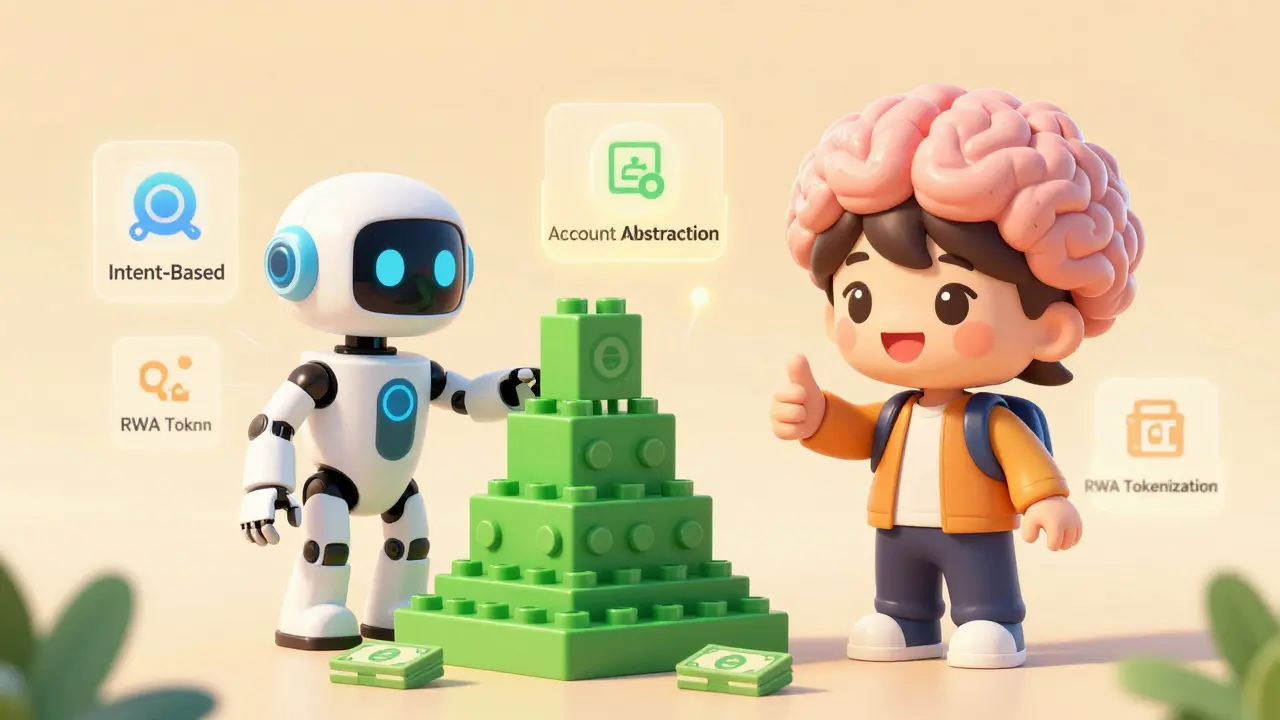
The next frontier? Modular account abstraction. This lets users set their own risk rules: “Only use protocols with under 5% TVL loss in the last 30 days,” or “Never borrow more than 50% of my staked assets.” Instead of relying on protocol defaults, you control the guardrails. Consensys’ research team calls this the “user-owned risk layer”-and it’s the key to scaling DeFi safely.
Regulators Are Watching-and They’re Not Happy
Composability’s speed is its strength-and its weakness in the eyes of regulators.
The SEC has issued 17 enforcement actions against DeFi aggregators since early 2024 for unregistered securities offerings. Why? Because these platforms bundle assets from multiple protocols into one product-like a mutual fund-and users can’t tell what’s underneath. The EU’s MiCA framework, effective December 2024, now requires aggregators to perform “combinatorial risk assessments” before allowing protocol integrations. That means regulators are finally acknowledging the risk of interconnectedness.
But here’s the irony: the same regulators who demand transparency are also pushing for financial inclusion. DeFi offers access to credit, yield, and savings tools to billions without bank accounts. The challenge? Finding a balance between safety and openness.
Who’s Winning the Composability Race?
The DeFi stack is now divided into three layers:
- Base Layer Protocols (Uniswap, Aave, Lido): The most reused blocks. They hold 45% of the market share and are the foundation of nearly every complex strategy.
- Aggregation Platforms (1inch, Matcha): The “apps” that let you click and combine. They hold 32% of the market and are where most retail users interact with DeFi.
- Intent-Based Execution Layers (Anoma, SUAVE): The future. These are the AI-powered engines that automate complex trades. They’re growing fastest, with 23% market share and rising.
Enterprise adoption is accelerating too. Deloitte reports 41 of the Fortune 500 are testing DeFi composability stacks for trade finance-using real-world assets (RWAs) like invoices and bonds tokenized onchain. That’s $16 trillion in potential capital waiting to enter the system, according to Pantera Capital.
What’s Next? The $1.2 Trillion Horizon
By 2030, Gartner forecasts DeFi could capture 2.7% of global financial transactions-up from 0.3% today. That’s not a stretch. The ingredients are all there:
- Composability enables rapid innovation.
- AI and intent systems reduce user error.
- RWA tokenization unlocks trillions in offline capital.
- Modular account abstraction gives users control over risk.
But growth won’t be linear. Ark Invest compares DeFi to the SaaS boom-where dozens of specialized tools (Slack, Zoom, Notion) eventually merged into unified suites (like Microsoft 365). We’ll see the same in DeFi: specialized protocols will consolidate into comprehensive financial suites, but the underlying interfaces will stay open. That’s how innovation survives.
The future of DeFi isn’t about more protocols. It’s about smarter, safer, and more user-controlled combinations. The money legos aren’t going away-they’re getting better.
Frequently Asked Questions
What does DeFi composability mean in simple terms?
DeFi composability means financial apps can connect like Lego blocks. You can take a lending platform, a trading exchange, and a staking service, and combine them into one automated strategy-all without building anything new. It’s like using pre-made parts to build a custom car instead of manufacturing every bolt yourself.
Is DeFi composability safe for beginners?
Not without education. While tools like 1inch and Matcha make it easy to click and earn, they hide complex risks. Over 60% of user losses in Q3 2025 came from beginners misconfiguring leveraged yield strategies. Start by using one protocol at a time, learn how liquidations work, and never use more than 10% of your crypto in complex stacks until you’ve practiced.
How is DeFi composability different from traditional finance?
Traditional finance is like a locked box-you need permission to add anything. DeFi is open-source and permissionless. If you want to combine a loan with a swap and a yield farm, you can do it in hours. Banks take months just to approve API access. DeFi’s speed comes from open standards, not bureaucracy.
What’s the biggest risk in DeFi composability?
Combinatorial risk. When protocols depend on each other, a failure in one can trigger chain reactions. The 2022 Euler exploit and 2023 Terra collapse showed how $40 billion can vanish in days because everything was linked. The more protocols you stack, the more fragile the system becomes.
Will regulators shut down DeFi composability?
They won’t shut it down-they’ll try to control it. The EU’s MiCA rules already require risk assessments for bundled DeFi products. The SEC is targeting aggregators that act like unregistered funds. The future isn’t banning composability-it’s forcing it to include safety features like circuit breakers, user risk controls, and transparency dashboards.
How do I get started with DeFi composability safely?
Start simple. Use Aave for lending and Uniswap for swapping-no stacking yet. Learn how collateral ratios and liquidation prices work. Then try a trusted aggregator like 1inch for one-click swaps. Only after you’ve used these for 3-6 months should you explore yield farming or leveraged positions. Always read the fine print on risk warnings-even if they’re buried in a GitHub doc.


Aaron Heaps
December 21, 2025 AT 13:34Composability is just Wall Street with better UX and zero accountability. You call it innovation? I call it a house of cards built on gas fees and delusion.
Dustin Bright
December 21, 2025 AT 14:42bro i tried stacking yield last week and lost 200 bucks in 10 mins 😭
why does everything feel like a casino with a github repo?
Lloyd Yang
December 22, 2025 AT 11:20Let me tell you something real: DeFi composability isn’t about tech-it’s about psychology. The reason beginners get wrecked isn’t because they’re dumb, it’s because they think ‘one-click yield’ means ‘no risk.’
But here’s the truth: every time you stack protocols, you’re not building wealth-you’re building exposure. To smart contract bugs. To oracle failures. To liquidity crunches. To rug pulls disguised as ‘governance upgrades.’
And don’t get me started on AI yield optimizers. They’re not magic. They’re just faster at compounding your mistakes. I’ve seen bots liquidate users during a 3% ETH dip because they didn’t account for slippage in cross-chain swaps.
The real innovation isn’t the code-it’s the user interfaces that pretend to simplify while hiding 17 layers of risk behind a ‘Maximize APY’ button.
People need to stop treating DeFi like a game and start treating it like a nuclear reactor: one wrong move, and everything goes up in smoke. And guess who pays the price? Not the devs. Not the VCs. The retail user who read a Medium post titled ‘How I Made 200% in 7 Days.’
There’s no shortcut to understanding liquidation thresholds. No emoji that fixes a flawed collateral ratio. No ‘intent-based’ system that can save you from your own greed.
So yeah, the tech is cool. But until we fix the human layer-the overconfidence, the FOMO, the ‘I don’t need to read the docs’ attitude-we’re just rearranging deck chairs on the Titanic. And the water’s already rising.
Megan O'Brien
December 23, 2025 AT 10:45composability? more like combinatorial dumpster fire. the 2023 terra collapse was just the first act.
Sophia Wade
December 25, 2025 AT 02:04There is a profound philosophical tension here: the promise of financial autonomy versus the reality of systemic fragility.
Composability is the digital equivalent of a cathedral built from matchsticks-each block a testament to human ingenuity, each connection a silent prayer that none will snap.
We have created a financial ecosystem that rewards complexity, yet punishes ignorance with total ruin. Is this progress-or hubris dressed in smart contracts?
The regulators, in their slow, bureaucratic way, are trying to impose order on chaos. But chaos is the birthplace of innovation. The question is not whether we should regulate, but how we can regulate without suffocating the very openness that makes DeFi revolutionary.
And yet-what is freedom if it comes with a 90% chance of losing your life savings because you clicked ‘stake & compound’ without understanding what a flash loan is?
Perhaps the true future lies not in more layers, but in fewer. In simplicity. In clarity. In the courage to say: ‘This is enough.’
roxanne nott
December 26, 2025 AT 05:30you said 83% of top protocols use composability but didn't cite the source. also, rapid innovation isn't a real firm. lmao.
Tyler Porter
December 27, 2025 AT 15:44Listen, I get it. You want to make money. But please, please, please-read the docs. Or at least watch a 10-minute video on how liquidations work.
I’ve seen people lose everything because they thought “high APY” meant “safe.” It doesn’t. It means “high risk.”
Start with one thing. Learn it. Then add one more. Don’t jump into five protocols at once. You’re not a trader-you’re a student. And this isn’t a game.
And if you’re using an aggregator? Check the risk score. Look at the audit history. Don’t just click “go.”
Save yourself. Please.
Grace Simmons
December 29, 2025 AT 06:44DeFi is a threat to national financial sovereignty. The U.S. must regulate these protocols immediately or risk losing control of its monetary system to anonymous code.
Mmathapelo Ndlovu
December 31, 2025 AT 01:50From Johannesburg, I see this as hope. People here can’t get loans from banks, but they can use Aave with a phone.
Yes, it’s risky. But so is waiting for a system that never works for you.
Let people try. Let them learn. Let them fail. That’s how freedom grows.
Not with regulations. With access.
🙏
vaibhav pushilkar
January 1, 2026 AT 12:06Composability is the only way forward. But beginners need guardrails. Not bans-just warnings. Like a car with airbags, not no engine.
Collin Crawford
January 2, 2026 AT 01:53While your analysis is superficially compelling, it fails to account for the fundamental inefficiencies inherent in Ethereum’s proof-of-stake consensus mechanism, which introduces non-linear latency spikes during high-congestion epochs. Furthermore, your reliance on DeFiLlama’s TVL metrics is statistically invalid, as it conflates locked value with actual utility. The notion that cross-chain bridges like Wormhole represent ‘infrastructure’ is a misnomer-they are merely trust-minimized intermediaries with non-trivial failure modes, as evidenced by the $600M Ronin breach. Until you address these foundational flaws, your entire thesis collapses under its own epistemological weight.
Rachel McDonald
January 3, 2026 AT 10:19so you’re telling me I should trust code written by some guy in his basement who got rich off a meme coin?
😂
no thanks. I’ll stick with my bank that at least has a physical branch.
Brian Martitsch
January 5, 2026 AT 03:09LOL. You think you’re building the future? You’re just feeding the algorithmic casino. Real finance doesn’t need 17 layers of contracts to lend $100.
Jake Mepham
January 6, 2026 AT 08:26Y’all are missing the big picture. DeFi composability isn’t just about finance-it’s about redefining trust.
For 500 years, we trusted banks, lawyers, regulators. Now we’re learning to trust math, code, and consensus.
It’s messy. It’s scary. But it’s real.
I’ve seen farmers in Kenya use Lido + Curve + Aave to earn more than their local bank pays in interest. No ID. No paperwork. Just a phone.
That’s not a bug. That’s the point.
Yes, people lose money. But they also gain freedom.
And freedom? It’s never safe. But it’s always worth it.
Melissa Black
January 7, 2026 AT 07:59Composability is the first true democracy of capital
no gatekeepers
no permission
just code and consequence
the system doesn’t care if you’re rich or poor
it only cares if you understand
and if you don’t
you pay the price
no tears
no bailouts
just math
that’s the revolution
not the yields
not the apps
but the accountability
Vyas Koduvayur
January 8, 2026 AT 02:08Look, I’ve been in this space since 2018. I’ve seen it all. The ICOs, the bear markets, the hacks, the rug pulls. And I’m telling you-this composability hype is the most dangerous thing yet.
Why? Because it’s not just technical risk. It’s psychological. People think they’re ‘doing DeFi’ when they’re really just gambling with borrowed time and leveraged exposure.
I had a friend-smart guy, MBA from Wharton-lost $42K trying to ‘automate yield’ using a bot that pulled from three protocols he didn’t understand. He thought ‘maximize APY’ meant ‘maximize safety.’
He cried in the DMs. Said he’d never touch crypto again.
And here’s the kicker: he wasn’t alone. The data shows 78% of retail losses in Q3 2025 came from users who didn’t even read the risk warnings.
So when you say ‘AI will fix it,’ you’re just putting lipstick on a pig. The AI doesn’t care if you’re broke. It just executes.
Real safety isn’t in smarter bots. It’s in slower learning. In patience. In reading the whitepaper. In understanding liquidation thresholds. In starting with 1% of your portfolio.
But nobody wants to hear that. They want the 200% APY. And that’s why the cycle keeps repeating.
I’m not against DeFi. I’m against the cult of instant wealth. That’s what’s killing it.
Helen Pieracacos
January 9, 2026 AT 16:45Oh wow, so now we’re pretending this isn’t just a giant game of financial Jenga? 🤡
Who’s gonna be the one to pull the wrong block?
SHEFFIN ANTONY
January 11, 2026 AT 02:32DEFI IS A SCAM. EVERYONE KNOWS IT. THE ONLY PEOPLE MAKING MONEY ARE THE DEV TEAM WHO LAUNCHED THE TOKEN AND THEN RUGGED. YOU THINK YOU’RE SMART? YOU’RE JUST THE LAST ONE IN THE ROOM.