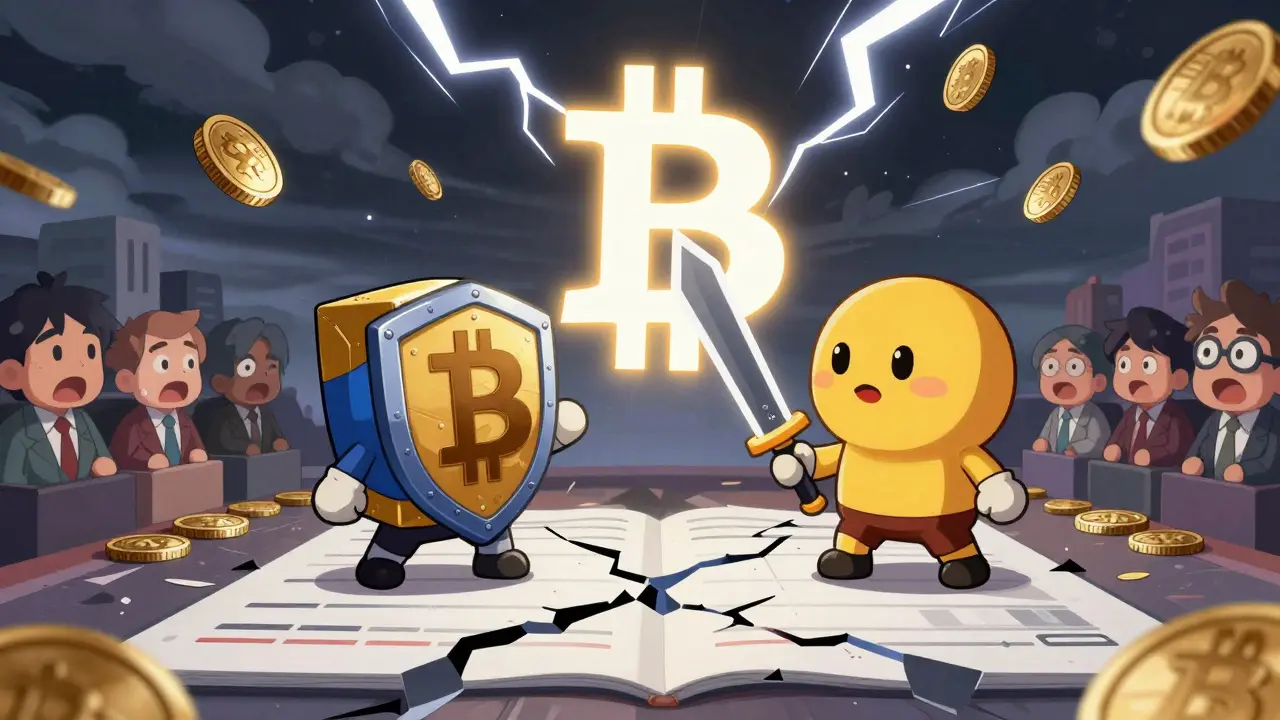
Blockchain forks aren’t just technical updates-they’re moments when a community decides to break from the past. Some forks fix bugs. Others change the soul of a network. A few have created entirely new cryptocurrencies worth billions. Understanding these forks means understanding how crypto evolved from a niche experiment into a global financial movement.
The First Major Fork: Bitcoin Cash
The most impactful blockchain fork in history happened on August 1, 2017. At block 478,558, Bitcoin split into two chains. One kept the original rules. The other became Bitcoin Cash (BCH). The difference? Block size. Bitcoin’s limit was 1MB. Bitcoin Cash raised it to 8MB overnight. That change meant more transactions could fit in each block-no need to wait hours or pay $5 in fees just to send money.
This wasn’t the first time someone tried to change Bitcoin’s block size. Bitcoin XT and Bitcoin Classic had tried before, but neither gained enough support. Bitcoin Cash succeeded because it had backing from big mining companies like Bitmain and influential figures like Roger Ver. Within days, BCH was trading at nearly $300 and became the fourth-largest cryptocurrency by market cap. At its peak in December 2017, it hit $48.7 billion.
But here’s the twist: Bitcoin Cash didn’t stay on top. By 2023, its market cap had dropped to $4.2 billion. Why? Because bigger blocks didn’t solve everything. Transaction volume didn’t grow as fast as expected. Miners didn’t stick around. And the community split again-leading to Bitcoin SV and later eCash.
The DAO Fork: Ethereum’s Moral Crossroads
In June 2016, hackers drained $50 million from The DAO, a decentralized venture fund built on Ethereum. The code had a flaw. The hackers exploited it legally-because in blockchain, code is law. But the Ethereum community didn’t accept that. They believed the spirit of the system mattered more than the code.
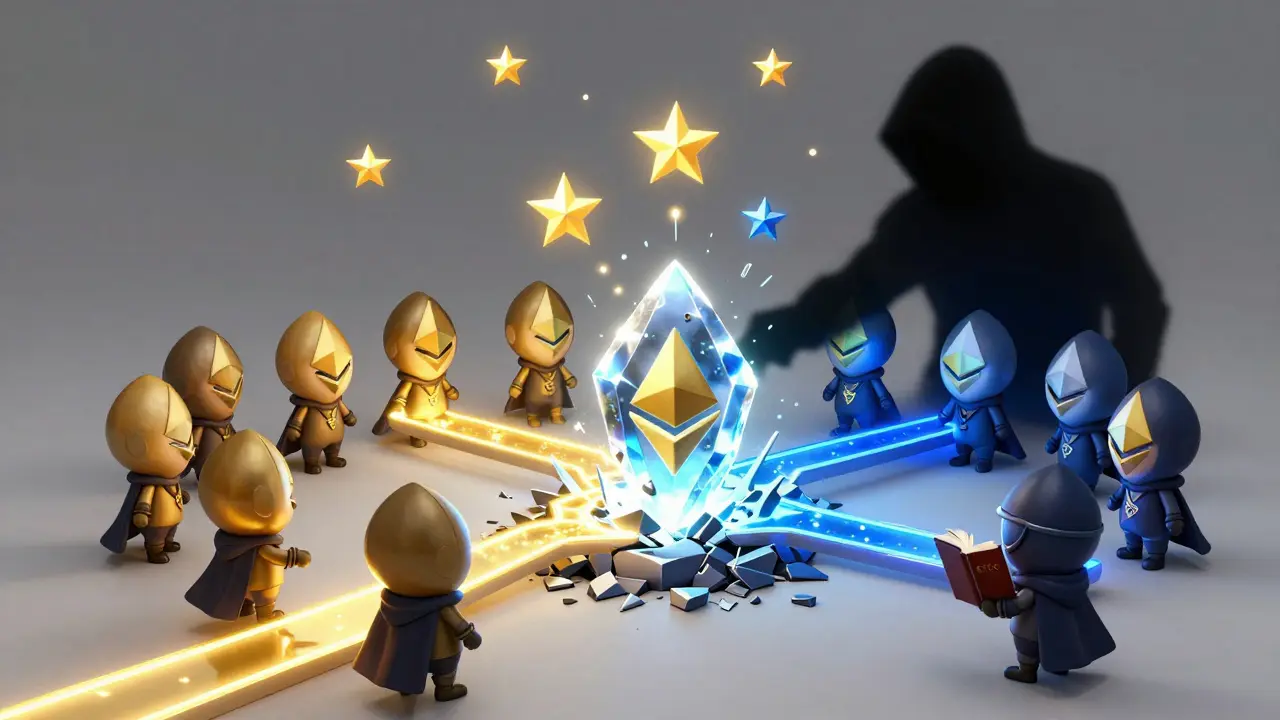
So they did something no one thought possible: they rolled back the blockchain. On July 20, 2016, at block 1,920,000, Ethereum executed a hard fork. All stolen ETH was returned to their original owners. The new chain became Ethereum (ETH). The old chain, untouched and unaltered, became Ethereum Classic (ETC).
This fork divided the community. About 90% of miners moved to ETH. The remaining 10% kept mining ETC. Today, ETC still exists. It has a $1.2 billion market cap. Some users prefer it because it never broke its promise of immutability. Others say ETH’s upgrade path-especially the Merge-made it more useful. ETC still runs on proof-of-work, with 12-second block times. ETH, after the Merge, runs on proof-of-stake and has variable block times. For microtransactions, some say ETC is more reliable.
SegWit: The Quiet Revolution
While Bitcoin Cash made headlines with big blocks, SegWit quietly changed how Bitcoin works. Proposed in 2015 by developer Pieter Wuille and activated on August 24, 2017, SegWit didn’t increase block size. Instead, it separated digital signatures from transaction data. Signatures used to take up 65% of each transaction. SegWit moved them out, freeing up space.
The result? Bitcoin could handle 2.6 transactions per second-up from 1.5. Fees dropped from $5.32 to under $2. It also fixed a flaw called transaction malleability, which made smart contracts risky. Most importantly, SegWit paved the way for the Lightning Network, a second-layer solution that now handles millions of microtransactions off-chain.
But not everyone liked it. Critics like Bitcoin Core developer Jimmy Song called it a “band-aid.” They argued it didn’t solve scaling. That frustration fueled Bitcoin Cash’s rise. Still, today, over 90% of Bitcoin transactions use SegWit. It’s the backbone of modern Bitcoin.
Bitcoin Gold and Bitcoin SV: The Fractured Legacy
Bitcoin Gold (BTG) forked on October 24, 2017. Its goal? To make mining more democratic. Bitcoin used SHA-256, a hash algorithm dominated by expensive ASIC miners. BTG switched to Equihash, which could be mined on regular GPUs. It gave every BTC holder 1 BTG. But it didn’t last. The network was quickly attacked by 51% attacks. Miners abandoned it. Today, BTG trades for pennies.
Then came Bitcoin SV (BSV) in November 2018. Created by Craig Wright and Calvin Ayre, BSV claimed to be the “true” Bitcoin. It pushed block sizes to 128MB, then 2GB. It promised massive scalability. But it never gained traction. Mining power stayed tiny. Developers left. In 2020, BSV forked again into eCash (XEC), converting 1 BCH into 1,000,000 XEC. It’s still around, but mostly a curiosity.
These forks show a pattern: technical changes alone don’t guarantee success. Community trust, developer support, and real-world usage matter more than block size numbers.
The Merge: Ethereum’s Biggest Leap
On September 15, 2022, Ethereum didn’t just fork-it transformed. The Merge ended proof-of-work mining after seven years. Ethereum switched to proof-of-stake. Instead of miners using electricity to solve puzzles, validators lock up ETH to secure the network.
The result? A 99.95% drop in energy use. That’s more than the entire country of Argentina saves in a year. It also reduced transaction costs and made Ethereum more scalable for future upgrades. The Merge required updates to dozens of client software versions-Geth, Nethermind, Prysm, Lighthouse-all working in sync. It was the most complex fork ever attempted.
And it worked. 99.98% of nodes updated successfully. No major outages. No lost funds. The Merge didn’t create a new coin. It upgraded the same one. That’s the future of forks: not splits, but upgrades.

What Happens After a Fork?
Forks aren’t clean breaks. They create chaos.
After the Bitcoin Cash fork, users reported losing money because of replay attacks. If you sent 1 BTC on the new BCH chain, the same transaction could replay on the original Bitcoin chain-double-spending your coins. Wallets had to add replay protection. Some didn’t. People lost thousands.
After the DAO fork, MyEtherWallet support tickets spiked 400%. Users didn’t know which chain their funds were on. They sent ETH to ETC addresses. They sent ETC to ETH addresses. Many never got their money back.
Even today, forks carry risk. The Shanghai upgrade in April 2023, which allowed users to withdraw staked ETH, was delayed 24 hours because one client didn’t sync properly. That’s how fragile these systems still are.
Which Forks Still Matter?
Most forks die. A 2022 UC study found 68% of Bitcoin hard forks vanish within 18 months. Only a few survive long-term:
- Bitcoin Cash (BCH) - Still in the top 30, with active development and merchant adoption.
- Ethereum Classic (ETC) - Maintains a loyal community and stable market cap.
- Litecoin (LTC) - Forked from Bitcoin in 2011, it’s still the 20th-largest crypto with $6.3 billion market cap.
- Ethereum (ETH) - Not a fork, but the result of one. The DAO fork gave us ETH as we know it.
What makes them last? They didn’t just change a number. They offered something real: faster payments, lower fees, better mining access, or stronger principles.
The Future of Forks
Forks are changing. The era of ideological splits is fading. Bitcoin’s Taproot upgrade in 2021 was a soft fork-no new coin, just better privacy and efficiency. Ethereum’s Shanghai upgrade was a planned, consensus-driven hard fork. No drama. No shouting. Just code.
Future forks will focus on interoperability. Cross-chain bridges, shared security, and standardized protocols will matter more than block size wars. The goal isn’t to break away anymore. It’s to connect.
But the lesson remains: every fork is a vote. A community deciding what kind of money, what kind of system, they want to build. Some choose speed. Others choose security. Some choose change. Others choose permanence.
That’s the real power of blockchain forks-not the coins they create, but the choices they reveal.
What’s the difference between a soft fork and a hard fork?
A soft fork is a backward-compatible upgrade. Old nodes still accept new blocks, but new nodes enforce stricter rules. SegWit and Taproot are examples. A hard fork breaks compatibility. Old nodes reject new blocks, forcing everyone to upgrade. Bitcoin Cash and the Ethereum DAO fork are hard forks. Hard forks create new cryptocurrencies. Soft forks don’t.
Can I still claim coins from old forks like Bitcoin Gold or Bitcoin SV?
Technically, yes-if you held Bitcoin at the exact block height of the fork and still have your private keys. But most exchanges and wallets stopped supporting these coins years ago. Claiming them now requires manual steps, risky software, and knowing exactly where your funds were at the time of the fork. For most people, the effort and risk outweigh the value. Bitcoin Gold and Bitcoin SV are worth pennies today.
Why did Ethereum Classic survive after the DAO fork?
Because some people believe blockchains should never be reversed-even to fix a hack. Ethereum Classic’s community sees immutability as sacred. They view ETH as a compromise. While ETH became a platform for DeFi and NFTs, ETC stayed true to its original vision: a simple, unchangeable ledger. That ideological purity keeps a small but dedicated group of users and miners supporting it.
Did any fork actually make Bitcoin better?
SegWit did. It fixed critical technical flaws, lowered fees, and enabled the Lightning Network. Bitcoin Cash made transactions cheaper in the short term but didn’t scale sustainably. Taproot improved privacy and efficiency without splitting the network. So yes-some forks improved Bitcoin. But the best ones didn’t split it.
Are blockchain forks still happening today?
Yes, but differently. Today’s forks are mostly planned upgrades, not rebellions. Ethereum’s Shanghai upgrade in 2023 was a hard fork that let users withdraw staked ETH. Bitcoin’s Taproot in 2021 was a soft fork that improved smart contracts. These aren’t fights-they’re collaborations. The community now prioritizes consensus over conflict.

Robert Mills
February 1, 2026 AT 21:45Ramona Langthaler
February 2, 2026 AT 04:13Aaron Poole
February 2, 2026 AT 12:44Sunil Srivastva
February 4, 2026 AT 00:28Kevin Thomas
February 5, 2026 AT 18:07Jerry Ogah
February 6, 2026 AT 20:29Andrea Demontis
February 6, 2026 AT 21:43Joseph Pietrasik
February 8, 2026 AT 18:13Raju Bhagat
February 10, 2026 AT 07:44laurence watson
February 11, 2026 AT 13:27Elizabeth Jones
February 12, 2026 AT 12:52Nickole Fennell
February 12, 2026 AT 20:37Edward Drawde
February 13, 2026 AT 05:04Richard Kemp
February 13, 2026 AT 23:03Gurpreet Singh
February 14, 2026 AT 19:44Jack Petty
February 16, 2026 AT 05:49Meenal Sharma
February 16, 2026 AT 13:13Freddy Wiryadi
February 18, 2026 AT 04:51Brianne Hurley
February 19, 2026 AT 03:22christal Rodriguez
February 20, 2026 AT 16:23Tressie Trezza
February 21, 2026 AT 19:09Aaron Poole
February 23, 2026 AT 09:39