Imagine spending twenty minutes verifying your identity, only to be told you can’t trade because of where you live. It happens more often than you’d think on OKX, a major global cryptocurrency exchange that processes billions in daily volume but keeps strict borders around its services. If you’re trying to sign up or wondering why certain features are grayed out, understanding these geographic limits is the first step to avoiding account bans or frozen funds.
As of mid-2026, OKX operates under a complex web of international sanctions and local financial laws. They don’t just block users randomly; they follow specific regulatory tiers that determine whether you get full access, limited features, or no service at all. This guide breaks down exactly which countries are blocked, what works where, and how to stay compliant without risking your assets.
Who Is Completely Banned from OKX?
The most critical thing to know is that some jurisdictions are entirely off-limits. These are Tier 1 restrictions, meaning you cannot create an account, deposit funds, or use any part of the platform. The list includes:
- United States: Due to strict SEC enforcement and the Bank Secrecy Act, U.S. residents are completely barred. Even if you hold a passport from another country, living in the U.S. means you are restricted.
- Canada: Similar to the U.S., Canadian regulators have pressured exchanges to limit direct retail access unless through specific regulated entities, which OKX does not currently offer for general public use.
- Malaysia & Singapore: While Singapore has a separate, highly regulated entity (OKX Singapore) for qualified investors, the main global platform blocks general residents. Malaysia remains fully restricted due to central bank directives.
- Sanctioned Regions: Cuba, Iran, North Korea, Syria, Crimea, Donetsk, and Luhansk are blocked globally due to OFAC (Office of Foreign Assets Control) sanctions. Attempting to access these regions results in immediate IP blocking.
- Other Restricted Nations: Bangladesh, Bolivia, Malta, and the Bahamas also face complete bans based on current compliance protocols.
If you live in one of these places, there is no workaround. Using a VPN to mask your location violates OKX’s Terms of Service Section 4.2. In September 2025 alone, OKX closed over 14,000 accounts for "geolocation fraud," proving they actively hunt for users trying to bypass these rules.
Countries with Limited Features (Tier 2 Restrictions)
Not every restriction is a total ban. Some countries allow you to trade basic cryptocurrencies but block high-risk products like futures, perpetual swaps, or margin trading. This is known as Tier 2 restriction. Key examples include:
- Australia: You can buy and sell spot Bitcoin or Ethereum, but derivatives trading is prohibited following Australian Securities and Investments Commission (ASIC) guidelines.
- Brazil: Spot trading is available, but leverage and futures are disabled to comply with local financial authority warnings.
- South Korea: Users must undergo real-name verification linked to their national ID. Derivatives are restricted, and fiat on-ramps may require additional banking checks.
- European Union (EU): Under the Markets in Crypto-Assets (MiCA) regulation, which became fully effective in late 2024, OKX restricts derivatives for all EU residents. However, spot trading remains robust via their OKX Europe entity.
This tiered approach allows OKX to maintain market share in regulated economies while adhering to local risk management laws. For traders in these regions, it means you can still use the platform for long-term holding or simple swapping, but day-trading strategies relying on leverage won’t work here.
| Region/Country | Access Status | Allowed Features | Restricted Features |
|---|---|---|---|
| United States | Banned | None | All Trading, Deposits, Withdrawals |
| United Kingdom | Limited | Spot Trading, Wallet | Futures, Margin, Earn Products |
| Germany (EU) | Limited | Spot Trading, SEPA Deposits | Derivatives (per MiCA) |
| Singapore | Complex | Global Platform Blocked | Separate MAS-regulated entity for pros only |
| Japan | Limited | Spot Trading | Leverage >3x, Certain Altcoins |
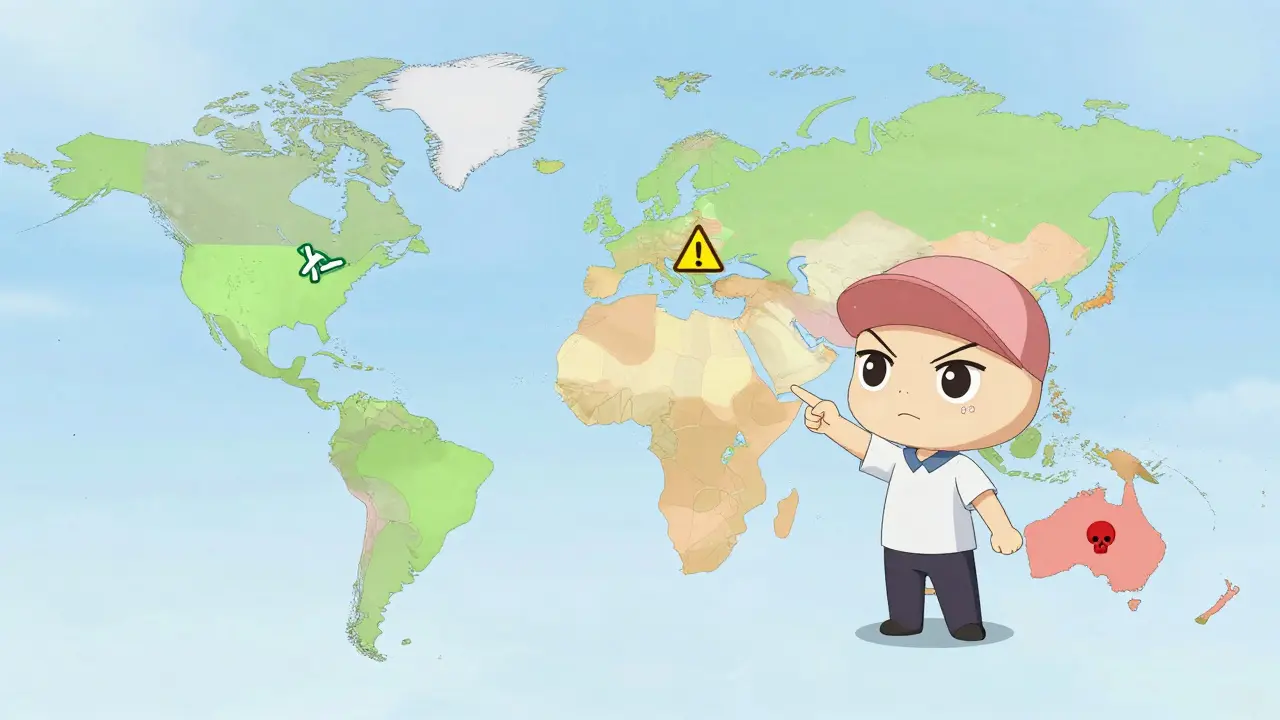
How OKX Enforces Geographic Limits
You might wonder how an online platform knows where you are. OKX uses a multi-layered detection system that makes bypassing restrictions nearly impossible for the average user.
First, they rely on IP Geolocation. When you connect to the app or website, OKX checks your IP address against global databases. Their audit reports claim 99.2% accuracy in identifying your physical location. If your IP shows you’re in Texas, the system flags you immediately.
Second, they use Device Fingerprinting. Even if you change your IP via a proxy, your device leaves digital traces-browser type, screen resolution, installed fonts, and hardware IDs. OKX cross-references these data points to detect if you’re rotating locations suspiciously.
Third, and most importantly, is KYC Verification. Since January 2023, OKX has required mandatory Know Your Customer verification for all core functions. You must upload a government-issued ID (passport, driver’s license) and take a selfie. The AI system reads the address on your ID and matches it against their restricted country list. If your ID says "New York" but your IP says "London," your account will likely be flagged for review or terminated.
Trying to trick this system is risky. In 2025, CoinLedger analyzed Trustpilot reviews and found that 37% of negative feedback came from users who believed they were in permitted countries but got blocked due to false positives in IP detection. Conversely, those caught using VPNs faced permanent bans without recourse.
The KYC Requirement: What You Need to Know
Regardless of your country, you cannot trade on OKX anonymously anymore. The platform implements a tiered verification system that dictates how much money you can move.
- Level 1 (Basic): Requires email and phone verification. Allows small deposits and withdrawals, typically capped at $10,000 daily. Suitable for beginners testing the waters.
- Level 2 (Intermediate): Requires ID upload and facial recognition. Increases limits significantly, allowing access to most spot trading pairs and higher withdrawal amounts.
- Level 3 (Advanced): May require proof of address or additional income documentation. Unlocks maximum limits of up to $1,000,000 daily and access to institutional-grade tools.
In permitted European countries, standard KYC verification usually takes 2-4 hours. In developing markets, support response times can stretch to 24+ hours, so plan accordingly if you need urgent access.
Alternatives if OKX Is Restricted in Your Area
If OKX doesn’t serve your region, you aren’t out of options. Other major exchanges have different regulatory footprints.
- Coinbase: Ideal for U.S. residents. Fully compliant with American regulations, offering deep liquidity and insurance on USD holdings. However, fees are higher than OKX.
- Kraken: Strong choice for Canada and Europe. Kraken maintains limited operations in Canada where others don’t, and offers excellent security records. They restrict Iran and North Korea but are generally more accessible in Western nations.
- Binance: Still serves many Asian and African markets, though they have expanded their own ban list to 49 countries. Be aware that Binance faces ongoing legal scrutiny, which could impact future stability.
- Local Brokers: In countries like Japan or South Korea, local platforms (e.g., BitFlyer in Japan) often provide better fiat on-ramps and customer support in native languages.
Switching platforms requires careful research. Always check the latest regulatory status before moving large sums of crypto, as rules change frequently.
Future Outlook: Will Restrictions Ease?
The landscape is shifting. In late 2025, reports surfaced that OKX was exploring a U.S.-compliant entity, potentially opening doors for American traders in the future. They’ve also invested $230 million in compliance infrastructure to enter markets like Switzerland and the UAE.
However, analysts warn that fragmentation is increasing. JPMorgan’s blockchain team predicts that by 2027, regulatory differences could reduce OKX’s addressable market by 18%. For now, the safest bet is to assume current restrictions will remain tight, especially in the U.S. and heavily sanctioned regions.
Stay informed. Regulatory bodies like the EU’s ESMA and the U.S. SEC update their stances regularly. What’s allowed today might be restricted tomorrow, and vice versa. Always verify your eligibility directly through OKX’s official Risk & Compliance Disclosure before funding an account.
Can I use a VPN to access OKX from the United States?
No, you should not. OKX explicitly prohibits using VPNs to bypass geographic restrictions in their Terms of Service. They use advanced device fingerprinting and IP analysis to detect such activity. If caught, your account will be terminated, and your funds may be frozen pending investigation. As of 2025, thousands of accounts were closed for this exact reason.
Why is Singapore listed as banned if OKX has a Singapore entity?
This is a common point of confusion. The global OKX platform blocks general Singaporean residents to comply with broad regulatory caution. However, OKX Singapore is a separate, strictly regulated entity overseen by the Monetary Authority of Singapore (MAS). It only serves professional or accredited investors who meet specific criteria. Retail users in Singapore generally cannot use the main OKX app.
What happens if my KYC verification fails?
If your ID documents are unclear, expired, or show an address in a restricted country, your verification will fail. You can usually resubmit clearer images within the app. However, if your residence is in a banned jurisdiction like the U.S. or Canada, repeated attempts will lead to account suspension. Support teams cannot override these automated compliance checks.
Is OKX safe to use in Europe under MiCA regulations?
Yes, for spot trading. OKX established OKX Europe to comply with the EU’s Markets in Crypto-Assets (MiCA) regulation. This entity ensures that user funds are segregated and that trading practices meet EU standards. However, note that derivatives trading is restricted for EU residents under these new rules, so you’ll only see spot markets available.
Will OKX ever launch in the United States?
There are rumors and discussions about a potential U.S.-compliant entity, but no concrete timeline exists as of mid-2026. The U.S. regulatory environment remains highly fragmented between the SEC and CFTC, making entry difficult. Until OKX receives explicit approval or establishes a fully licensed subsidiary, U.S. residents should look to domestic alternatives like Coinbase or Kraken.