Imagine swapping tokens with the speed of a high-end video game and the security of Ethereum, all while interacting with assets tied to your favorite anime or concert tickets. That is exactly what Uniswap v3 on Soneium promises. It’s not just another decentralized exchange (DEX) deployment; it’s a strategic bridge between the massive world of Web3 finance and Sony’s global entertainment empire. If you are looking to trade digital collectibles, participate in fan economy projects, or simply want lower gas fees than Ethereum mainnet, this integration deserves your attention. But does it live up to the hype? Let’s break down the reality behind the marketing.
What Is Uniswap v3 on Soneium?
To understand why this matters, we first need to look at the two giants involved. Uniswap is the leading automated market maker (AMM) protocol in the cryptocurrency space. Created by Hayden Adams in 2018, it revolutionized trading by removing order books and replacing them with liquidity pools. Version 3, launched in May 2021, introduced "concentrated liquidity," allowing providers to allocate capital within specific price ranges for up to 4,000x more efficiency than previous versions.
On the other side is Soneium, an Ethereum Layer 2 blockchain developed by Sony Block Solutions Labs. Launched officially in January 2025, Soneium is built on the OP Stack (Optimism Stack) and is explicitly designed as an "entertainment-focused" chain. Its goal is to bring mainstream consumers into Web3 through intellectual property protection, tokenized IP, and interactive fan experiences. When Uniswap Labs deployed its v3 contracts on Soneium in October 2024, following governance proposal RFC-25413, they created a specialized hub where DeFi meets pop culture.
How Does It Work? Technical Deep Dive
The mechanics of Uniswap v3 on Soneium are robust but require some understanding of Layer 2 architecture. Because Soneium uses the Optimism Stack, it benefits from Ethereum’s security model while offering significantly faster transaction speeds and lower costs. Here is how the system operates:
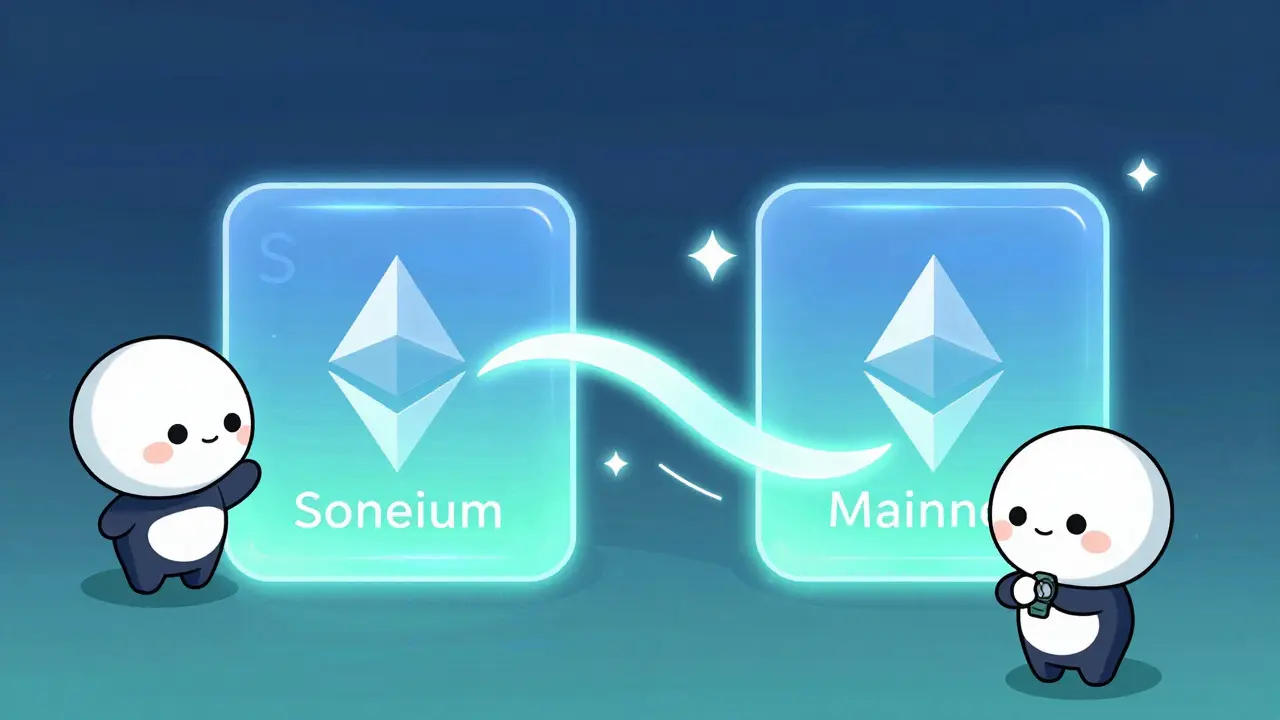
- Bridging Assets: You deposit ETH or ERC-20 tokens from Ethereum Mainnet into the L1StandardBridge. These assets move through the OptimismPortal (v2) to reach Soneium.
- Trading: Once on Soneium, you can swap thousands of compatible tokens using Uniswap’s interface. The protocol supports standard fee tiers: 0.05%, 0.30%, and 1.00%.
- Withdrawals: This is the catch. Due to fraud-proof security mechanisms inherent in Optimism-based chains, withdrawals back to Ethereum Mainnet have a mandatory 7-day challenge window. Your funds are locked during this period to ensure no fraudulent transactions occur.
This structure means that while buying and selling on Soneium is nearly instant and cheap (often under $0.03 in gas), getting your money *off* the chain takes time. For active traders who plan to stay within the ecosystem, this is fine. For those needing quick access to fiat or mainnet assets, it’s a significant friction point.
Pros and Cons: A Balanced View
No platform is perfect. Based on user feedback from Reddit, Trustpilot, and community Discord channels in late 2024 and early 2025, here is a realistic assessment of the experience.
| Feature | Uniswap v3 (Soneium) | Uniswap v3 (Ethereum Mainnet) |
|---|---|---|
| Transaction Speed | Under 2 seconds | Variable (15s - several minutes) |
| Average Gas Fee | $0.01 - $0.05 | $2.00 - $50.00+ |
| Liquidity Depth | ~$12.7 Million (Oct 2024) | $Billions |
| Token Variety | 87 Active Pools | 5,300+ Active Pools |
| Withdrawal Time | 7 Days (Challenge Period) | Instant |
| Use Case Focus | Entertainment, NFTs, Fan Tokens | General DeFi, Stablecoins, Blue Chips |
The Good: Users love the seamless integration with entertainment applications. During the Sandalphone concert NFT drop, over 12,000 unique users interacted with the platform. Fees are negligible, making micro-transactions viable. The concentrated liquidity feature allows sophisticated providers to earn higher yields by targeting narrow price bands relevant to volatile entertainment tokens.
The Bad: Liquidity is still fragmented. With only about $12.7 million in total value locked (TVL) compared to billions on mainnet, slippage can hit 3.2% during peak demand periods. The 7-day withdrawal wait frustrates new users who aren’t familiar with Layer 2 mechanics. Additionally, the token selection is limited; if you want to trade obscure altcoins, you might not find a pool on Soneium yet.
Who Should Use Uniswap v3 on Soneium?
This platform isn't for everyone. If you are a day trader looking to flip stablecoins for small profits, stick to Ethereum Mainnet or Arbitrum where liquidity is deeper. However, Uniswap v3 on Soneium shines for specific audiences:
- Fan Economy Participants: If you are buying tokenized merchandise, concert tickets, or digital collectibles tied to Sony properties like Solo Leveling or JPop groups, this is the native home for these assets.
- Liquidity Providers Seeking Niche Yields: Experienced LPs can exploit the concentrated liquidity model to provide services in emerging entertainment pairs before they become saturated.
- Web3 Beginners Entering via Gaming: Sony plans to integrate PlayStation Network swaps by Q3 2025. Early adopters positioning themselves now will be ready for that influx of gamers.
Security and Trust Considerations
Security is paramount in DeFi. Uniswap’s core code is battle-tested, having processed over $1 trillion in lifetime volume. However, the deployment on Soneium had a rapid rollout. Security researcher Elena Rodriguez noted that the independent audit was completed only 14 days post-deployment, which is faster than usual standards. While no critical exploits have been reported as of mid-2026, users should always verify contract addresses directly from official sources.
Regulatory-wise, Japan’s Financial Services Agency (FSA) provided guidance in August 2024 suggesting that entertainment NFTs without financial utility may not be classified as securities. This creates a safer legal environment for Soneium’s primary use cases compared to jurisdictions with stricter crypto laws.

How to Get Started: Step-by-Step Guide
If you decide to try Uniswap v3 on Soneium, here is how to set up your wallet correctly. Getting the network parameters wrong is the most common mistake beginners make.
- Install a Compatible Wallet: MetaMask, Coinbase Wallet, or Trust Wallet work best. Ensure your app is updated to the latest version.
- Add Soneium Network: Go to your wallet settings and add a custom network. Use these exact parameters:
- Network Name: Soneium
- RPC URL: https://rpc.soneium.org
- Chain ID: 1946
- Block Explorer: https://explorer.soneium.org
- Bridge Funds: Use the official Superbridge interface or the Uniswap Bridge tool. Deposit ETH or USDC from Ethereum Mainnet. Remember, this process is instant, but withdrawing will take 7 days.
- Connect to Uniswap: Visit the Uniswap interface, select the Soneium network from the dropdown menu, and connect your wallet.
- Swap Tokens: Select your input and output tokens. Check the estimated gas fee (should be near zero) and confirm the transaction.
Future Outlook: Is It Worth Holding?
The potential for growth is substantial. Delphi Digital forecasts that Uniswap on Soneium could process $2.4 billion in quarterly volume by Q4 2025. With Sony projecting 50 million potential users through its existing entertainment properties, the addressable market is huge. Upcoming features like cross-bridge swap aggregation and PlayStation Network integration suggest a long-term commitment to this ecosystem.
However, risks remain. Liquidity fragmentation across Layer 2s is a persistent issue in DeFi. If Soneium fails to onboard mainstream consumers quickly, the platform could struggle against competitors like Immutable X or Gala Chain. For now, it holds a "High Potential" rating among analysts, but success depends entirely on execution and user adoption.
Is Uniswap v3 on Soneium safe to use?
Yes, it is generally considered safe. Uniswap's smart contracts are audited and widely used. However, because it is a Layer 2 solution, you rely on the security of the Optimism Stack and the Soneium bridge. Always use official links and be aware of the 7-day withdrawal period for bridging back to Ethereum.
Why does it take 7 days to withdraw funds?
The 7-day challenge window is a security feature of the Optimism Stack. It allows anyone to prove if a fraudulent transaction occurred on the Layer 2 chain before the funds are finalized on Ethereum Mainnet. This ensures maximum security at the cost of speed for withdrawals.
Can I trade Bitcoin on Uniswap v3 Soneium?
You can trade Wrapped Bitcoin (WBTC), which is an ERC-20 token representing Bitcoin on Ethereum. Native Bitcoin cannot be traded directly on Ethereum-based Layer 2s without wrapping.
What are the fees for trading on Soneium?
Gas fees are extremely low, typically between $0.01 and $0.05 per transaction. Trading fees depend on the pool tier you choose: 0.05% for stablecoins, 0.30% for most pairs, and 1.00% for exotic or high-volatility pairs.
How does Soneium differ from Arbitrum or Optimism?
While all three are Layer 2 solutions built on similar technology, Soneium is uniquely backed by Sony Group Corporation. Its primary focus is entertainment, IP tokenization, and fan engagement, whereas Arbitrum and Optimism are general-purpose DeFi hubs with broader financial use cases.
Do I need a Sony account to use Uniswap on Soneium?
No, you do not need a Sony account. Uniswap is permissionless. You only need a compatible Web3 wallet like MetaMask. However, future integrations with PlayStation Network may require linking accounts for specific in-game features.