Imagine you are an artist who sells a painting for $100. Years later, that same painting is resold at an auction for $1 million. In the traditional art world, you get nothing from that second sale. The money goes entirely to the seller and the gallery. Now, imagine if you automatically received a cut of that $1 million every time the piece changed hands. That is the promise of NFT royalties, which are automated cryptocurrency payments sent to original creators whenever their non-fungible tokens are sold or resold on secondary marketplaces.
This concept was supposed to revolutionize the creative industry. It offered artists, musicians, and writers a way to earn passive income forever, not just once. But by 2026, the reality is messier than the early hype suggested. While the technology exists to enforce these payments, many major platforms have made them optional. Understanding how this system works-and why it is breaking down-is crucial for anyone looking to mint or buy digital assets today.
How NFT Royalties Actually Work
To understand royalties, you first need to understand the mechanism behind them: the smart contract. A smart contract is a self-executing contract with the terms of the agreement directly written into code. When you mint an NFT, you don't just upload an image; you deploy a script on a blockchain, usually Ethereum, which is a decentralized public blockchain platform that enables developers to build and deploy smart contracts and decentralized applications.
Inside that code, you set a percentage-let's say 5%. This number is immutable, meaning it cannot be easily changed after the fact. Here is what happens when someone buys your NFT:
- The buyer transfers the full purchase price (e.g., 1 ETH) to the marketplace.
- The smart contract intercepts the transaction.
- It calculates 5% of the total value (0.05 ETH).
- It sends that 0.05 ETH directly to your wallet address.
- The remaining 95% (0.95 ETH) goes to the current owner selling the item.
This process happens instantly and transparently on the blockchain. There is no middleman checking your bank account or sending a check. The code executes exactly as written. This was the core value proposition: trustless, automated compensation.
The Beeple Effect: Why Royalties Mattered
The potential power of this system became clear in February 2021. Digital artist Mike Winkelmann, known as Beeple, who is a contemporary digital artist known for his daily digital artworks and record-breaking NFT sales, saw his work "Crossroads" resold on the secondary market for $6.6 million. Because he had set a 10% royalty rate, he automatically received $660,000 from that single transaction.
This wasn't just a lucky break. It demonstrated a new economic model. In traditional industries, intermediaries like record labels, publishing houses, and galleries capture the vast majority of revenue from ongoing sales or resales. Artists often see only a one-time payment or a tiny fraction of streaming revenue. NFT royalties promised to flip this script, allowing creators to benefit directly from the appreciation of their work's value over time.
For years, this created a wave of optimism. Musicians started releasing albums as NFTs to keep fan engagement high and earn from resale. Writers began tokenizing chapters of books. The idea was simple: if your community values your work enough to trade it, you should profit from that trade.
The Enforcement Crisis: Why Platforms Stopped Caring
If the code enforces the royalty, why is there a problem? The issue isn't the blockchain; it's the marketplace. Blockchains like Ethereum do not force users to interact with specific websites. They only record transactions.
In 2023 and 2024, a significant shift occurred. Major marketplaces including X2Y2, an NFT marketplace that pioneered optional royalty structures to attract traders, LooksRare, which is a competitive NFT trading platform that rewards users with tokens and allows bypassing creator royalties, and Magic Eden, a multi-chain NFT marketplace that has adopted flexible royalty policies across different blockchains, made royalties optional.
Why did they do this? Competition. Traders want to maximize their profits. If Platform A charges a 5% royalty to the creator and Platform B does not, traders will flock to Platform B. To survive, marketplaces felt pressured to remove mandatory fees. This created a race to the bottom.
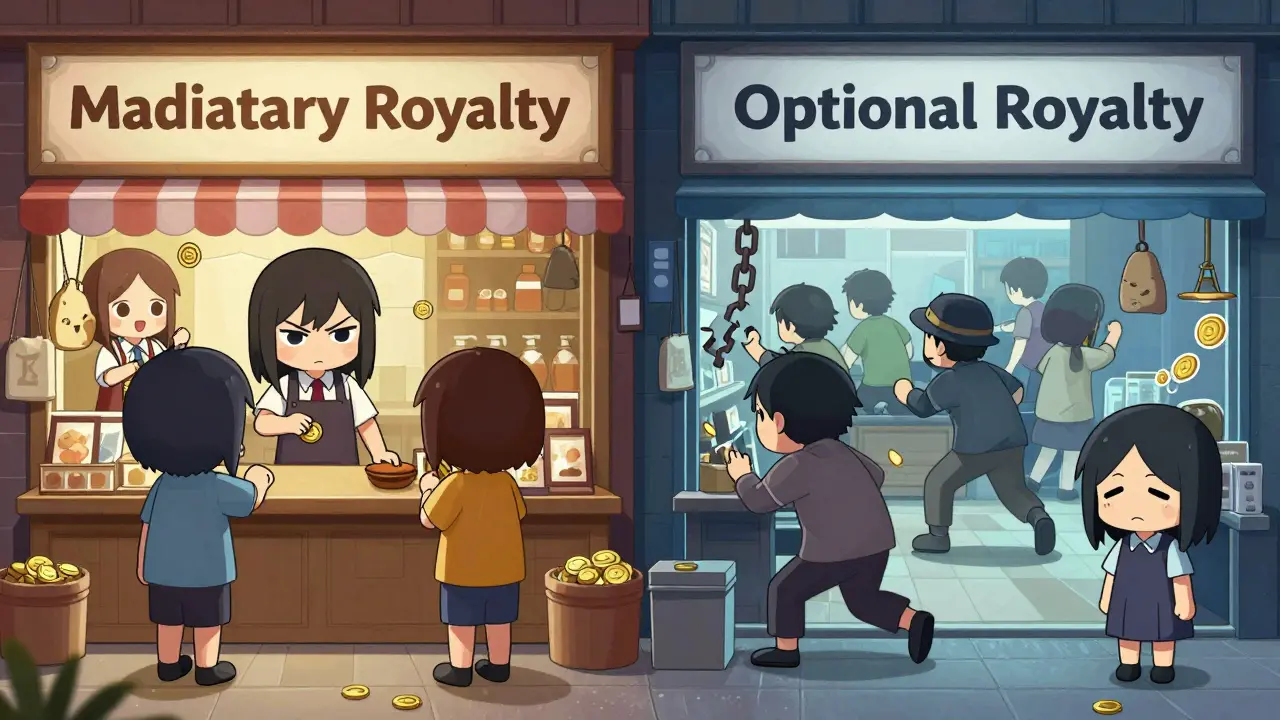
Now, when an NFT is listed on these platforms, the buyer can choose whether or not to pay the royalty. Many choose not to. As a result, creators who relied on steady secondary sales have seen their income drop to near zero, even if their projects remain popular.
Legal vs. Technical Enforcement
This brings us to a critical distinction. Smart contracts can execute code, but they cannot enforce legal rights outside the blockchain. Legal experts at firms like White & Case, a global law firm that has analyzed the regulatory implications of digital asset royalty structures, have pointed out that while the technology facilitates payment, it lacks external accountability.
If a buyer uses a platform that ignores royalties, the creator has little recourse. They cannot sue the blockchain. They would have to sue the marketplace, which is often complex due to jurisdictional issues. Furthermore, existing intellectual property laws vary wildly by country. Some regions recognize "droit de suite" (right of resale) for physical art, but few have updated laws to cover digital assets explicitly.
This means NFT royalties are currently a voluntary social contract rather than a hard legal right. They work only if the ecosystem participants agree to honor them.
Comparison: Mandatory vs. Optional Royalty Models
| Feature | Mandatory Model (e.g., OpenSea Legacy) | Optional Model (e.g., Blur, X2Y2) |
|---|---|---|
| Creator Income Stability | High: Predictable revenue from all secondary sales. | Low: Revenue depends on buyer goodwill. |
| Trader Costs | Higher: Buyers pay more upfront. | Lower: Buyers save the royalty amount. |
| Marketplace Volume | May decrease as traders seek cheaper options. | Often increases due to lower friction. |
| Enforcement Mechanism | Platform-level restriction. | None; relies on user choice. |
| Best For | Long-term project sustainability and community health. | Short-term speculation and high-frequency trading. |

Community Pushback and New Solutions
The crypto community did not accept the death of royalties quietly. Projects like ImmutableX, a layer-2 scaling solution for NFTs that launched tools to help communities blacklist non-compliant marketplaces, introduced mechanisms to pressure platforms. The idea was simple: if a marketplace doesn't pay royalties, collectors should refuse to use it.
Some newer protocols are experimenting with technical solutions. Instead of relying on the marketplace to split the payment, some developers are coding royalties directly into the transfer function of the token itself. However, this requires buyers to use specific wallets or interfaces that support these advanced features, creating friction for mainstream adoption.
Another approach is the rise of "creator-first" marketplaces. These smaller platforms differentiate themselves by strictly enforcing royalties, appealing to collectors who care about supporting artists rather than just flipping assets for quick profit. While their volume is lower, their loyalty among serious collectors is higher.
What This Means for Creators in 2026
If you are considering minting an NFT today, you must adjust your expectations. You can no longer assume that secondary sales will generate significant passive income unless you operate within a closed ecosystem or a platform that guarantees enforcement.
Here are practical steps to protect your interests:
- Choose Your Platform Wisely: Research which marketplaces enforce royalties for your specific blockchain. Avoid platforms known for ignoring creator fees if long-term income is your goal.
- Set Realistic Rates: Extremely high royalty rates (above 10%) may discourage trading altogether. Aim for a balance that incentivizes holders to sell while still providing you with a cut.
- Build Community Value: Royalties are a bonus, not a business plan. Focus on creating utility, access, or emotional connection that keeps your community engaged regardless of resale mechanics.
- Diversify Revenue: Do not rely solely on secondary sales. Combine NFTs with direct sales, subscriptions, or exclusive content offerings.
The Future of Creator Compensation
The story of NFT royalties is not over. It is evolving. The initial phase of wild experimentation gave way to a harsh reality check regarding enforcement. Now, the industry is searching for a sustainable middle ground.
We may see the emergence of standardized protocols where royalty enforcement is built into the blockchain layer itself, making it impossible to bypass without using obscure workarounds. We might also see legal frameworks catch up, giving creators actual legal standing to claim unpaid royalties.
Until then, the power lies with the community. Collectors who value fair compensation for creators will drive demand toward ethical platforms. Creators who adapt to this fragmented landscape will find ways to thrive. The technology remains powerful, but its success depends on human cooperation, not just code.
Are NFT royalties guaranteed?
No, NFT royalties are not guaranteed. While the smart contract code specifies a percentage, many major marketplaces now allow buyers to opt out of paying these fees. Enforcement depends entirely on the platform you use and the willingness of the buyer to comply.
How much do creators typically earn from NFT royalties?
Traditionally, creators set royalty rates between 2.5% and 10% of the secondary sale price. However, due to the rise of optional royalty models, actual earnings can vary significantly. On platforms that enforce royalties, earnings are consistent. On others, they may be zero.
Can I change my NFT royalty rate after minting?
In most cases, no. Once an NFT is minted, the royalty percentage is hardcoded into the smart contract and cannot be altered. Some newer standards allow for mutable metadata, but this is rare and often discouraged by the community as it undermines trust.
Which marketplaces still enforce royalties?
Policies change frequently, but historically, OpenSea (on certain chains) and smaller niche marketplaces have been more supportive of mandatory royalties. Always check the current policy of any platform before listing your work. Look for badges or statements indicating "Royalty Enforced."
Do I pay royalties when I sell my own NFT?
Yes. If you are the original creator, you receive the royalty. If you are a secondary holder selling someone else's NFT, you typically do not pay the royalty to yourself, but the buyer might expect you to facilitate the transfer according to the platform's rules. On optional platforms, you can choose to waive the fee to make your item more attractive.
Is it illegal to skip NFT royalties?
Currently, it is generally not illegal to skip NFT royalties because there are no specific laws governing digital asset resale rights in most jurisdictions. It is considered a breach of the informal social contract of the NFT space, but not a criminal act.