
Imagine buying a coffee for $4.50. Now imagine having to wait ten minutes and pay a $3 transaction fee just to complete that single purchase on the blockchain. It sounds absurd, right? That is exactly the problem facing many blockchain networks today. High fees and slow speeds make everyday use cases-like gaming, micropayments, or instant data updates-nearly impossible.
This is where State Channels come in. They are a Layer 2 scaling solution that allows you to move money or data off the main blockchain, conduct thousands of transactions instantly and cheaply, and then settle the final result back on the chain. Think of it like playing poker with chips at a table. You don't hand over cash for every single bet; you just move chips around. At the end of the night, you count your stack and exchange it for real money. State channels work the same way.
How State Channels Actually Work
To understand state channels, you need to look past the hype and see the mechanics. The process relies on three simple steps: opening, operating, and closing. Let's break down how this technology functions under the hood.
- Opening the Channel: Two or more parties agree to open a channel. They lock up a specific amount of funds (like Bitcoin or Ethereum) into a multi-signature smart contract on the main blockchain. This acts as an escrow. Both parties must sign any future withdrawal from this contract.
- Operating Off-Chain: Once the funds are locked, the participants start exchanging signed messages. Each message represents a new "state" of the balance. For example, if Alice pays Bob 1 satoshi, they both sign a document saying "Alice has 99, Bob has 1." They do not send this to the blockchain yet. They keep these signed states locally.
- Closing the Channel: When they are done transacting, either party can submit the latest signed state to the blockchain. The smart contract checks the signature, verifies it is the most recent one, and distributes the funds accordingly. The channel closes.
The magic here is efficiency. Whether you make one transaction or one million between opening and closing, you only pay gas fees twice: once to open and once to close. All the activity in between happens instantly and for free, outside the public ledger.
Why Do We Need State Channels?
You might wonder why we can't just fix the main blockchain itself. The issue is scalability trilemma: blockchains struggle to be decentralized, secure, and fast all at the same time. If you increase block size to handle more transactions, you need more powerful computers to run nodes, which centralizes the network. If you keep blocks small, fees go up when demand spikes.
State channels solve this by moving the load off the main chain. Here is why this matters for different users:
- For Micropayments: Sending fractions of a cent on-chain is economically unviable due to gas fees. State channels make sending $0.001 cost-effective.
- For Gaming: Video games require hundreds of interactions per second (movement, attacks, trades). Doing this on-chain would lag terribly. State channels allow smooth gameplay while keeping assets secure.
- For IoT Devices: Smart devices generate constant data streams. State channels allow these devices to communicate and settle micro-transactions without clogging the network.
By handling high-frequency interactions off-chain, state channels preserve the security of the underlying blockchain while offering speed comparable to traditional centralized servers.
State Channels vs. Other Layer 2 Solutions
State channels are not the only game in town. They compete with other Layer 2 technologies like Rollups (Optimistic and ZK-Rollups) and Sidechains. Understanding the differences helps you choose the right tool for the job.
| Feature | State Channels | Rollups | Sidechains |
|---|---|---|---|
| Transaction Finality | Near-instant (off-chain) | Delayed (batch settlement) | Fast (independent chain) |
| Security Model | Inherited from Main Chain | Inherited from Main Chain | Independent Security |
| User Experience | Complex (requires active participation) | Simple (like normal transactions) | Simple (bridge required) |
| Best Use Case | Micropayments, Gaming, Known Parties | DeFi, General Purpose Payments | High-throughput apps, Independent Logic |
| Online Requirement | Participants must stay online | No special requirement | No special requirement |
Notice the key difference: Rollups batch transactions from anyone and post them periodically. State channels are private lanes between specific parties. Rollups are better for general-purpose payments where you don't know who you are paying. State channels are superior for ongoing relationships, like a subscription service or a multiplayer game session.

Real-World Examples: Lightning and Raiden
State channels aren't just theory. They are live and running on major blockchains. Let's look at the two most prominent implementations.
Lightning Network is the most famous state channel implementation, built on top of Bitcoin. Launched in 2018, it has grown to include thousands of nodes and significant liquidity. It enables Bitcoin users to send small amounts instantly across the globe. For instance, a vendor in Wellington can accept Bitcoin tips from customers worldwide without worrying about confirmation times or fees eating their profit. However, Lightning requires users to manage channels carefully. If you want to send money to someone who isn't directly connected to you, the payment routes through intermediate nodes, which adds complexity.
Raiden Network was designed for Ethereum. It aimed to bring similar micropayment capabilities to ERC-20 tokens. While development has slowed compared to the surge in rollup technologies, Raiden demonstrated the viability of state channels for token transfers. Its architecture allowed for bidirectional payment channels, enabling complex payment flows that were previously too expensive on the Ethereum mainnet.
Another notable mention is Aeternity, a blockchain that integrates state channels directly into its protocol. This approach simplifies development for builders, as they don't have to construct the channel logic from scratch. Aeternity's focus on hybrid consensus and built-in state channels makes it a strong contender for enterprise applications requiring high throughput.
The Challenges and Limitations
If state channels are so great, why isn't everyone using them? There are significant hurdles that prevent mass adoption. Being honest about these limitations is crucial for understanding the current landscape.
1. Liquidity Lock-up: To use a state channel, you must lock up capital. If you deposit 1 BTC into a channel, that BTC is stuck there until you close the channel. This ties up your funds and reduces their utility elsewhere. In a volatile market, this opportunity cost can be high.
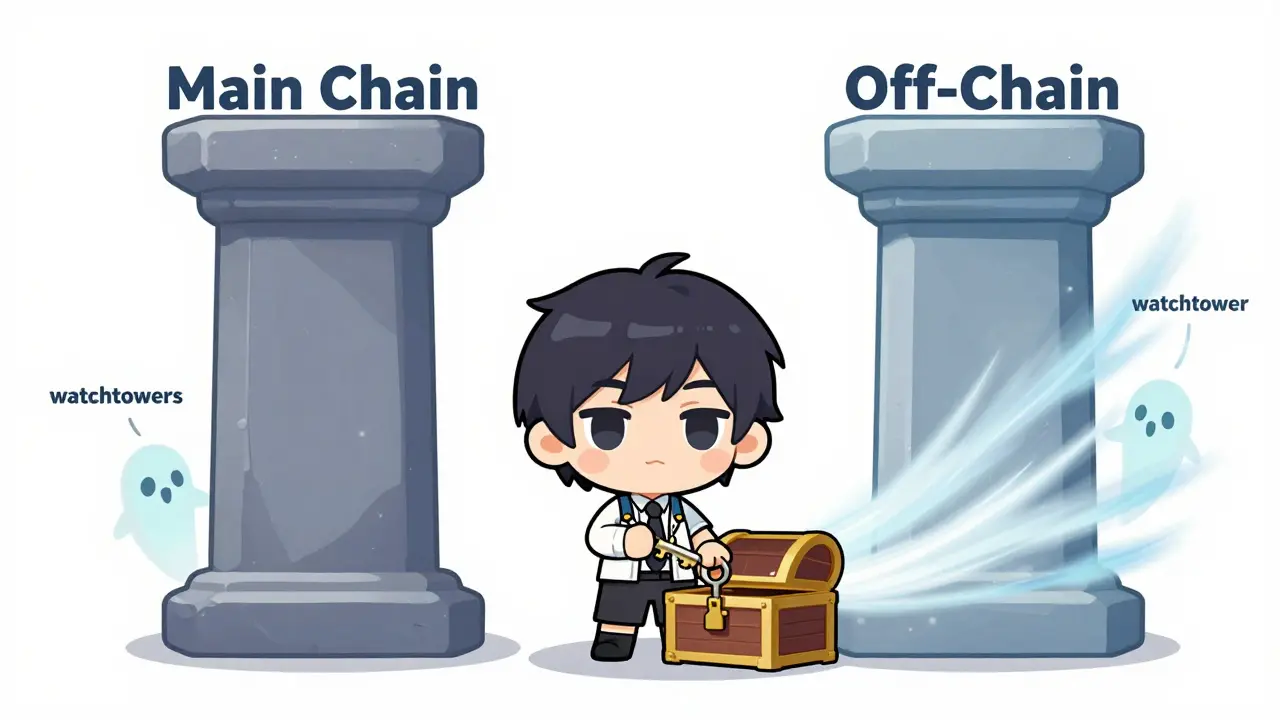
2. Online Requirement: Unlike regular blockchain transactions where you can sign and forget, state channels often require participants to remain online or monitor the chain closely. Why? Because if one party tries to cheat by submitting an old state to the blockchain, the other party must detect this and submit a newer, valid state within a dispute window. If you are offline during this window, you lose your funds. This "watchtower" mechanism adds technical overhead.
3. Routing Complexity: In a direct channel between Alice and Bob, things are simple. But what if Alice wants to pay Charlie, and she doesn't have a channel with him? She needs a route through intermediaries. Finding a path with enough liquidity and negotiating fees with each hop is computationally difficult and prone to failure. This is known as the "routing problem."">
4. User Experience Friction: Opening a channel involves waiting for blockchain confirmations. Closing it does too. For casual users, this friction is unacceptable. They expect click-and-done simplicity, not a multi-step process involving seed phrases and channel management software.
Who Should Use State Channels?
Based on the trade-offs, state channels are not a one-size-fits-all solution. They are best suited for specific scenarios:
- Gaming Studios: If you are building a play-to-earn game with frequent in-game asset swaps, state channels provide the necessary speed and low cost.
- Subscription Services: Platforms charging daily or hourly micro-fees can use state channels to deduct payments seamlessly without spamming the blockchain.
- Enterprise Supply Chains: Companies with established, long-term trading partners can open persistent channels to settle invoices and logistics data efficiently.
For general retail payments or occasional transfers, rollups or even Layer 1 improvements might offer a smoother experience. State channels shine when frequency and relationship longevity are high.
The Future of State Channels
The landscape of blockchain scaling is evolving rapidly. With the rise of ZK-Rollups and Optimistic Rollups, some experts argued that state channels were dead. However, the reality is more nuanced. Rollups are excellent for general-purpose scaling, but they still face congestion during peak times. State channels complement rather than replace them.
We are seeing a trend toward hybrid solutions. Imagine a future where you use a rollup for general DeFi activities but switch to a state channel for your daily coffee purchases or gaming sessions. Projects are working on improving routing algorithms to make multi-hop payments more reliable. Additionally, advancements in watchtower services aim to reduce the burden of staying online, making state channels safer for passive users.
As blockchain infrastructure matures, state channels will likely become invisible to the end-user. Just as you don't think about TCP/IP protocols when browsing the web, you won't think about state channels when sending a micro-payment. The technology will sit quietly in the background, enabling a faster, cheaper, and more scalable internet of value.
Are state channels safe?
Yes, state channels are considered very safe because they inherit the security of the underlying blockchain. Funds are locked in a smart contract on the main chain. Even though transactions happen off-chain, the final settlement is guaranteed by the blockchain's consensus mechanism. The primary risk is human error or software bugs in the client managing the channel, not the protocol itself.
Do I need to be online to use state channels?
Generally, yes. Because disputes must be resolved within a specific time window, participants need to monitor the blockchain to ensure no one submits an outdated state. However, third-party "watchtower" services can help mitigate this by alerting you or acting on your behalf if a dispute arises while you are offline.
What is the difference between a state channel and a sidechain?
A sidechain is a separate blockchain that runs parallel to the main chain, with its own validators and security model. A state channel is a private communication line between specific parties that uses the main chain only for setup and settlement. State channels offer higher security guarantees (since they rely on the main chain) but are less flexible than sidechains.
Can I use state channels for anonymous transactions?
State channels themselves do not provide anonymity. Since the channel is opened and closed on the public blockchain, the initial and final balances are visible. Furthermore, intermediaries in multi-hop payments may see transaction details. For true privacy, you would need to combine state channels with privacy-preserving technologies like zero-knowledge proofs.
Which blockchain has the best state channel implementation?
Bitcoin's Lightning Network is currently the most mature and widely used state channel implementation, with significant liquidity and merchant adoption. On Ethereum, Raiden Network pioneered the concept, but development has shifted more toward rollups. Aeternity also offers native support for state channels, making it a strong choice for developers building specific high-throughput applications.

Craig Swanson
June 1, 2026 AT 09:11Listen up, because I'm only going to say this once. State channels are not the magic bullet you think they are for general payments. The liquidity lock-up is a nightmare for retail users who want instant access to their funds. You're tying up capital in an escrow contract just to save a few cents on gas? That's inefficient and risky if the counterparty goes rogue or disappears. Rollups are where the real scalability lies because they don't require you to be online or manage complex state updates manually. Wake up.
saradee dee
June 3, 2026 AT 06:26Oh wow, Craig, you really bring the sunshine every morning! But honestly, I think the poker analogy in the post is so beautiful and simple. It makes me feel like we can actually trust this technology without needing a PhD in cryptography. Isn't it amazing how we can just move chips around? It feels so collaborative and safe, like playing with friends. I love that idea of settling at the end. It’s dramatic but true!
Dana Rapoport
June 3, 2026 AT 23:15The philosophical implication of moving value off-chain is profound. We are essentially creating private realities within a public truth structure. This duality mirrors many human social interactions where private agreements supersede public declarations until a final settlement occurs. It requires us to rethink what 'finality' means in a digital context. Is a transaction real if it hasn't touched the main ledger? These are questions worth pondering.
Barclay Chantel
June 5, 2026 AT 20:02This article is painfully basic. Anyone who has spent five minutes reading the Lightning Network whitepaper already knows all of this. The comparison table is superficial and ignores the nuanced security trade-offs of sidechains versus rollups. It reads like marketing fluff rather than technical analysis. One might expect better depth from a guide claiming to simplify complex topics. Disappointing.
Bill Gunn
June 7, 2026 AT 14:38Hey folks! 🚀 Great points here everyone. I’ve been tinkering with Aeternity’s native state channels and let me tell you, the dev experience is a whole new ballgame compared to building on top of Bitcoin or Ethereum. No need to reinvent the wheel for channel logic! 🛠️ It’s like having a Swiss Army knife for high-throughput apps. Who else is experimenting with hybrid consensus models? Let’s share some war stories! 💡
Hadleigh Edwards
June 9, 2026 AT 12:52I have found that when one delves into the intricacies of blockchain scaling solutions, particularly those involving off-chain computations and subsequent on-chain settlements, there arises a profound sense of optimism regarding the future trajectory of decentralized financial ecosystems, provided that the underlying infrastructure continues to evolve at a pace that matches the growing demand for seamless user experiences across various platforms and applications, which ultimately leads to a more inclusive and accessible digital economy for all participants involved in this grand experiment.
mark valmart
June 10, 2026 AT 12:20man i get it but the ux is still trash. opening a channel takes forever and then you gotta stay online? come on. its cool for gamers maybe but regular people wont deal with that hassle. rollups are just easier for now.
Crystal Davis
June 10, 2026 AT 17:16You are all missing the point about security inheritance. State channels are superior because they do not introduce new trust assumptions. Rollups rely on fraud proofs or validity proofs which add complexity and potential attack vectors. Sidechains are just separate blockchains with weaker security. If you care about actual decentralization and security, state channels are the only logical choice for known-party interactions. Your arguments are flawed.
Christina Pearce
June 11, 2026 AT 10:40I appreciate the clear breakdown of the mechanics. It helps to understand exactly where the friction points are, especially regarding the online requirement. I’m curious about how watchtower services are evolving to mitigate that risk for passive users. Are there any reliable implementations currently available that don’t compromise privacy too much?
Miss Masquer
June 11, 2026 AT 15:52As someone who has traveled extensively through different tech communities, I find the cultural adoption of these technologies varies wildly depending on the region and the specific use cases prevalent there. In some circles, the concept of locking up liquidity is seen as a barrier, while in others, it is viewed as a necessary step towards true sovereignty over one's assets. It is fascinating to observe how these differing perspectives shape the development priorities of various projects and teams working on Layer 2 solutions globally.
Joshua Alcover
June 12, 2026 AT 03:32It is imperative that we recognize the inherent superiority of established cryptographic protocols when discussing state channel implementations. The notion that newer, unproven architectures could supplant the robustness of time-tested mechanisms is preposterous. We must adhere to rigorous formal verification standards and ensure that all multi-signature contracts undergo exhaustive audit procedures before deployment. Any deviation from this strict protocol undermines the foundational integrity of the entire decentralized ecosystem.
Diana Morris
June 12, 2026 AT 10:00stop overcomplicating it. lightning works. raiden worked. why are we still debating this? just use it for micropayments and stop complaining about being online. if you cant stay online for a game session dont play games. simple as that.
Dianne Wright
June 14, 2026 AT 00:58i mean sure it sounds great but ive lost money before because i was offline during a dispute window and my watchtower failed so yeah dont trust it blindly. its always something with these crypto things. never really works out how they promise. just sad really.
trisya hazriyana
June 15, 2026 AT 05:26oh look another guide explaining the obvious. state channels are basically just p2p payment rails. nothing special. but sure lets pretend its revolutionary. the jargon is heavy but the concept is trivial. sarcasm aside, the routing problem is still unsolved and thats the real bottleneck. good luck with that.
Debbie Lewis
June 15, 2026 AT 22:29I just sit back and watch these debates unfold. It’s interesting how passionate everyone gets about off-chain vs on-chain. I guess it depends on what you’re trying to achieve. For my small project, I’m leaning towards rollups for simplicity, but I keep an eye on state channels for specific features. No rush though.
Eric Grosso
June 17, 2026 AT 15:30does anyone know if u can use state channels for anon txs? the post says no but i heard zk proofs might help. just wondering cuz privacy is kinda important to me. also spelling is hard lol.
Edith Mair
June 19, 2026 AT 04:15The assertion that state channels are dead is demonstrably false. While rollups have gained traction, state channels remain the optimal solution for high-frequency, low-value transactions between known parties. The data supports this. Look at the throughput capabilities. We need to stop dismissing them based on UX hurdles that are actively being solved by improved client software and watchtower networks.
lorna erni
June 19, 2026 AT 14:37Let’s keep this discussion respectful and focused on the technology! I think we can all agree that scaling is crucial. Whether it’s state channels, rollups, or sidechains, each has its place. Let’s collaborate to build a better ecosystem rather than tearing each other down. Positive energy only! ✨