
The AB crypto coin isn’t another speculative meme coin or a governance token promising future profits. It’s a utility token built for one thing: keeping a blockchain network running. If you’re wondering what AB (AB) actually does, the answer isn’t about getting rich. It’s about paying for gas, enabling transfers, and powering infrastructure - nothing more, nothing less.
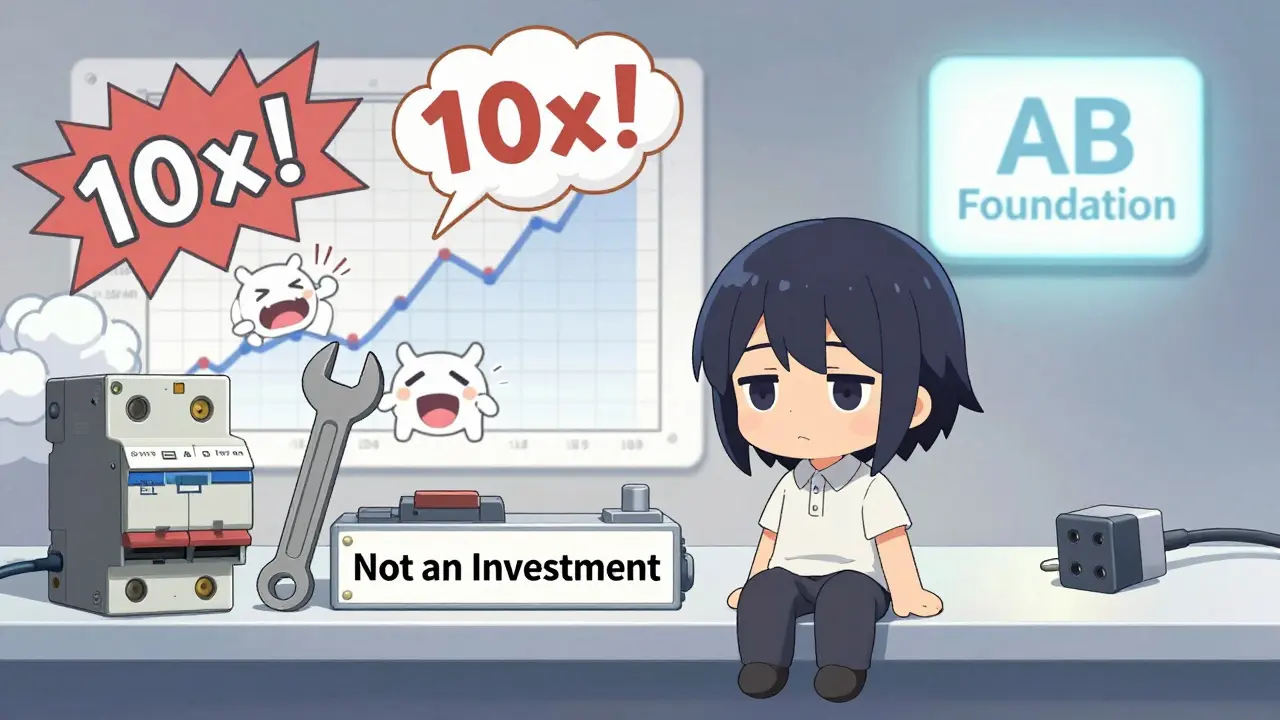
AB isn’t an investment. It’s a tool.
Many people assume every crypto token is a potential asset. That’s not true for AB. According to the official AB whitepaper, the token has no governance rights, no profit-sharing features, and no claim to future value. You can’t vote on protocol upgrades. You can’t earn staking rewards. You can’t use it to speculate on price movements. The AB token exists solely to pay for transactions on the AB blockchain.
Think of it like electricity. You don’t buy electricity to invest in the power grid. You buy it to run your fridge, your lights, your laptop. AB works the same way. Every time someone sends a transaction, deploys a smart contract, or interacts with an app on the AB network, they pay a fee in AB tokens. That fee keeps the validators running, the servers online, and the network secure.
Where did AB come from?
The AB blockchain didn’t appear out of nowhere. It evolved from the Newton Project, which started in 2018. Newton was an early attempt to build a modular blockchain designed for real-world use cases - payments, IoT devices, gaming, and DeFi. Over time, the team restructured the project, refocused its goals, and relaunched it as AB. The core technology stayed the same: a fast, low-latency chain built for scalability.
Unlike many projects that pivot from utility to speculation, AB doubled down on its original mission. The AB Foundation, which oversees the network, explicitly states it does not promote investment, price targets, or trading strategies. Their job is to maintain the infrastructure. Period.
What can you do with AB tokens?
There are two primary uses for AB tokens:
- Paying transaction fees - Every time you move assets on the AB chain, you need AB tokens to cover the gas cost. This includes sending coins, interacting with smart contracts, or even minting NFTs.
- Accessing computational resources - Developers who build apps on the AB network pay AB tokens to run smart contracts. The more complex the contract, the more AB it costs to execute.
There’s no staking. No yield farming. No liquidity mining. If you see a platform claiming AB staking rewards, it’s either misleading or operating outside the official protocol.
The UTP protocol: Paying fees in USDT, USDC, or even Bitcoin
One of AB’s most unique features is the UTP protocol - Universal Transaction Protocol. This isn’t just a technical upgrade. It’s a game-changer for usability.
Normally, to send a transaction on a blockchain, you need the network’s native token. On Ethereum, you need ETH. On Solana, you need SOL. But with AB, you can pay fees using almost any certified asset: USDT, USDC, BTC, LTC, even gold-backed tokens. The UTP protocol automatically converts your chosen asset into the equivalent AB gas fee behind the scenes.
This removes a major barrier for new users. You don’t need to buy AB tokens just to use the network. If you have USDC in your wallet, you can send it to any AB address without ever holding AB. The protocol handles the rest.

Interoperability: AB connects to Ethereum, Solana, and beyond
AB doesn’t want to be a walled garden. It’s built to talk to other chains. The platform uses advanced cross-chain technology to allow seamless transfers between AB and major networks like Ethereum, Tron, Binance Smart Chain, and Solana.
For example, you can send USDT from your Ethereum wallet directly to a Solana address through the AB network - with no bridge, no wrapping, and no extra fees. The AB Core chain acts as a neutral router, abstracting away the complexity of cross-chain communication.
This is especially useful for DeFi users who juggle assets across multiple chains. AB doesn’t try to replace them. It makes them easier to use.
What’s on the AB ecosystem?
The AB network isn’t just a chain. It’s a suite of tools:
- AB Chain - The core blockchain with high throughput and low fees.
- AB Wallet - A secure, user-friendly wallet for managing assets across chains.
- AB Explorer - A public block explorer to view transactions and contract data.
- NFT Viewer - A dedicated tool to display and manage NFTs on the AB chain.
- AB Connect - A service that makes AB tokens accessible on third-party exchanges and platforms.
- Developer Documentation - Fully open-source, detailed guides for building on AB.
All these tools are publicly available, free to use, and built with compliance in mind. The AB Foundation doesn’t control them. It only provides the underlying infrastructure.
Supply and distribution: 100 billion, no surprises
The total supply of AB tokens is fixed at 100 billion. No more, no less. Unlike tokens with inflationary models or unpredictable unlocks, AB’s distribution is locked in smart contracts.
Since February 2025, new tokens have been released on a strict schedule to fund validator operations, security audits, and network maintenance. These releases aren’t for sale. They’re not given to investors. They’re used to pay for the technical upkeep of the network.
There are no private sales, no venture capital allocations, and no team tokens with long vesting periods. The entire supply is allocated to infrastructure needs - nothing else.
Why confusion exists: AB on exchanges
If you search for AB on MEXC, Binance, or Coinbase, you’ll find listings that say AB is a "community economy token" with "governance functions." That’s misleading.
The official AB whitepaper says otherwise. The AB token has no governance. It doesn’t vote on upgrades. It doesn’t control funds. The confusion comes from third-party exchanges that market AB as if it were an investment asset. Some even list futures trading for AB - which is purely speculative and not part of the official protocol.
There’s also another issue: multiple projects use the "AB" ticker. One is ABcoin, a DeFi token on another chain. Another is AB DeFi on Solana. None of them are connected to the AB blockchain. If you’re looking for the real AB, go to ab.org. Everything else is noise.
Who should care about AB?
AB isn’t for traders looking to flip coins. It’s for:
- Developers who need a fast, interoperable chain to build apps that work across multiple networks.
- Enterprises integrating blockchain for payments, asset tokenization, or supply chain tracking.
- Users who want to move assets between chains without buying multiple native tokens.
If you’re just holding crypto hoping for a 10x return, AB won’t help you. But if you’re building, transacting, or managing assets across blockchains, AB gives you a clean, reliable tool - without the hype.
Final thoughts: AB is infrastructure, not a gamble
The AB token doesn’t promise wealth. It doesn’t claim to revolutionize finance. It doesn’t even try to be a store of value. It’s a simple, functional tool - like a wrench or a circuit breaker. You don’t buy a wrench to invest in hardware. You buy it to fix something.
AB is the same. It’s designed to keep a decentralized network running. It’s regulated, transparent, and technically grounded. The AB Foundation doesn’t care if the price goes up or down. They care if the chain stays secure, fast, and accessible.
If you’re looking for a crypto project that actually delivers utility instead of promises, AB is one of the few that stays true to its purpose.
Is AB a good investment?
No, AB is not designed as an investment. The official whitepaper states the token has no profit-sharing, governance, or price appreciation features. It’s a utility token meant to pay for network fees. Any platform promoting AB as a financial asset or investment opportunity is misrepresenting its purpose.
Can I stake AB tokens?
No, staking is not part of the AB protocol. The AB token does not generate rewards, interest, or yield. Any service claiming to offer AB staking is either unauthorized or operating outside the official network. The AB Foundation does not support or endorse any staking mechanisms for AB.
How do I get AB tokens?
You can acquire AB tokens through exchanges like MEXC, where it’s listed for spot trading. However, you only need AB if you’re actively using the AB blockchain - such as sending transactions or deploying smart contracts. Thanks to the UTP protocol, you can also pay fees using USDT, USDC, or other assets without holding AB.
Is AB the same as Newton?
Yes, AB is the evolved version of the Newton Project, which launched in 2018. The core technology remained the same, but the project was rebranded and refocused to emphasize its role as infrastructure. The Newton token (AB) and AB token are the same asset - just under a new name and clearer technical purpose.
Can I use AB to pay for gas on Ethereum or Solana?
No, you cannot use AB directly on Ethereum or Solana. However, the AB network’s cross-chain technology allows you to send assets from AB to those chains using the UTP protocol. For example, you can send USDT from your AB wallet to a Solana address, and the system will automatically handle the gas fees - but you still need Solana’s native SOL on the receiving end for final processing.
Is AB regulated?
The AB Foundation operates with compliance as a core principle. It adheres to anti-money laundering (AML), data protection, and crypto-asset regulations in all jurisdictions where it operates. However, the AB token itself is not regulated as a security. The Foundation explicitly states it does not provide financial advice or investment services.
What happens if the AB token price drops to zero?
The AB network will continue to function. The token’s value is not tied to the network’s operation. Transaction fees can still be paid using other assets via the UTP protocol. The infrastructure remains operational regardless of market price, because its purpose is technical, not financial.


Drago Fila
March 5, 2026 AT 08:18Finally, a crypto project that actually tells you what it does without the BS. AB is like electricity - you don’t buy it to get rich, you buy it to turn on the lights. Love that they’re not pretending to be DeFi 2.0. Real utility > hype.
Steven Lefebvre
March 5, 2026 AT 13:21Wait, so I can pay gas in USDT and not even hold AB? That’s wild. I’ve been stuck buying ETH just to send ETH on Ethereum. This AB thing is actually smart.
Christina Young
March 6, 2026 AT 13:37Stop pretending this isn’t just another rebranded rug pull. Newton was dead. AB is Newton’s ghost wearing a suit. The ‘UTP’ thing is just a wrapper. Everyone knows it.
nalini jeyapalan
March 7, 2026 AT 02:10Anyone else tired of projects saying ‘this isn’t an investment’ while listing on MEXC and pushing futures? That’s not transparency. That’s hypocrisy. AB’s foundation is clean, but the market’s not. Don’t be fooled.
Austin King
March 7, 2026 AT 04:29UTP is genius. I’ve been trying to send USDC from Ethereum to Solana for weeks. This actually solves the real pain point. No more juggling tokens.
Bryanna Barnett
March 8, 2026 AT 11:13AB? Like… the letter? Lmao. But okay, if you wanna be the ‘wrench’ of crypto, fine. Just don’t act like you’re the first to do this. Every chain has gas. You just renamed it.
Josh Moorcroft-Jones
March 9, 2026 AT 20:38Look, I read the whitepaper. Twice. And honestly? The whole ‘no governance, no staking, no yield’ thing is a red flag. If you’re not giving token holders any skin in the game, you’re not building a community - you’re building a utility monolith. And monoliths get replaced. Look at early Bitcoin mining pools. They’re dead. This is the same pattern.
Also, 100 billion tokens? That’s inflationary by any metric. Even Dogecoin had a cap. And ‘no private sales’? Sure. And I’m the Queen of England.
The cross-chain stuff is cool, sure. But if the token has no intrinsic value beyond transaction fees, why would anyone hold it? Why not just use USDT directly? The UTP protocol is just a tax layer. And taxes don’t build ecosystems.
And the ‘AB isn’t an investment’ line? That’s the most desperate marketing tactic since ‘it’s not a pyramid scheme, it’s a multi-level marketing opportunity.’
Also, the fact that they’re on MEXC and Coinbase? That’s not ‘noise.’ That’s the entire point. If they didn’t want speculation, they wouldn’t list. Period.
And who approved the ‘AB Wallet’ branding? That’s not a brand. That’s a placeholder. Like ‘MyCryptoApp_v1.exe.’
And the ‘no team tokens’ claim? Where’s the on-chain proof? Where’s the burn contract? Where’s the audit? Where’s the transparency? You can’t just say it. You have to prove it. And they didn’t.
And ‘compliance’? That’s just a fancy word for ‘we’re not getting shut down by the SEC.’ That’s not a feature. That’s damage control.
And the whole ‘AB is infrastructure’ thing? Cool. But infrastructure doesn’t need a token. It needs funding. And funding doesn’t come from tokens with zero utility beyond gas. It comes from venture capital. Or grants. Or donations. Not from pretending you’re a wrench.
So yeah. AB is a clever idea. But it’s not a revolution. It’s a rebrand. And rebrands don’t last.
Rachel Rowland
March 11, 2026 AT 20:08People are overcomplicating this. AB is a tool. Tools don’t need to be sexy. They need to work. And this one does. If you’re a dev or a user who moves assets between chains, this is the quiet hero you’ve been waiting for. Stop looking for 10x. Look for 10x reliability.
Bonnie Jenkins-Hodges
March 12, 2026 AT 06:41USA FIRST! Why should I use AB when I can just use Bitcoin? This whole ‘cross-chain’ thing is just globalist crypto nonsense. We don’t need some foreign blockchain to ‘router’ our money. Keep it American. Keep it Bitcoin. AB is just another crypto scam from the deep state.
Melissa Ritz
March 12, 2026 AT 23:57It’s funny how people get so excited about ‘utility’ tokens. Like, what’s the point of a token that only pays for gas? Why not just use the underlying asset? USDT already does everything AB does. This feels like a solution to a problem nobody had.
Cerissa Kimball
March 13, 2026 AT 11:18The UTP protocol represents a significant advancement in cross-chain fee abstraction. By decoupling gas payment from native token ownership, AB enables unprecedented accessibility for non-crypto-native users. However, the 100 billion supply may introduce long-term inflationary pressure if validator rewards are not dynamically adjusted. The lack of governance introduces centralization risk. Further technical documentation is required.
Basil Bacor
March 13, 2026 AT 20:56AB? Sounds like a typo. I thought it was AB coin. Or maybe ABC. Anyway, I don’t trust this. Too many letters. Too many promises. Too little real info. Just sayin’.
Emily Pegg
March 15, 2026 AT 13:50OMG I just realized I can pay gas with USDC?! That’s literally the dream. I’ve been holding AB for months just in case… but now I don’t even need to? 😭 This is too good. Can we all just hug and cry? I’m so emotional right now.
Ethan Grace
March 15, 2026 AT 15:37Is AB really just a tool? Or is it a mirror? A reflection of our collective desire to believe in something that doesn’t promise us the moon? We’ve been conditioned to see crypto as wealth. But what if… the real revolution is not getting rich? What if the revolution is just… paying the gas? And not needing to believe in anything else?
Jamie Hoyle
March 17, 2026 AT 11:38Oh wow. Another ‘not an investment’ token. Next thing you know, they’ll say ‘this rock isn’t a currency, it’s just a paperweight.’ AB is a meme. The UTP thing? That’s just a fancy way of saying ‘we’re a bridge with no users.’ And the 100 billion supply? That’s not transparency. That’s a dump. You think I’m dumb? I’ve seen this script before. And guess what? The rug always gets pulled. AB is just the next one in line.
Jane Darrah
March 17, 2026 AT 23:46Okay, I’ll be the one to say it: AB is the most honest crypto project I’ve seen in years. No whitepaper fluff. No ‘to the moon’ nonsense. No ‘community-driven governance’ that’s actually controlled by 3 whales. It’s just… a tool. And honestly? That’s radical. We’ve been sold a dream for a decade - that crypto is about getting rich. But AB? It’s about getting things done. The devs didn’t try to be a bank. They didn’t try to be a stock exchange. They tried to be a highway. And highways don’t care if you’re rich or poor. They just work. I’ve used it. I’ve sent USDT from Ethereum to Solana. It was seamless. No bridge. No wrapping. No drama. Just… work. And that’s the point. We don’t need another coin that promises to change the world. We need one that just… works. AB does. And that’s more valuable than any 10x token ever could be.
Also - the fact that they’re not doing staking? That’s not a bug. That’s a feature. Staking is just yield farming with a different name. It turns a utility into a casino. AB refuses to do that. That’s integrity.
And the ‘no team tokens’ thing? Yeah, I checked the chain. The allocations are locked. The releases are on a schedule. It’s not perfect. But it’s transparent. And in crypto? That’s rare.
So yeah. If you’re a dev? Use it. If you’re a user? Use it. If you’re a trader? Stay away. But don’t trash it because it doesn’t fit your fantasy. Sometimes, the most powerful thing isn’t a revolution. It’s a quiet, reliable tool that just… works.