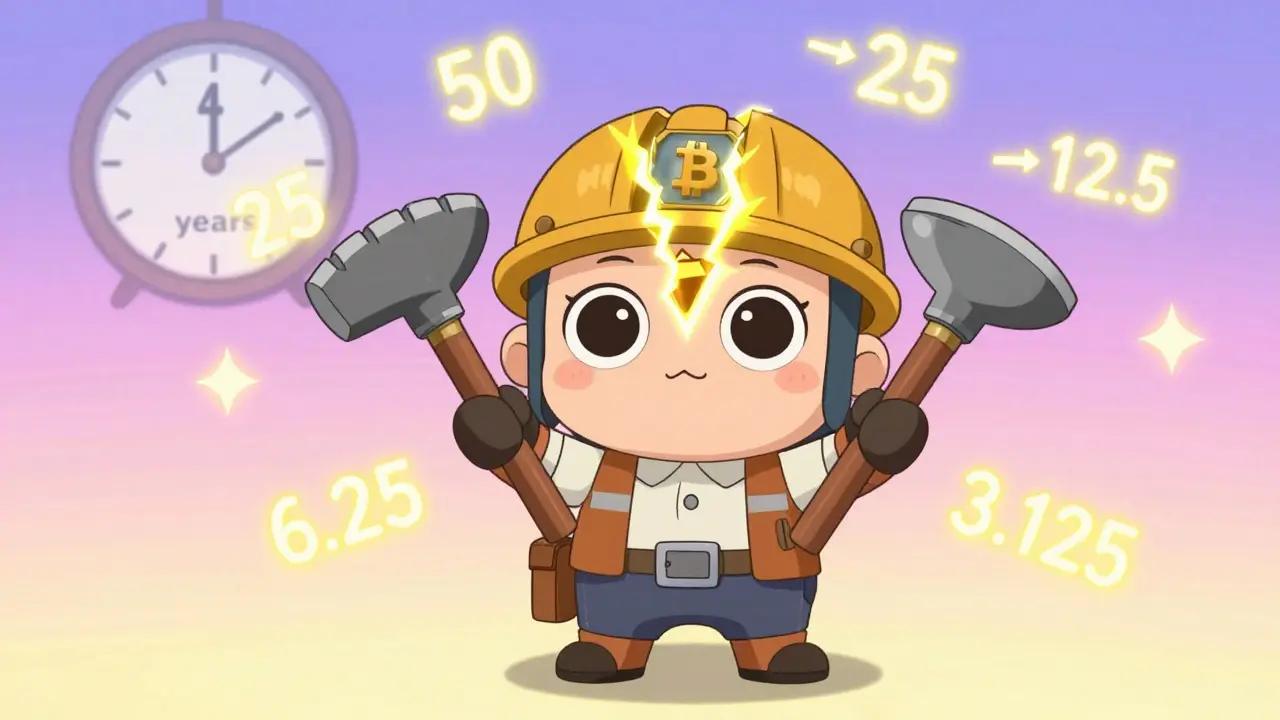
Bitcoin halving isn’t just a technical update-it’s a scheduled economic event that reshapes how new Bitcoin enters circulation. Every four years, roughly, the reward for mining a new block gets cut in half. This isn’t optional. It’s hardcoded into Bitcoin’s code. No one can change it. Not a government. Not a company. Not even the developers who originally built it. The halving is what makes Bitcoin different from traditional money. It’s what gives it scarcity.
How Bitcoin Halving Works
When Bitcoin launched in 2009, miners got 50 BTC for every block they validated. That reward wasn’t arbitrary. It was designed to slowly decrease over time. Every 210,000 blocks, the reward drops by 50%. That’s the halving. Since Bitcoin blocks are mined about every 10 minutes, it takes roughly four years to reach 210,000 blocks. So, halvings happen about every four years.
The first halving happened in November 2012. The reward dropped from 50 BTC to 25 BTC. The second came in July 2016-down to 12.5 BTC. The third, in May 2020, brought it to 6.25 BTC. The most recent one, on April 20, 2024, cut it again-to 3.125 BTC per block.
This isn’t just a number change. It’s a structural shift. Less new Bitcoin is being created. The total supply of Bitcoin is capped at 21 million. As of early 2026, about 19.7 million BTC have already been mined. That means less than 1.3 million BTC remain to be released-and they’ll come in smaller and smaller doses over the next 114 years.
Why It Matters: Scarcity Over Supply
Most currencies lose value over time because governments print more money. That’s inflation. Bitcoin was built to fight that. The halving ensures that Bitcoin’s supply grows slower and slower until it stops entirely. By 2140, no new Bitcoin will be created. Miners will survive only on transaction fees.
This design makes Bitcoin behave more like gold than dollars. Gold is rare. You can’t just dig up more whenever you want. Bitcoin’s halving mimics that. In 2024, Bitcoin’s annual issuance rate fell below 0.8%. That’s lower than gold’s annual mining growth rate of about 1.6%. For the first time, Bitcoin became scarcer than the metal it’s often compared to.
This isn’t theoretical. It’s measurable. Bitcoin’s market cap crossed $1.2 trillion right after the 2024 halving. Institutional investors, ETFs, and hedge funds now hold over 46% of all Bitcoin. That’s up from 38.7% in 2020. The halving didn’t cause this-but it reinforced the idea that Bitcoin is a finite asset.
What Happens to Miners After a Halving?
Miners are the backbone of Bitcoin. They use powerful computers to verify transactions and secure the network. In return, they get newly minted Bitcoin plus transaction fees.
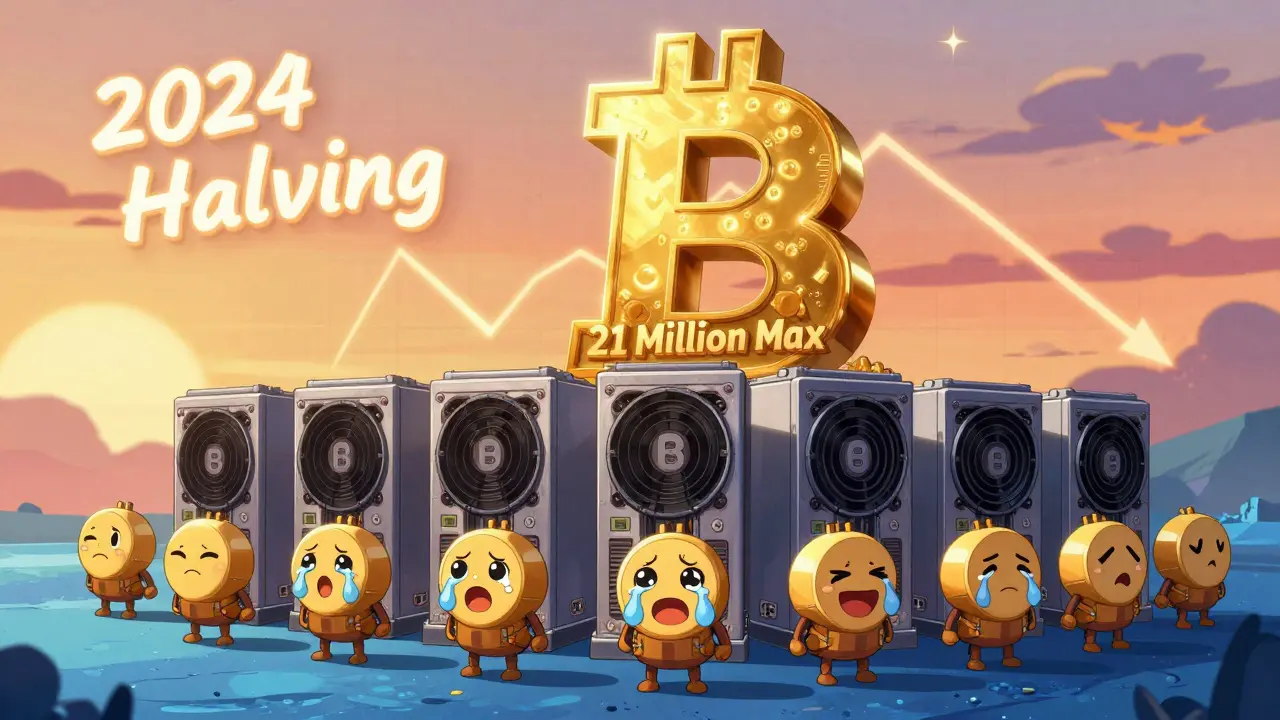
After each halving, their income from block rewards drops by half. That’s a huge blow. In 2024, when the reward dropped from 6.25 to 3.125 BTC, miners instantly lost half their income. Many small miners couldn’t survive. Mining rigs became less profitable. According to HashRateIndex, only the most efficient machines-like Bitmain’s Antminer S21, which uses 17 joules per terahash-could still turn a profit.
Large mining companies started buying up weaker competitors. Marathon Digital bought 1,500 miners from Riot Platforms in May 2024. Mining addresses on the network dropped by 27% in the first month after the halving. The industry consolidated. Efficiency became survival.
Transaction fees are supposed to fill the gap. But right now, they’re not enough. After the 2024 halving, fees covered only about 15% of what miners used to earn from block rewards. That’s a problem for the long term. If fees don’t rise significantly before 2140, the network could become less secure. That’s why developers are watching closely.
Does Bitcoin’s Price Go Up After a Halving?
People love to talk about price. And yes-historically, Bitcoin has surged after each halving.
- After the 2012 halving, price went from $12 to $1,150 in a year.
- After 2016, it jumped from $650 to $2,550.
- After 2020, it rose from $9,000 to $64,000.
That’s a pattern. But correlation isn’t causation. The 2020 halving happened during massive global money printing. Central banks flooded the economy with cash. Bitcoin benefited from that, not just the halving.
The 2024 halving was different. Bitcoin ETFs had just launched. Over 877,000 BTC-nearly 4.5% of total supply-was locked up in ETFs by April 2024. That created new, steady demand. Price rose 12.7% in the 30 days after the halving, but that was lower than previous cycles. The market had already priced in the event.
Most retail traders still believe in the halving effect. A Reddit poll from April 2024 showed 68% of users expected a bull run. But serious investors know better. Coinbase’s research team says: “The halving reduces supply. If demand stays the same-or grows-price could rise. But it’s not guaranteed.”
What’s Next? The Road to 2140
The next halving is scheduled for August 2028. At that point, the block reward will drop to 1.5625 BTC. After that, it’ll halve again in 2032, then 2036, and so on. The final halving won’t happen until around 2140.
By then, Bitcoin will be fully issued. No more new coins. Miners will survive only on fees. Will that work? Experts aren’t sure. Bernstein Research thinks Bitcoin’s annual issuance will fall to 0.2% by 2032-so low that it’s practically zero. But WisdomTree warns: if fees don’t rise fast enough, miners may stop securing the network. That’s the biggest risk Bitcoin faces after the halvings end.
For now, the system works. The network is more secure than ever. Mining has become a global, institutional industry. The halving isn’t just a code update. It’s a test of Bitcoin’s long-term viability.
What Should You Do?
If you’re holding Bitcoin, the halving reinforces why you’re holding it. It’s not a speculation tool. It’s a store of value with a fixed, predictable supply. The halving proves that.
If you’re a miner, you need to be efficient or get out. The era of cheap rigs and high electricity is over.
If you’re new to Bitcoin, don’t chase the halving like a lottery ticket. Understand it. Know that Bitcoin’s scarcity is programmed. That’s what makes it unique.
There’s no magic formula. No guaranteed price spike. But if you believe in sound money-money that can’t be inflated at will-then Bitcoin’s halving is one of the most important economic events in modern history.
What happens to Bitcoin mining after a halving?
After a halving, miners receive 50% less Bitcoin for each block they mine. This cuts their income in half. Many small miners shut down because they can’t cover electricity and equipment costs. Only the most efficient miners-those using the latest hardware and low-cost power-stay profitable. Transaction fees must rise to compensate, but they’re still too low to fully replace lost block rewards.
How often does Bitcoin halving occur?
Bitcoin halving occurs approximately every four years, or more precisely, every 210,000 blocks. Because blocks are mined about every 10 minutes, it takes roughly 3.99 years to reach 210,000 blocks. The last halving was on April 20, 2024. The next one is expected in August 2028.
Why does Bitcoin have a halving?
Bitcoin’s halving was designed by Satoshi Nakamoto to control inflation and create scarcity. Unlike fiat currencies, which can be printed endlessly, Bitcoin has a fixed supply of 21 million coins. Halving slowly reduces the rate at which new coins enter circulation, mimicking how precious metals like gold become harder to mine over time. This makes Bitcoin a deflationary asset.
Will Bitcoin’s price go up after the next halving?
Past halvings have been followed by major price increases, but there’s no guarantee it will happen again. The 2024 halving occurred alongside the launch of Bitcoin ETFs, which created new institutional demand. Price movements now depend on broader factors like macroeconomic conditions, regulation, and adoption-not just the halving. While scarcity may support higher prices, it doesn’t guarantee them.
How many Bitcoin halvings are left?
There are about 60 halvings left until Bitcoin’s total supply reaches 21 million. The final halving is expected around the year 2140. After that, no new Bitcoin will be created. Miners will rely entirely on transaction fees to earn income and keep the network secure.
Final Thought
The Bitcoin halving isn’t a marketing gimmick. It’s a mathematical rule. It’s the reason Bitcoin can claim to be digital gold. It’s what separates it from every other cryptocurrency that can be inflated at will. You don’t need to predict the price. You just need to understand the mechanism. Bitcoin’s scarcity isn’t promised-it’s coded. And that’s powerful.



Roshmi Chatterjee
January 23, 2026 AT 09:34Bitcoin halving is wild because it’s not just tech-it’s economics made visible. Every four years, the system says, ‘No more free lunch.’ And yet, people still act like it’s a magic price button. The real story is how miners adapt. The ones who survived 2024 are now running on solar farms in Texas and hydro in Canada. This isn’t a bubble. It’s a slow burn.
Nadia Silva
January 23, 2026 AT 21:27It’s amusing how Americans treat this like a religious rite. Bitcoin isn’t gold. Gold has industrial uses. Bitcoin has zero intrinsic value beyond collective delusion. And yet, you all treat it like it’s divine law. Pathetic.
Shamari Harrison
January 24, 2026 AT 17:36Just wanted to add: the 2024 halving was the first one where institutional demand actually outpaced retail hype. ETFs locked up nearly 5% of supply-that’s structural. Not speculative. Miners are now competing with pension funds, not just crypto bros. The network’s security model is evolving. We’re not just watching a price chart anymore.
Jeffrey Dufoe
January 26, 2026 AT 00:56Yeah, I’ve been holding since 2021. Didn’t sell after 2020. Didn’t panic in 2022. Just kept stacking sats. Halving’s just another Tuesday for me now.
Andy Marsland
January 26, 2026 AT 05:07Let’s be real-the entire narrative around halving is a marketing myth pushed by crypto influencers who need to sell you something. The 2012 price surge? That was the end of the Great Recession and the birth of the smartphone era. 2016? QE still in full swing. 2020? Pandemic stimulus. 2024? ETFs. The halving is a red herring. It’s a distraction from the real drivers: liquidity, regulation, and macroeconomic policy. Bitcoin doesn’t have a price-it has a narrative. And the narrative is always changing. Don’t confuse code with causality.
Deepu Verma
January 26, 2026 AT 16:33Man, I used to run a mining rig in my garage in Delhi. 2020 was the last year it made sense. By 2024? I sold it for parts and bought a solar panel. Now I just buy BTC on UPI and chill. The halving didn’t make me rich-it made me smarter. You don’t need to mine to believe in scarcity. You just need to understand it.
MICHELLE REICHARD
January 28, 2026 AT 02:13Oh please. You all act like Bitcoin is the answer to everything. But you ignore the fact that 80% of mining is in China and Iran. The ‘decentralized’ network is just a new form of state-controlled energy arbitrage. And now you’re celebrating it like it’s a virtue? Wake up. This isn’t freedom. It’s just capitalism with a blockchain sticker.
Abdulahi Oluwasegun Fagbayi
January 29, 2026 AT 15:57Halving is just math. But what’s beautiful is how humans keep trying to turn math into meaning. We give it names. We pray to it. We make memes. The code doesn’t care. But we do. And that’s the real story.
Jen Allanson
January 30, 2026 AT 12:24It is imperative to note that the foundational architecture of Bitcoin’s monetary policy is predicated upon a deterministic, algorithmic reduction in issuance velocity, thereby engendering a deflationary monetary regime unparalleled in human history. This is not a feature-it is a constitutional imperative. Any assertion that price movements are correlated with halving events constitutes a fundamental misapprehension of the underlying economic ontology.
Arielle Hernandez
January 31, 2026 AT 01:30Most people don’t realize the 2024 halving was the first one where Bitcoin’s issuance rate dropped below gold’s. That’s historic. Gold still gets 1.6% new supply yearly. Bitcoin’s at 0.8%. And it’s going lower. This isn’t speculation-it’s a paradigm shift in asset scarcity. We’re witnessing the birth of the first truly deflationary global asset. That’s bigger than ETFs. Bigger than hype.
Tselane Sebatane
January 31, 2026 AT 10:39I remember when miners were just guys with GPUs in their basements. Now it’s billion-dollar corporations with data centers in Iceland and Kazakhstan. The halving didn’t kill Bitcoin-it killed the amateurs. And honestly? That’s a good thing. The network is stronger now. More institutional. More resilient. The real test isn’t price-it’s whether miners can survive on fees alone in 2140. That’s the real cliff. And nobody’s talking about it enough.
Jonny Lindva
February 1, 2026 AT 22:13Love how people act like halving is some kind of secret sauce. Nah. It’s just the rules. You don’t need to time it. You just need to believe in the rules. I bought my first BTC in 2017. Didn’t sell. Didn’t trade. Just held. Halving? Cool. But I’m not waiting for it to get rich. I’m waiting for the world to catch up.
Anna Topping
February 3, 2026 AT 14:19So… if Bitcoin’s supply is capped, and miners get paid in fees… what happens when no one wants to transact? What if everyone just HODLs? Then fees go to zero. Then miners leave. Then the chain dies. Is that… the endgame? Or is that just… the point?
Mathew Finch
February 3, 2026 AT 20:38Bitcoin isn’t scarce. It’s just locked up. ETFs are hoarding it. Central banks are buying it. The real scarcity isn’t in supply-it’s in access. If you don’t have a brokerage account, you’re not part of the club. This isn’t financial freedom. It’s financial gatekeeping with a blockchain veneer.
Julene Soria Marqués
February 4, 2026 AT 21:54So you’re telling me after all this time, the only reason Bitcoin has value is because it’s hard to make? That’s it? No utility? No innovation? Just… less supply? Wow. That’s so… 2012. I miss when crypto was about changing the world. Now it’s just rich people betting on math.
Clark Dilworth
February 5, 2026 AT 10:52Post-halving miner consolidation is a classic case of network effect optimization. The hashrate distribution curve has become increasingly log-normal, with the top 5 pools now controlling over 60% of global hashrate. This introduces a new attack surface: centralized mining infrastructure. The 2024 halving didn’t just reduce rewards-it accelerated the transition from a permissionless mining ecosystem to a regulated, institutionalized mining oligopoly. We’re entering the post-Byzantine era of Bitcoin security.
Barbara Rousseau-Osborn
February 6, 2026 AT 13:38LOL you all think halving = free money. Newsflash: the price already priced it in. Everyone knew it was coming. ETFs were already buying. Miners were hedging. The ‘halving rally’ is a myth created by YouTubers who need ad clicks. If you bought BTC because of halving, you’re not a believer-you’re a sucker. And don’t even get me started on the ‘digital gold’ nonsense. Gold has jewelry, electronics, dentistry. Bitcoin has… memes. 🤡
Arnaud Landry
February 6, 2026 AT 17:41What if the halving is a trap? What if the real goal is to force miners to rely on fees… so governments can track every transaction? What if the ‘decentralized’ network is being slowly turned into a surveillance ledger? The halving isn’t about scarcity-it’s about control. And the next step? Mandatory KYC for mining rigs. You think this is freedom? It’s the quietest revolution ever.
Steve Fennell
February 8, 2026 AT 04:01Just wanted to say thanks for this post. I’m 68 and I didn’t understand Bitcoin until I read this. Now I get it. It’s like a digital savings bond that gets harder to earn over time. I bought a little bit last year. Not for profit. Just because it feels right. Like putting money in a jar you can’t open until you’re old. Good stuff.