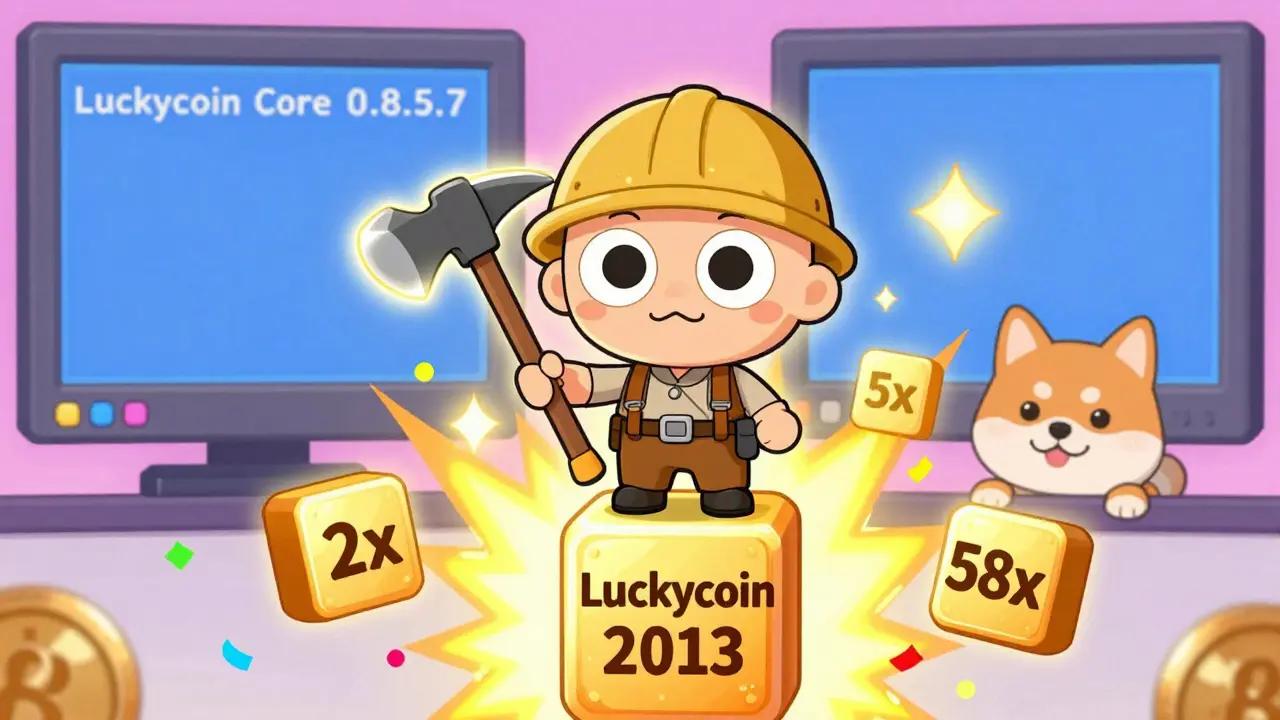
Most people think Dogecoin was the first meme coin. They’re wrong. The real pioneer? Luckycoin - a coin so old, so obscure, and so strangely preserved that it’s become a digital artifact. Launched in May 2013, Luckycoin (LKY) predates Dogecoin by months and was the very codebase Dogecoin copied. Today, it trades for pennies, has less than 1,250 active wallets, and barely registers on most exchanges. But if you care about crypto history, Luckycoin isn’t just a coin - it’s a time capsule.
How Luckycoin Was Born (And Why It Matters)
In 2013, Bitcoin was still a fringe experiment. Miners were running software on old PCs, and the idea of a fun, meme-driven cryptocurrency was unheard of. Then came LuckyC - an anonymous developer who dropped Luckycoin into the wild. Unlike Bitcoin’s rigid 50 BTC per block reward, Luckycoin introduced something wild: random lucky blocks.
Every time someone mined a block, they got 88 LKY. But sometimes - and this was the magic - the system would randomly multiply that reward. Two times. Five times. Even 58 times. One miner once got 5,104 LKY from a single block. It wasn’t fair. It wasn’t predictable. It was fun. And that’s what made it different.
This wasn’t just a gimmick. It was the first time anyone tried to inject humor, luck, and surprise into blockchain mining. Dogecoin didn’t invent meme coins - it borrowed Luckycoin’s entire codebase, changed the logo to a Shiba Inu, and turned it into a global phenomenon. Luckycoin? It faded into obscurity… until 2024.
The 2024 Revival: A Blockchain Time Machine
In August 2024, something unbelievable happened. Bitcoin developers, digging through old backups, found a pristine copy of Luckycoin’s original blockchain - from block 81,743 onward. They didn’t create a new chain. They didn’t fork it. They restored the original. The same genesis block. The same transaction history. The same weird reward algorithm.
This wasn’t a reboot. It was a resurrection. Suddenly, Luckycoin was alive again. The price spiked. Traders scrambled to get in. The all-time high hit $16.94 in November 2024. People who held it since 2013 woke up to find their digital dust worth thousands.
Today, the circulating supply sits at just over 19.2 million LKY. Total supply? Almost the same. No new coins are being created in massive waves. The halving schedule - every 100,000 blocks (about every 69 days) - keeps supply tight. But here’s the catch: it’s still running on 2013-era software. No smart contracts. No mobile wallets. No DeFi. Just raw, unmodified Proof of Work.
How Luckycoin Works (Technically)
Luckycoin is a Layer 1 blockchain. That means it’s its own network - not built on Ethereum or Solana. It uses the same SHA-256 hashing algorithm as Bitcoin. Mining is done with regular GPUs, not ASICs. The difficulty adjusts every 4 hours - way faster than Bitcoin’s two weeks. If more miners join, the puzzle gets harder almost immediately.
The lucky block system is still active. Every 10,000 blocks (roughly every 7 days), the algorithm randomly picks one block to multiply the reward. The multiplier is chosen from a fixed set: 2x, 5x, or 58x. There’s no pattern. No way to predict it. That’s the whole point.
Transactions need 6 confirmations to be final - longer than Bitcoin’s 2-3. That’s because the network is small. Fewer miners = slower confirmation times. You can’t use Luckycoin to pay for coffee. You can’t send it through a wallet app on your phone. The only official client is Luckycoin Core 0.8.5.7, last updated in August 2024. It runs on Windows. It’s clunky. It doesn’t support multi-sig. It’s a relic.
Market Value and Liquidity: A Ghost Town
As of February 2026, Luckycoin’s market cap is $5.99 million. That’s less than 0.00021% of the entire crypto market. Compare that to Dogecoin’s $60 billion. Or even Shiba Inu’s $5 billion. Luckycoin is a whisper in a hurricane.
Trading volume? Around $103,777 per day - according to CoinGecko. That’s not enough to move the needle. Try selling 50,000 LKY? You’ll tank the price. One Reddit user said they tried to sell 100,000 LKY and watched the price drop 15% before their order filled. That’s illiquidity. That’s risk.
There are only 10 exchanges listing LKY. Most are small, obscure platforms. You won’t find it on Binance, Coinbase, or Kraken. Wallet support? Barely existent. The Luckycoin Foundation maintains a Telegram group with 3,452 members - but response times to technical questions average 18 hours. No one’s building tools. No one’s fixing bugs. The GitHub repo has had only 3 contributors in 2025.
Who Holds Luckycoin? And Why?
Most holders aren’t traders. They’re historians. Collectors. Crypto archaeologists.
Chainalysis data shows 68% of active LKY holders are people who’ve owned it since before 2020. Many were miners in 2013. Others bought it for a few cents in 2015. They didn’t sell when it crashed. They didn’t abandon it. They held. And when the chain was restored in 2024, they were rewarded - not with riches, but with validation.
Reddit user u/HistoricalHodler put it best: “I’ve held LKY since the 2024 revival because it’s like owning a piece of crypto history - the fact that it’s the actual chain that Dogecoin forked from gives it unique value beyond pure speculation.”
There’s also a small group of collectors - people who treat Luckycoin like a rare coin or vintage comic book. The Luckycoin Foundation has even started talking to crypto museums about archiving the blockchain. Imagine a digital exhibit: “The First Meme Coin: Luckycoin, 2013-Present.”
Why Luckycoin Can’t Compete Today
Let’s be clear: Luckycoin isn’t trying to beat Ethereum. It doesn’t have a roadmap. It doesn’t have developers. It doesn’t have partnerships. It’s not integrating with Shopify or Twitch. It doesn’t even have a mobile app.
Its biggest flaw? It’s stuck in 2013. No smart contracts. No staking. No yield. No cross-chain bridges. No NFTs. No DeFi. No tokenomics. Just a blockchain that mines, rewards randomly, and waits.
Compare it to Dogecoin - which now has its own payment gateway, a dedicated team, and over 9.8 million active wallets. Luckycoin has 1,247. That’s not a bug. That’s the design.
Analysts are split. Dr. Alan Chen from MIT calls it “the missing link between Bitcoin and the memecoin explosion.” Maria Rodriguez from Delphi Digital says it’s “a historical curiosity with dangerous security gaps.” JPMorgan’s blockchain team called it a “niche artifact with limited investment appeal.”
One thing everyone agrees on: if you’re looking for a coin to make money, Luckycoin isn’t it. But if you want to understand where meme coins came from - this is it.
The Future of Luckycoin: Collectible or Obsolete?
The Luckycoin Foundation announced in January 2026 that it’s working on a lightweight wallet. No details. No timeline. No code. Just a promise. Bernstein Research predicts that by 2028, the market for digital historical assets like Luckycoin could hit $1.2 billion. Think of it like eBay for blockchain artifacts.
But here’s the problem: no one is building on it. No one is improving it. The code is frozen. The miners are few. The exchanges are scarce. The community is passionate - but tiny.
Luckycoin survives because of memory, not utility. It’s not a currency. It’s not a platform. It’s a story. And in crypto, stories sometimes outlive technology.
If you’re curious - buy a few hundred LKY. Not to profit. Not to trade. But to say you held the original. The one that started it all. The coin that made Dogecoin possible.
Is Luckycoin (LKY) still being mined?
Yes. Luckycoin is still actively mined using Proof of Work. Miners receive 88 LKY per block, with random multipliers (2x, 5x, or 58x) applied to "lucky blocks." The difficulty adjusts every 4 hours, and halving events occur every 100,000 blocks. Mining is done with standard GPUs using the original Luckycoin Core client.
Can I use Luckycoin to buy things online?
No. Luckycoin has no merchant integrations, payment gateways, or partnerships. Unlike Dogecoin, which is accepted by companies like Shopify and Twitch, Luckycoin is not used for transactions. Its only practical use is as a historical collectible or speculative asset.
Why did Luckycoin’s price spike in 2024?
In August 2024, developers restored the original Luckycoin blockchain from a 2013 backup - preserving every transaction since day one. This revival confirmed Luckycoin’s authenticity as the true progenitor of Dogecoin, sparking massive interest among crypto historians and collectors. The price jumped from under $0.10 to a peak of $16.94 in November 2024.
Is Luckycoin safer than Dogecoin?
Not necessarily. While Luckycoin inherits Bitcoin’s core security features, its 2013-era codebase lacks modern updates like multi-sig wallets, improved encryption, or automated vulnerability patches. Dogecoin has an active development team and regular security audits. Luckycoin’s minimal activity makes it more vulnerable to exploits, despite its historical integrity.
Where can I buy Luckycoin (LKY)?
As of February 2026, Luckycoin is listed on only 10 exchanges globally, according to Liquidity Finder. Most are small, lesser-known platforms like CoinEx, HotBit, and P2PB2B. It is not available on major exchanges like Binance, Coinbase, or Kraken. Always verify the exchange’s reputation before trading, due to low liquidity and high slippage risks.
Does Luckycoin have a future?
Its future isn’t in finance - it’s in history. Luckycoin won’t compete with modern blockchains. But as digital preservation gains traction, it may become a key artifact in crypto museums and educational archives. The Luckycoin Foundation is exploring lightweight wallet development, but no major upgrades are planned. Its value lies not in utility, but in authenticity - it’s the original memecoin.



sabeer ibrahim
February 7, 2026 AT 15:12LKY is just a ghost chain with a Wikipedia page and zero utility. Why are we even talking about this? Dogecoin had memes, community, and a fucking dog. Luckycoin? A miner’s dusty backup drive with a price tag. This isn’t history - it’s crypto hoarding.
Kieren Hagan
February 7, 2026 AT 20:26While Luckycoin’s historical significance is undeniable, its technical architecture is fundamentally incompatible with modern blockchain standards. The absence of smart contract capabilities, lack of wallet interoperability, and reliance on 2013-era consensus mechanisms render it non-viable as a functional asset. Its value is purely archival.
sachin bunny
February 8, 2026 AT 00:23bro this is all a psyop 🤡 the 2024 "restoration"? that was the feds. they dug up LKY to distract us from the real memecoin - the one they’re hiding in the NSA’s basement. 😈💎
Olivette Petersen
February 8, 2026 AT 10:56I think it’s beautiful that someone still holds onto this. In a world obsessed with the next big thing, Luckycoin is a quiet reminder that not everything has to be useful to be valuable. Sometimes, just being the first counts. 💙
Michelle Anderson
February 8, 2026 AT 15:27This isn’t history. It’s a corpse with a price tag. 1,247 wallets? That’s not a community - it’s a graveyard. You’re not a collector. You’re a hoarder with delusions of grandeur.
Kyle Pearce-O'Brien
February 10, 2026 AT 08:13Let’s be real - Luckycoin is the crypto equivalent of a vinyl record found in your grandfather’s attic. It’s got soul, sure. But if you’re trying to play it on a Bluetooth speaker, you’re not a visionary - you’re a Luddite with a wallet. The blockchain is evolving. LKY? It’s still stuck on 2013’s dial-up internet.
And don’t get me started on that "lucky block" nonsense. Random multipliers? That’s not innovation - that’s a casino with a blockchain logo. Dogecoin had memes. Luckycoin had a dice roll.
It’s poetic, I’ll give you that. But poetry doesn’t pay bills. Or fund dev teams. Or even load a damn wallet without crashing your PC. This isn’t preservation. It’s digital taxidermy.
And the "Luckycoin Foundation"? Please. Three commits in 2025? That’s not a team - that’s a GitHub ghost haunting its own repo. You can’t build a future on nostalgia. You can only bury it.
So yeah, I get it. You mined this in 2014. You watched it die. You held on. That’s noble. But don’t confuse sentimentality with sound investment. This isn’t Bitcoin’s origin story - it’s its ghost.
And if you think this is going to be in a museum? Good luck convincing the curators that a 2013-era SHA-256 chain with no API, no docs, and no mobile app is worth displaying next to the first Bitcoin whitepaper.
It’s a relic. A beautiful, weird, hilarious relic. But relics don’t move markets. They just sit there. Waiting. Like us.
Molly Andrejko
February 11, 2026 AT 07:05I really appreciate how this post honors the quiet pioneers of crypto. Most people only celebrate the winners - but Luckycoin reminds us that the first steps matter too. Even if no one else remembers them.
It’s not about the price. It’s about the story. And sometimes, the story is enough.
orville matibag
February 13, 2026 AT 04:39Just ran Luckycoin Core on my old laptop. It took 12 minutes to sync. The GUI looked like Windows XP. I mined 88 LKY. Then I closed it. Didn’t even send it to a wallet. Just… left it there. Kinda felt like I was talking to the ghost of 2013.
It’s not useful. But it’s real.
Mendy H
February 14, 2026 AT 08:1519.2 million LKY. Market cap: $5.99M. That’s a valuation of $0.31 per coin. You’re telling me this is worth more than Dogecoin’s 134B supply? The math doesn’t lie - this is a bubble built on delusion.
And the "original" claim? Dogecoin forked the code. But Luckycoin didn’t create the meme. It just got lucky. Literally.
Michael Sullivan
February 15, 2026 AT 12:24It’s not a coin. It’s a museum piece. And museums don’t have liquidity. They have velvet ropes. And security guards. And signs that say "Do Not Touch."
Why are we even here? 😭
perry jody
February 16, 2026 AT 01:08Just bought 10,000 LKY. Not for profit. Just to say I was there. The original. The one that started it all. 🙌
Paul Jardetzky
February 17, 2026 AT 04:48If you’re holding LKY, you’re not a trader. You’re a time traveler. This isn’t crypto - it’s archaeology. And honestly? That’s cooler than any DeFi yield farm.
Paul Gariepy
February 18, 2026 AT 03:32I’ve been mining LKY since 2014. I didn’t sell when it crashed. I didn’t leave when no one cared. I kept the wallet open. Just in case. And now? It’s like the universe whispered, "Hey, you did good."
It’s not about the money. It’s about being the one who never gave up.
Also, the GUI still crashes if you click "Send" too fast. Classic.
laura mundy
February 19, 2026 AT 09:51Everyone’s acting like this is sacred. It’s not. Dogecoin copied it because it was easy. Not because it was brilliant. Luckycoin was a glitch. A happy accident. A typo that went viral.
Stop romanticizing failure.
Jacque Istok
February 21, 2026 AT 07:06So you mined 88 LKY… and got a 58x multiplier? Congrats. You won the crypto lottery. Now go buy a house. Or a car. Or… wait. You can’t spend it. You just have a number in a broken wallet. That’s not a victory. That’s a punchline.