Puffer Staking Rewards Calculator
Calculate your potential earnings from staking ETH or LSTs on the Puffer protocol. Based on current market data (as of December 2025).
Most people hear "Puffer" and think it’s just another crypto coin. But PUFFER isn’t designed to be a store of value like Bitcoin or a meme coin with viral hype. It’s a Puffer protocol - a behind-the-scenes tool that’s quietly making Ethereum faster, cheaper, and more secure for apps you already use. If you’ve ever waited 10 seconds for a trade to confirm, or lost money to front-running on DeFi, Puffer’s tech is trying to fix that.
What Exactly Is Puffer (PUFFER)?
Puffer is a decentralized infrastructure protocol built on Ethereum. It doesn’t compete with Ethereum - it enhances it. Think of it like a turbocharger for Ethereum’s existing engine. Its native token, PUFFER, powers two main functions: rewarding participants and giving holders a say in how the protocol evolves.
Launched in 2023 by an anonymous team focused purely on Ethereum scalability, Puffer’s core innovation is something called liquid restaking. That sounds jargon-heavy, but here’s the simple version: Normally, if you stake your ETH to help secure the network, your coins are locked up. Puffer lets you stake your ETH (or liquid staking tokens like stETH) and still use them in other DeFi apps - all while earning rewards. It’s like having your cake and eating it too.
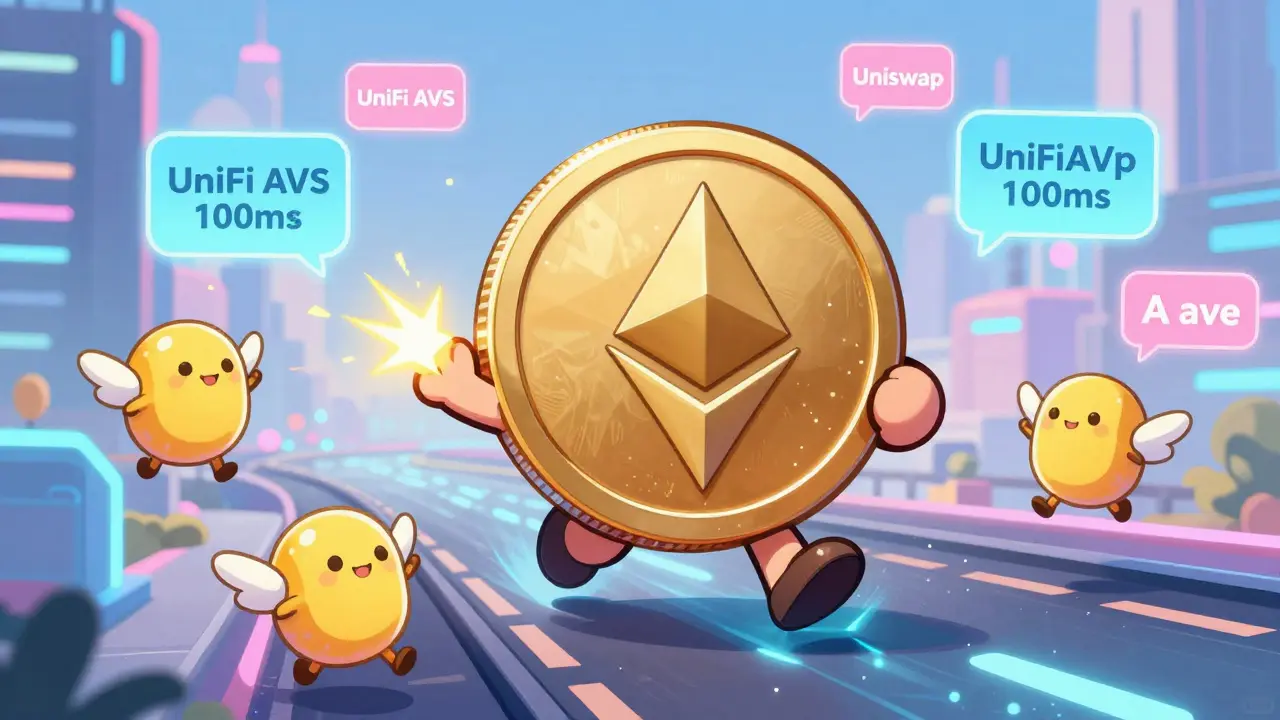
Puffer’s biggest product is UniFi AVS (Actively Validated Service). This isn’t a wallet or an exchange. It’s a service that gives DeFi apps near-instant transaction confirmations - under 100 milliseconds. That’s 10 times faster than Ethereum’s base layer. For traders, this means less slippage. For users, it means fewer failed transactions.
How Does Puffer Work?
Puffer doesn’t run its own blockchain. Instead, it hooks into EigenLayer, a restaking platform that lets ETH stakers re-use their security to protect other protocols. Validators on EigenLayer can opt-in to Puffer’s network. In return, they earn extra rewards in PUFFER tokens.
Here’s how a retail user interacts with it:
- Connect your wallet (MetaMask, Coinbase Wallet, or Ledger).
- Deposit ETH or a liquid staking token (like stETH) into Puffer’s pool.
- Optionally, enable UniFi AVS for specific apps - like Uniswap or Aave - to get faster confirmations.
You don’t need 32 ETH to participate. That’s the requirement for full validators. Regular users can join with as little as $10 worth of ETH or LSTs. Rewards are paid out in PUFFER tokens, and they compound automatically.
Puffer’s architecture is modular. That means it can plug into different rollups and Layer 2s without needing to rebuild everything. It’s designed to be a universal preconfirmation layer - a service any Ethereum app can use.
PUFFER Token: Supply, Use Cases, and Value
The total supply of PUFFER is capped at 1 billion tokens. But the circulating supply varies across platforms - CoinGecko reports 180 million, Dropstab says 324 million, and CoinPedia lists 175 million. This isn’t an error. It’s because different exchanges and analytics sites track token unlocks differently. Puffer releases tokens gradually over time, tied to protocol milestones.
As of December 12, 2025, PUFFER’s price hovers around $0.071, giving it a market cap of roughly $12.8 million. That’s tiny compared to the $3.12 trillion crypto market, but it’s significant within its niche.
PUFFER tokens are used for:
- Governance: Holders vote on upgrades, fee structures, and new integrations.
- Rewards: Stakers earn PUFFER as compensation for securing the network.
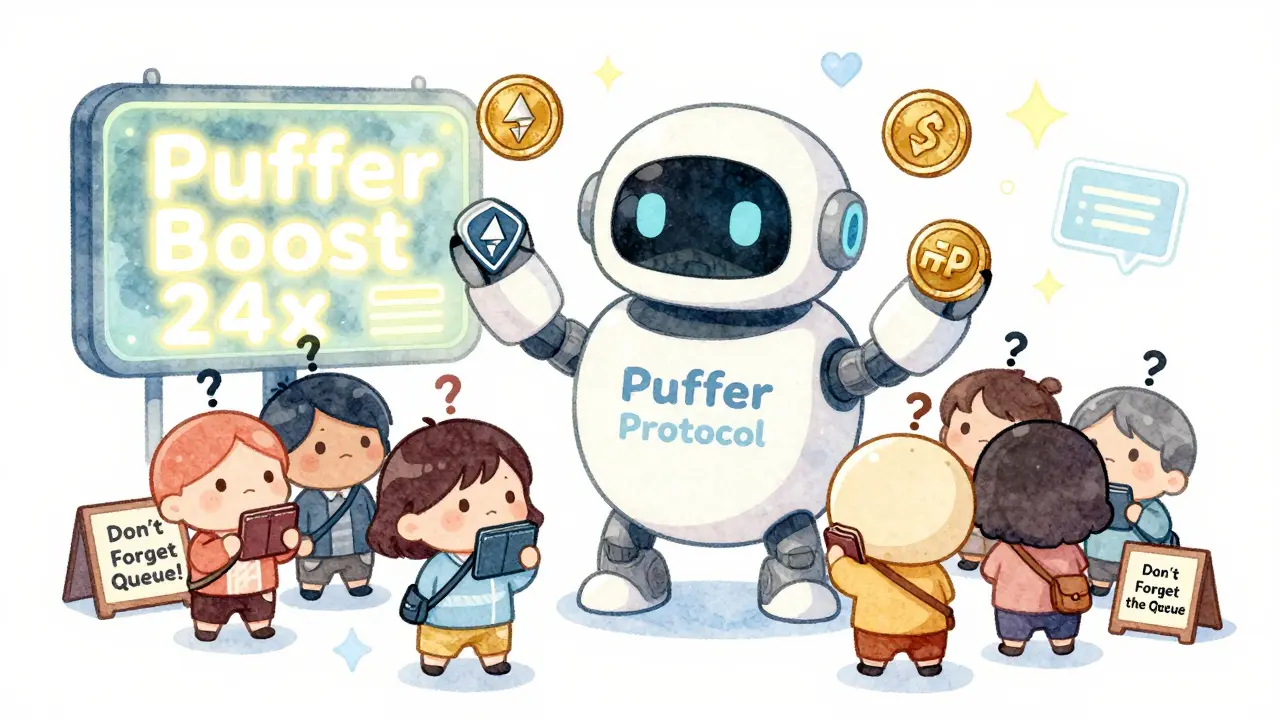
- Boost: Starting December 10, 2025, PUFFER holders can activate "Puffer Boost" - a feature that multiplies staking rewards by up to 24x for a limited time.
It’s not a payment token. You won’t buy coffee with PUFFER. It’s a utility token for a specific technical ecosystem.
How Puffer Compares to Other Liquid Restaking Protocols
Puffer isn’t alone in the liquid restaking space. Here’s how it stacks up:
| Protocol | Focus | TVL (Total Value Locked) | Key Advantage | Key Limitation |
|---|---|---|---|---|
| Puffer | Preconfirmations & rollup interoperability | $5.4 billion | 100ms finality; 99.98% uptime on UniFi AVS | Complex onboarding; no native cross-chain support |
| EtherFi | Solo staking derivatives | $18.4 billion | Simple UI; highest TVL | Limited to staking rewards; no preconfirmation layer |
| Renzo | Multi-chain restaking | $4.2 billion | Works on Solana, Polygon, Arbitrum | Slower preconfirmations; less optimized for Ethereum |
| Eigenpie | Restaking for EigenLayer | $3.1 billion | Lower gas fees than Puffer | No built-in preconfirmation service |
Puffer’s edge is specialization. While EtherFi is the go-to for simple staking, and Renzo covers multiple chains, Puffer is the only one focused on solving Ethereum’s "preconfirmation problem" - the delay between when a transaction is sent and when it’s visible to users. That’s why big DeFi apps like Uniswap V4 and Aave V4 integrated Puffer’s service.
Real-World Impact: Who Uses Puffer and Why?
Most everyday users won’t interact with Puffer directly. But if you use DeFi, you’re already benefiting.
Here’s what’s happening:
- DeFi traders: Use Puffer’s preconfirmations to avoid front-running. One user reported cutting losses from front-running by 63% after switching.
- Exchanges: Kraken Institutional says trades executed 42% faster when using Puffer’s layer.
- Developers: 17 major protocols have integrated UniFi AVS. That means faster swaps, quicker lending, and fewer failed transactions.
But it’s not perfect. A common complaint on Reddit and Trustpilot is the setup process. You need to understand wallets, gas fees, and restaking mechanics. One user lost $1,200 because they didn’t realize withdrawals had a queue system. Puffer’s documentation is thorough - 38 API endpoints, 12 categories - but it’s written for developers, not beginners.
For non-technical users, Puffer still feels like a black box. You deposit ETH, you get PUFFER tokens, and your transactions get faster. But if something goes wrong, troubleshooting requires digging into Discord or GitHub.
Expert Opinions: Is Puffer the Future?
Opinions are split - but mostly positive.
Vitalik Buterin praised Puffer’s approach in a September 2024 blog post, calling UniFi AVS a "promising direction" for improving Ethereum’s user experience. David Hoffman from Bankless said it "solved the preconfirmation trilemma" - a problem that’s plagued Ethereum for years.
But not everyone is convinced. Ethereum core developer Danny Ryan warned in a December 2024 panel that if preconfirmation services become too centralized around a few providers like Puffer, it could create new risks. And researcher Hasu pointed out that Puffer’s multi-layer architecture might introduce new attack vectors.
CoinGecko rates Puffer 7.8/10 for technology but only 6.2/10 for user experience. That gap tells the story: brilliant tech, messy front-end.
Current Developments and Future Roadmap
Puffer is far from done. Its roadmap has three phases:
- Phase 1 (Completed): UniFi AVS mainnet launched in Q4 2024.
- Phase 2 (Q1-Q2 2025): Cross-rollup interoperability - letting users move assets between different Layer 2s using Puffer’s infrastructure.
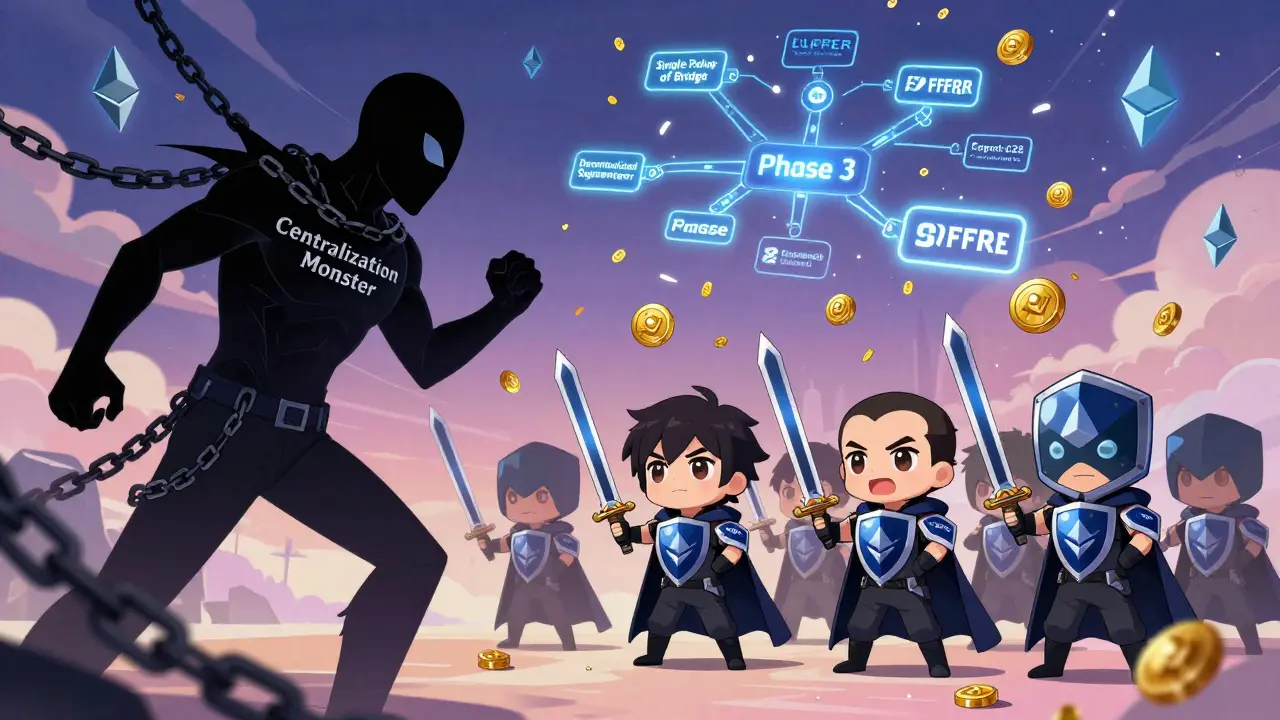
- Phase 3 (Q3 2025+): Building a decentralized sequencer network to remove reliance on centralized nodes.
The biggest update as of December 10, 2025, is "Puffer Boost." It lets token holders multiply their staking rewards by up to 24x. It’s temporary, designed to incentivize early adoption and liquidity.
Another major milestone is the upcoming "Commit-Boost" integration. This standardizes how transaction proposers commit to blocks across Ethereum. If successful, it could become the industry standard - not just for Puffer, but for the whole ecosystem.
Risks and Challenges
Nothing in crypto is risk-free. Puffer has its own:
- Complexity: Too many moving parts for average users.
- Centralization risk: If too many validators rely on Puffer, it becomes a single point of failure.
- Competition: Ethereum’s own proto-danksharding upgrade (expected in 2026) could make some of Puffer’s features redundant.
- Smart contract risk: Two medium-severity bugs were patched in November 2024. Audits are ongoing.
But here’s the thing: Puffer isn’t trying to be everything. It’s solving one specific problem - and doing it better than anyone else right now.
Should You Use Puffer?
Here’s who should care:
- DeFi traders: Yes. If you’re active on Uniswap, Aave, or Curve, Puffer’s preconfirmations will save you money.
- ETH stakers: Yes. You can earn extra PUFFER rewards without locking up your assets.
- Developers: Yes. If you’re building on Ethereum, integrating UniFi AVS makes your app feel faster and more reliable.
- Beginners: Wait. If you’re still learning how to send ETH, skip Puffer for now. The setup is confusing, and mistakes cost money.
It’s not a get-rich-quick token. It’s a tool. And like any tool, its value depends on how you use it.
As of December 2025, Puffer has 48,700 unique stakers. Only 37% are retail users. The rest are institutions - the kind of players who don’t gamble on hype. That tells you something.
Final Thoughts
Puffer isn’t a coin you buy to moon. It’s infrastructure you use to make crypto work better. Its token is a byproduct of a system designed to fix Ethereum’s biggest usability flaws. If you’re serious about DeFi, you’ll likely interact with Puffer before you know it - not because you chose it, but because the apps you use chose it.
It’s not perfect. It’s not easy. But it’s one of the most technically sound projects in the restaking space. And in crypto, that’s rare.
Is Puffer (PUFFER) a good investment?
PUFFER isn’t a traditional investment like Bitcoin. It’s a utility token tied to a protocol’s usage. Its value grows if more apps adopt its preconfirmation service. If Ethereum’s DeFi ecosystem expands, Puffer could see strong demand. But if Ethereum’s native upgrades make it obsolete, its value could stagnate. Only invest what you’re comfortable losing.
Can I stake PUFFER directly?
No. You can’t stake PUFFER tokens themselves. You stake ETH or liquid staking tokens (like stETH) through Puffer’s pool to earn PUFFER rewards. The token is earned, not staked. Think of it like earning points for using a service - you don’t lock the points, you earn them by using the service.
Is Puffer safe to use?
Puffer’s smart contracts have been audited by ChainSecurity and OpenZeppelin, and two medium-severity bugs were patched in 2024. Its security relies on Ethereum’s proof-of-stake and EigenLayer’s slashing mechanism - meaning validators risk losing ETH if they act maliciously. However, user errors - like misconfiguring wallets or misunderstanding withdrawal queues - have caused real losses. Safety depends on your understanding of the system.
How do I get PUFFER tokens?
You earn PUFFER by depositing ETH or LSTs into Puffer’s restaking pool. You can also buy PUFFER on exchanges like KuCoin, Gate.io, and Bitrue. But earning it through staking gives you a direct stake in the protocol’s success and often better long-term returns than buying on the open market.
Does Puffer work on other blockchains?
Not yet. Puffer is currently focused solely on Ethereum and its Layer 2 rollups. Unlike Renzo, it doesn’t support Solana or Polygon. However, Phase 2 of its roadmap (Q1-Q2 2025) aims to enable cross-rollup interoperability, meaning users might soon move assets between Arbitrum, Optimism, and Base using Puffer’s infrastructure.
What’s the difference between Puffer and EigenLayer?
EigenLayer is the underlying restaking infrastructure. Think of it as the highway. Puffer is a specific service that runs on that highway - like a toll booth that gives you faster lanes. Puffer uses EigenLayer’s security to offer preconfirmations. Other projects like EtherFi and Renzo also use EigenLayer, but they offer different services. Puffer is the only one focused on transaction speed for DeFi apps.
Can I use Puffer on my phone?
You can connect your mobile wallet (like MetaMask Mobile) to Puffer’s interface, but the experience is inconsistent. Many users report crashes, slow loading, and confusing menus on mobile. For now, it’s best to use Puffer on a desktop browser with a hardware wallet for security and reliability.


Stanley Machuki
December 14, 2025 AT 01:14Jessica Petry
December 15, 2025 AT 14:10Kathleen Sudborough
December 16, 2025 AT 10:49JoAnne Geigner
December 17, 2025 AT 00:06Taylor Fallon
December 17, 2025 AT 14:49Joey Cacace
December 18, 2025 AT 06:23Caroline Fletcher
December 20, 2025 AT 00:32Vidhi Kotak
December 21, 2025 AT 13:47amar zeid
December 21, 2025 AT 14:20Sarah Luttrell
December 23, 2025 AT 08:01Andy Walton
December 24, 2025 AT 05:26Kathleen Sudborough
December 25, 2025 AT 01:45Kathryn Flanagan
December 26, 2025 AT 19:55Lloyd Cooke
December 27, 2025 AT 01:20Kim Throne
December 27, 2025 AT 09:35Taylor Farano
December 27, 2025 AT 12:37Ike McMahon
December 29, 2025 AT 04:17PRECIOUS EGWABOR
December 30, 2025 AT 12:02Anselmo Buffet
December 30, 2025 AT 23:14Hari Sarasan
December 31, 2025 AT 08:58