
Ever wondered if you could invest in a gold bar, a stock, or a piece of real estate without actually owning the physical asset? That is the core idea behind synthetic assets, and it is exactly what Sypool is a decentralized finance (DeFi) platform designed for the management and investment of synthetic assets. Also known as the Sypool Ecosystem, it aims to bridge the gap between traditional financial markets and the blockchain world using the speed of the Solana network.
If you are looking at Sypool SYP crypto, you are essentially looking at a utility token that powers a specialized investment hub. Instead of buying a real asset, you hold a "synthetic" version that tracks the price of the original. However, as with any niche DeFi project, the reality of its market performance often tells a different story than the technical promises. Let's break down how it actually works and whether it still holds value in the current market.
Key Takeaways for SYP Investors
- Purpose: A utility token used for synthetic asset portfolios, governance, and staking.
- Network: Built on Solana, ensuring low fees and high transaction speeds.
- Supply: Total cap of 1 billion tokens, though only a small fraction is currently circulating.
- Current Status: High volatility with a significant drop from its all-time high, indicating high risk.
How the Sypool Ecosystem Works
At its heart, Sypool wants to make diversifying your portfolio easier. Instead of opening five different accounts on five different platforms, you use the platform to create synthetic versions of assets. Think of it like a digital mirror; the synthetic asset reflects the price of the real-world asset, allowing you to trade and manage it without the hassle of traditional brokerage paperwork.
The SYP Token is the engine that keeps this running. It isn't just a coin you hold for a price increase; it has specific jobs within the system:
- Governance: If you hold SYP, you get a seat at the table. You can vote on protocol upgrades and propose changes to how the funds are managed.
- Staking: Users can lock up their tokens to earn rewards, a process commonly known as yield farming in the DeFi world.
- Transactions: It facilitates the movement and swapping of synthetic funds across the ecosystem.
Because it runs on the Solana blockchain, users aren't killed by "gas fees." While Ethereum users might pay dollars for a single trade, Sypool transactions typically cost around $0.002 USD. This makes it much more attractive for people who want to make frequent, small adjustments to their synthetic portfolios.
Technical Specs and Market Reality
When evaluating a coin, you have to look past the marketing and check the numbers. Sypool's tokenomics are straightforward but reflect a project that is currently struggling to find its footing. With a maximum supply of 1 billion tokens, the project has plenty of room for growth, but the circulating supply is only around 65.36 million. This suggests a heavy concentration of tokens, which can lead to price swings if a few "whales" decide to sell.
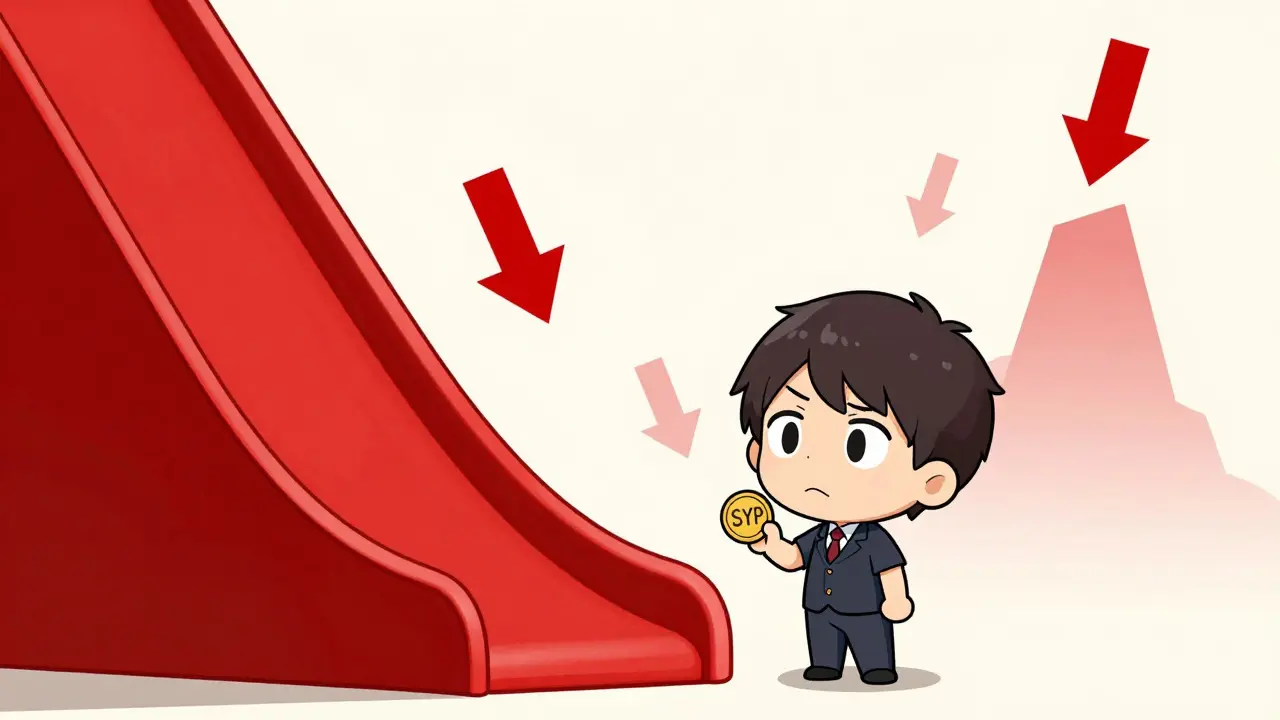
The price history is a cautionary tale. After hitting an all-time high of $0.1549, the token crashed nearly 99.88%, trading in the range of $0.000191 to $0.000222. For a regular investor, this means the asset is now in "penny stock" territory. Its market cap sits at a modest $12.4K, placing it far down the rankings compared to the giants of the crypto world.
| Attribute | Value |
|---|---|
| Blockchain Network | Solana |
| Max Supply | 1,000,000,000 SYP |
| All-Time High | $0.1549 |
| Avg. Transaction Fee | ~$0.002 USD |
| Primary Exchange | AscendEX |
Where Can You Trade SYP?
Liquidity is the most important thing for any trader. If there is no one to buy your coin, you are stuck with it. Currently, Sypool has a very concentrated liquidity profile. The vast majority of trading-about 99.63%-happens on AscendEX (formerly BitMax), specifically through the SYP/USDT pair.
If you prefer decentralized exchanges (DEX), you can find SYP on Raydium. While Raydium offers more pairs like SYP/SOL and SYP/USDC, the volume there is tiny compared to AscendEX. If you are trying to move a large amount of SYP, using a DEX might result in significant "slippage," where the price changes mid-trade because there aren't enough buyers to absorb your order.

Sypool vs. The Competition
Sypool isn't the first to try synthetic assets. It competes with heavy hitters like Synthetix and Mirror Protocol. The main difference is the infrastructure. Synthetix was built on Ethereum, which offers massive liquidity but can be slow and expensive. Sypool chooses the "speed lane" of Solana.
However, being on Solana is a double-edged sword. While it is faster, the Ethereum ecosystem is where most of the "big money" in DeFi resides. Sypool attempts to fix this with cross-chain compatibility, allowing assets from other blockchains to interact with its system. But without a massive surge in active users, these technical advantages don't always translate into price growth.
The Red Flags and Risks
It is important to be honest about the risks here. The most glaring issue is the lack of transparency. There is very little public information regarding the founding team, a detailed development roadmap, or active GitHub repositories. In the crypto world, "anonymous teams" are common, but they add a layer of risk, especially when the token price has dropped so significantly.
Furthermore, the extreme price decline over the last year-down nearly 70% against the USD and even more against Bitcoin-shows that investor confidence is low. When a coin underperforms Bitcoin and Ethereum by 80% or more, it usually indicates that the market is not seeing enough utility or growth to justify holding the asset.
Is Sypool Still Viable in 2026?
Whether Sypool can make a comeback depends on its ability to actually attract users. A tool that lets you manage synthetic assets is only useful if people are actually using it to hedge their portfolios or speculate on prices. Right now, the low market cap and concentrated trading suggest it is a niche project with limited traction.
If the team releases a concrete roadmap or introduces new, highly demanded synthetic assets, there could be a spark. But for most people, this is a high-risk, high-reward play. It's the kind of asset you treat as a speculative bet rather than a core part of a retirement portfolio.
What exactly is a synthetic asset in Sypool?
A synthetic asset is a digital token that mimics the value of another asset, such as a stock, commodity, or currency. For example, if you have a synthetic gold token in Sypool, its price will move up and down exactly like real gold, but you don't have to store a physical bar of gold in your house.
Is SYP a safe investment?
No investment in cryptocurrency is "safe," but SYP is considered high-risk. It has lost over 99% of its value from its all-time high and has very low liquidity compared to major coins. Only invest money you are completely comfortable losing.
How do I stake my SYP tokens?
Staking typically involves locking your tokens into the Sypool platform via a connected Solana wallet. In return for providing liquidity and supporting the network, you earn rewards in the form of additional SYP tokens.
Why is the price of SYP so low compared to its peak?
Several factors usually cause this: a lack of new user adoption, a decrease in interest in synthetic assets compared to other DeFi trends, and potential selling pressure from early investors or whales.
Can I use SYP on any wallet?
Since SYP is built on the Solana blockchain, you need a Solana-compatible wallet, such as Phantom or Solflare, to hold and manage your tokens.
Next Steps for Potential Users
If you are still interested in Sypool, don't just buy the coin. First, explore the platform's interface to see if the synthetic assets they offer are actually useful for your strategy. Check the current trading volume on AscendEX to ensure you can get in and out of your position without crashing the price.
For those who find Sypool too risky, you might want to look into more established synthetic platforms like Synthetix or explore other Solana-based DeFi projects with higher Total Value Locked (TVL) to get a feel for how the ecosystem behaves before diving into micro-cap tokens.



Arlen Medina
April 8, 2026 AT 14:31Absolute joke of a project. Imagine thinking a 99% drop is just a "cautionary tale" when it's clearly a dead coin. Real money is made in US-backed assets, not some Solana ghost town 🙄
Suvoranjan Mukherjee
April 10, 2026 AT 12:52The architecture leveraging Solana is actually quite brilliant for reducing latency and gas overhead! For those new to DeFi, synthetic assets essentially allow you to capture the delta of an underlying asset without the custodial friction. Just be mindful of the liquidity gaps on Raydium before you execute any large swaps 🚀
Bruce Micciulla Agency
April 12, 2026 AT 04:14look at the market cap 12k is basically a rounding error in any real portfolio and the fact that it is mostly on one exchange just means you are exit liquidity for whatever whale is still holding the bag while the team stays anonymous and hides their roadmap which is a classic red flag if i ever saw one in this space
Diana Martín Prieto
April 12, 2026 AT 23:04It is definitely a high-risk play, but for those looking to learn about synthetic mirrors, this is a great case study. I'd suggest focusing on the TVL trends across the whole Solana ecosystem first to see if there's a broader recovery happening!
JERRY ORTEGA
April 14, 2026 AT 05:10just chill and treat it as a gamble man... not worth stressing over a penny coin
Alexandra Lance
April 15, 2026 AT 08:34Oh honey, imagine actually believing the "team" exists 🤡 This has the fingerprints of a coordinated pump and dump all over it, likely run by a shadow group trying to divert attention from the real financial collapse. Good luck with your magic beans! ✨
david head
April 16, 2026 AT 22:15solana is the way 🚀🚀🚀
Suzanne Robitaille
April 17, 2026 AT 13:39There is something profoundly poetic about the way we chase digital ghosts of real gold. It speaks to a human longing for stability in a world that is increasingly fluid and ephemeral, yet we attempt to capture that stability through a line of code on a blockchain. It is a dramatic dance between the tangible and the virtual, isn't it?
Robert Coskrey
April 18, 2026 AT 18:12I agree with the assessment regarding liquidity; it is paramount. One must be extremely cautious when the vast majority of trading is concentrated on a single exchange, as it creates a significant single-point-of-failure risk!
Susan Payne
April 20, 2026 AT 08:20The lack of a public GitHub repository is simply inexcusable for a project claiming to be a "complete guide" to synthetic assets. It is a farce of the highest order to expect any sophisticated investor to put capital into a black box managed by ghosts.
Patty Levino
April 20, 2026 AT 19:15If you're feeling overwhelmed by the risk, maybe just stick to SOL or USDC for a bit. No one is judging you for playing it safe when the numbers look this scary.
Emily 2231
April 22, 2026 AT 08:28The anonymous teams are just a front for the globalist agenda to track every single cent we move using Solana's speed to keep us under a digital thumb no one is safe when the money is this invisible
Lauren Gilbert
April 23, 2026 AT 02:54I find myself wondering if the very nature of a synthetic asset is a reflection of our own detachment from reality, where the image of the gold becomes more tradeable and desirable than the metal itself, creating a loop of abstraction that eventually collapses under its own weight because there is no longer any anchor to the physical world we once understood.
Hugo Lopez
April 24, 2026 AT 01:52I think there's still a lot of potential for synthetic assets to help people diversify! 🌟 Let's hope the developers bring more transparency to the project soon. 😊
Taylor Meadows
April 25, 2026 AT 04:25Look at all of you pretending to be experts. You're all just gambling with money you don't have while pretending it's "investing." It's pathetic how people cling to these dying tokens just to feel like they're part of a club.
gladys christine
April 25, 2026 AT 11:24just keep pushing forward everyone!! the dips are where the magic happens sometimes just stay positive and keep learning the ways of the blockchain 🌈✨