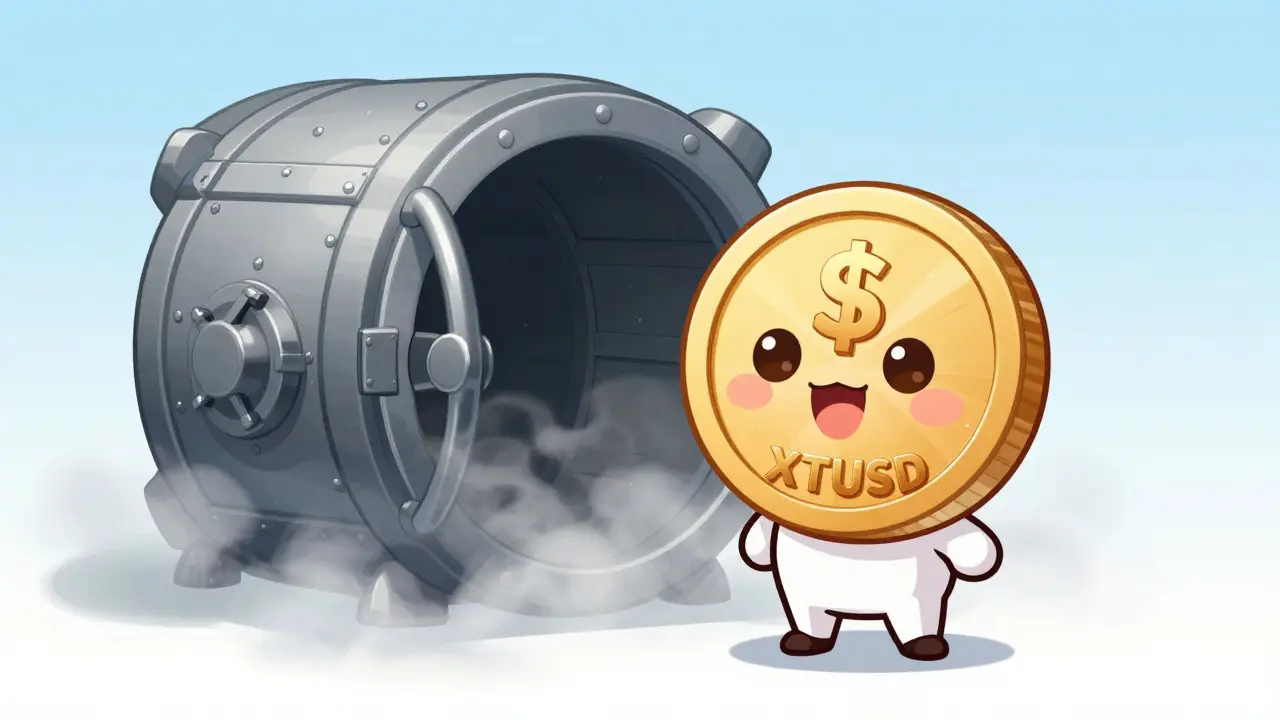
| Attribute | Value |
|---|---|
| Market Cap | $32.8 Million |
| Circulating Supply | 32,809,985 XTUSD (100%) |
| Blockchain Standard | ERC20 (Ethereum) |
| Price Range (1 Year) | $0.974 - $1.06 |
| Primary Trading Pair | XTUSD/USDT |
How XTUSD Works and Its Architecture
To understand XTUSD, you have to look at the XT.COM is a cryptocurrency exchange established in 2018, registered in Seychelles, with operational headquarters in Dubai ecosystem. XTUSD isn't a community-driven project; it is a corporate tool. It uses a "vault-minting" mechanism to create tokens, which in theory means that for every XTUSD in circulation, there is a dollar (or equivalent asset) held in a vault. Unlike MakerDAO is a decentralized organization that manages DAI, the first decentralized stablecoin using over-collateralized loans , which uses complex smart contracts to manage stability, XTUSD is far more centralized. It relies almost entirely on the trust you place in the XT.COM exchange. If you're using it, you aren't just betting on the stability of the dollar-you're betting on the solvency of the exchange.The Liquidity Trap: Where Can You Trade It?
One of the biggest red flags for any crypto asset is where it can be traded. If a coin is only available on one platform, you are essentially locked in. XTUSD is exclusively traded on the XT exchange. This creates a massive centralization risk. If XT.COM were to face regulatory hurdles or technical failures, your XTUSD holdings could become virtually impossible to liquidate instantly. Currently, the primary activity happens in the XTUSD/USDT pair. While the 24-hour volume fluctuates between $6.4 million and $10.5 million, this is tiny compared to the giants. For context, a high-liquidity stablecoin can handle billions in volume without moving the price. With XTUSD, a few large "whale" sell-offs could easily push the price away from its $1 peg, a phenomenon known as depegging.
The Reserve Transparency Problem
In the crypto world, "Trust me, bro" isn't a valid audit. Following the collapse of several high-profile projects in 2022, the industry moved toward rigorous, third-party monthly attestations. This is where Tether is the issuer of USDT, currently the most dominant stablecoin globally with over 60% market share and Circle is the issuer of USDC, known for high transparency and regulatory compliance in the US have set the bar. XTUSD doesn't meet this bar. Instead of an independent audit from a reputable accounting firm, it relies on self-reported daily reserve attestations. This means the exchange is essentially grading its own homework. Without a public audit trail for the $32.8 million in claimed reserves, holders are exposed to significant counterparty risk. If the reserves aren't actually there, the peg can collapse in minutes.Staking Rewards and the Yield Question
To keep users from leaving, XT.COM offers staking rewards for holding XTUSD. On the surface, getting paid to hold a "stable" asset sounds like a win. However, there is a catch: the Annual Percentage Yield (APY) is often undisclosed or opaque. When a platform doesn't clearly state where the yield comes from, you have to ask: Is this sustainable? If the rewards are paid out of new token emissions or unsustainable loans, the yield itself becomes a risk factor. High yields without clear collateral can put immense pressure on the peg if users decide to exit all at once to realize their profits.
Performance Analysis: Is the Peg Actually Stable?
If you look at a 24-hour chart, XTUSD looks like a flat line, usually hovering around $1.001. But if you zoom out to a full year, the cracks appear. The token has swung between $0.974 and $1.06. For a standard cryptocurrency, a 3% or 6% move is nothing. For a stablecoin, it's a crisis. A drop to $0.97 means a 3% loss of value-something that should never happen with a dollar-pegged asset. These deviations prove that the liquidity is shallow and the market's confidence in the reserves is shaky.| Feature | XTUSD | USDT / USDC |
|---|---|---|
| Reserve Audit | Self-Reported | 3rd Party Attestations |
| Exchange Access | XT.COM Only | Global / Multi-Exchange |
| DeFi Integration | Minimal | Extensive (Aave, Compound) |
| Market Dominance | ~0.0008% | ~68% (USDT) |
The Verdict: Should You Use It?
XTUSD serves a very specific purpose: it's a convenient tool for people already trading on XT.COM who want a local stablecoin to avoid constant conversions. If you are already deep in that ecosystem, it might be useful. However, for the average investor or someone looking for a safe haven for their capital, it fails several critical tests. The lack of third-party audits, the confinement to a single exchange, and the history of price deviations make it a high-risk choice compared to established alternatives. In a post-2022 market, transparency isn't a luxury-it's a requirement. Until XTUSD provides verified, independent proof of reserves, it remains a niche product with a significant risk profile.Is XTUSD safe to hold for long periods?
Holding XTUSD carries higher risk than industry leaders like USDC or USDT. The primary concern is the lack of independent third-party audits of its reserves, meaning you are relying entirely on the honesty of the XT.COM exchange. Additionally, because it is only traded on one exchange, you face liquidity risk if that platform encounters issues.
Why does the price of XTUSD occasionally deviate from $1?
Price deviations (depegging) happen when there is an imbalance between buying and selling pressure and not enough liquidity to absorb the trade. Because XTUSD has a small market cap and is limited to one exchange, a few large trades can push the price up or down, as seen in its yearly range of $0.974 to $1.06.
Can I use XTUSD in DeFi protocols like Aave or Uniswap?
Generally, no. XTUSD has very limited DeFi integration. Most decentralized finance protocols require high liquidity and verified reserves to accept a stablecoin as collateral. XTUSD remains largely confined to the XT.COM exchange environment.
What is the difference between XTUSD and USDT?
USDT (Tether) is a global standard traded on almost every exchange in the world with billions in liquidity. XTUSD is a niche stablecoin issued by XT.COM specifically for its own users. While both aim for a $1 peg, USDT has far more adoption, liquidity, and established (though still debated) reserve reporting.
How do I earn staking rewards with XTUSD?
Staking rewards for XTUSD are managed directly through the XT.COM exchange platform. Users can typically deposit their tokens into a staking pool to earn a percentage yield, although the exact APY is often not transparently listed, which is a point of concern for many analysts.


Ian Chait
April 19, 2026 AT 07:38Typical centrally managed trash. This whole thing smells like a massive exit scam waiting to happen. They're probably using a fraudulent algorythm to fake the peg while the insiders dump their bags on us. Just another way for the globalists to control the flow of digital cash before the Great Reset hits us all. Totaly rigged system!
Michelle Stanish
April 19, 2026 AT 15:29Actually seems fine if you just trade on the platform.
Sean Douglas
April 20, 2026 AT 20:41Oh my god, can we just talk about the absolute audacity of a "self-reported" audit? It is practically an invitation to a financial massacre! I am physically shaking thinking about the sheer level of incompetence and greed on display here. It is a breathtakingly bold attempt to deceive the masses, and the fact that people are still falling for this is just a tragic comedy of errors!
Abhinav Chaubey
April 21, 2026 AT 22:29Honestly, if you aren't using a domestic exchange or a global giant, you're just asking to lose your money. I've seen these niche coins a thousand times and they always end up as dust. XTUSD is just a corporate toy for a mid-tier exchange that doesn't have the clout to actually secure a real audit. Pathetic.
Adam Mann
April 23, 2026 AT 00:24It's always great to see new options coming into the space, even if they have some growing pains! I think we should remember that every big project started somewhere, and maybe XTUSD is just in its early phase of figuring out the best way to communicate with its users. If we provide constructive feedback and keep pushing for better standards, the whole industry moves forward together in a positive direction. It's all about the journey of innovation and learning how to trust the technology while we build a brighter future for everyone involved in the crypto movement, regardless of where they are in the world.
Alex Long
April 24, 2026 AT 21:50Imagine thinking this is an innovation. It's just a bad coin.
Sandeep Bhoir
April 26, 2026 AT 07:30Sure, a "convenient tool" for those who enjoy gambling with their rent money. The sarcasm is just dripping off the official pitch for this thing.
Gaurav Undirwade
April 26, 2026 AT 20:48It is an absolute travesty that individuals would venture into such a precarious financial instrument without the most rigorous scrutiny of its moral and fiscal foundations. One must possess a profound lack of discipline to trust a self-reported attestation in an era where transparency is the only acceptable standard of integrity. I find it deeply disturbing that some would even suggest this is a viable option for the prudent investor. It is a violation of the basic tenets of financial stewardship.
siddharth narula
April 28, 2026 AT 14:22Indeed, the pursuit of wealth without a foundation of truth is a hollow endeavor 🧘♂️. We must ask ourselves if the convenience of a local stablecoin outweighs the existential risk of a collapse. It is a classic dilemma of the modern age: speed versus stability. May we all seek a path of enlightened investment 🌟.
Chintu Parikh
April 30, 2026 AT 01:21I believe we can all find a middle ground here! While the risks are certainly present, there is a huge opportunity for XT.COM to step up and implement the transparency we all want. Let's encourage them to move toward third-party audits so that everyone can feel safe and motivated to grow their portfolios in this exciting ecosystem!
Mark Pfeifer
April 30, 2026 AT 10:26The most concerning part is the liquidity trap mentioned. Being locked into a single exchange for a stable asset completely defeats the purpose of having a portable digital dollar. If the exchange's API goes down or they hit a regulatory wall, the asset is effectively frozen.
Mike Kempenich
May 1, 2026 AT 05:52I'm sure the team behind this is just working through the kinks. Every platform has its hurdles at the start, and they'll likely fix the transparency issues as they scale up.
Jeff Barlett
May 1, 2026 AT 12:09Oh please, it's not "kinks," it's a red flag the size of a billboard! Why is everyone pretending this isn't a disaster waiting to happen? It's actually hilarious how some people are still optimistic about a coin that can't even keep its own peg for a year. Absolute chaos!
Michael Harms
May 2, 2026 AT 04:04Hey, let's keep it positive! If you're new to the scene, just start with small amounts and learn the ropes. There's a lot of great info out there to help you navigate these risks safely.
Keri Pommerenk
May 3, 2026 AT 03:06definitely a good heads up for anyone thinking about it i think sticking to the big ones is safer for now
Tracy Sperandio
May 4, 2026 AT 09:33This is a total snooze-fest of a token! Give me something with some real fire and explosive growth, not some stale, corporate-issued digital dollar that's barely keeping its head above water! Let's see some real volatility or just stick to the heavy hitters!
Robert Preston
May 5, 2026 AT 15:49From a technical perspective, the reliance on a vault-minting mechanism without external verification is a massive single point of failure. If you're planning to use this, make sure you're not holding more than you're willing to lose instantly during a liquidation event.
Evan Iacoboni
May 7, 2026 AT 13:26The peg variance between $0.97 and $1.06 is absolutely insane for a stablecoin.
Luke George
May 7, 2026 AT 18:07They aren't showing the receipts because there are no receipts. It's a ghost in the machine. The Dubai headquarters is just a shell for the real players who are probably moving the money into offshore accounts before the bubble bursts. I've seen this pattern in a dozen other shadow-coins.
Yuhan Mo
May 8, 2026 AT 11:02The slippage on that XTUSD/USDT pair must be quite significant during high-volatility periods given the market cap. It is a textbook example of low-depth liquidity providing a poor experience for larger traders.
nathan jones
May 8, 2026 AT 11:57just seems like another exchange coin trying to lock people in
Andrew Southgate
May 10, 2026 AT 11:04I've always found that when you dive deep into the mechanics of these exchange-backed tokens, the risk usually outweighs the reward, but it's a great learning experience for anyone trying to understand how market makers operate. If you take the time to analyze the order books and watch the price movements relative to the overall market, you can start to see why the lack of third-party audits is such a critical failure point. It really comes down to whether you trust the platform's internal accounting more than you trust an independent auditor, which, in my professional opinion, is a gamble that rarely pays off in the long run for the retail user.
Karen Mogollon Gutierrez
May 11, 2026 AT 07:43The sheer audacity of offering an undisclosed APY is a scandal of the highest order! How can any reputable entity expect users to commit capital to a black box of rewards? It is a theatrical performance of financial stability while the actual substance is completely missing from the stage!
Vicky Duffala
May 11, 2026 AT 12:48We should look at this as a catalyst for better regs! 🚀 If we keep talking about these gaps in transparency, we'll eventually push the whole industry to a place where every single coin has to prove its reserves. Let's turn this risk into a lesson for the next generation of DeFi! ✨
Ankit Sindhu
May 12, 2026 AT 16:25I suggest anyone currently holding these tokens to carefully evaluate their exit strategy. It's better to be safe and migrate to a more liquid asset now than to be stuck when the volatility spikes.