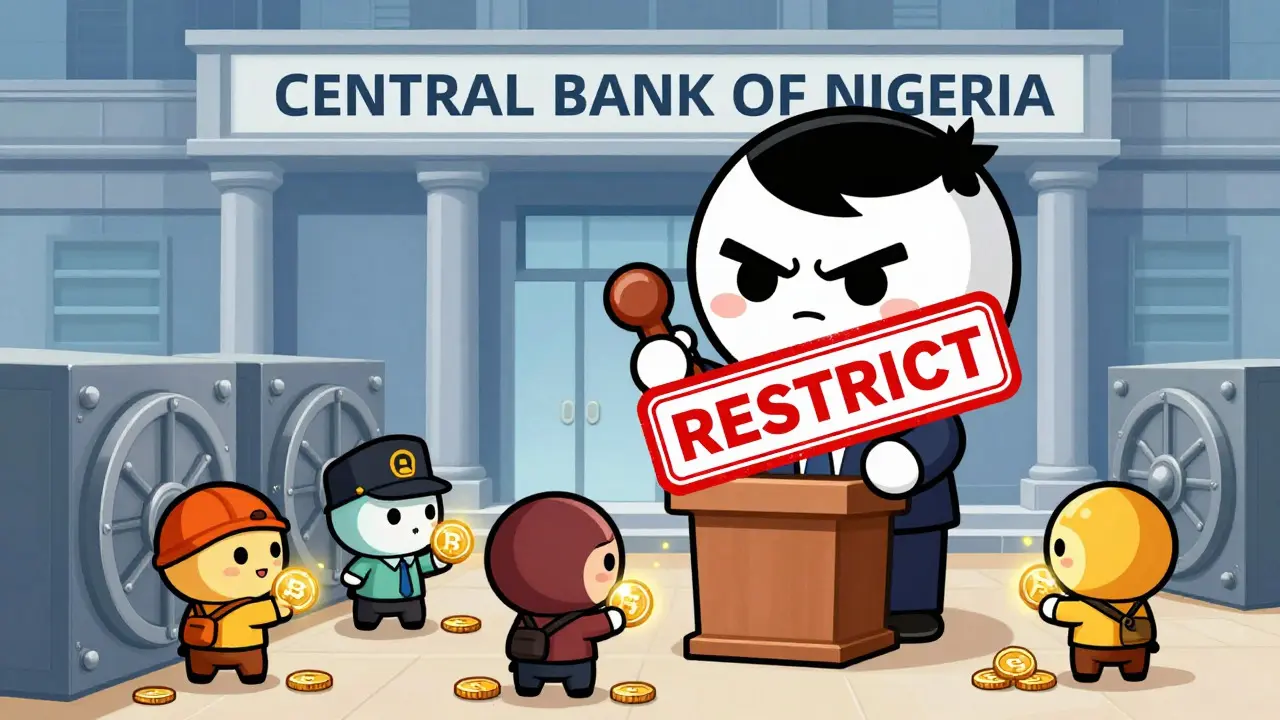
Imagine telling your bank to close the accounts of anyone trading Bitcoin. That is exactly what the Central Bank of Nigeria did in early 2021. It was a blunt instrument meant to crush the cryptocurrency sector. Eight years later, after a dramatic U-turn, the same institution now allows banks to service licensed crypto firms. This shift from hostility to accommodation defines the modern Nigerian digital asset landscape.
The story of Nigeria's crypto policy is not just about money; it is about control, resilience, and the limits of centralization. For investors, traders, and businesses operating in West Africa, understanding this timeline is critical. The rules have changed so rapidly that advice given in 2022 is often obsolete by 2024. Here is how the regulatory environment evolved, why it shifted, and what it means for you today.
The Early Warnings: 2017 Circulars
The first major move came on January 12, 2017. The CBN issued a circular to banks and financial institutions regarding virtual currency operations. At the time, Bitcoin was still relatively new to mainstream Nigerian finance. The directive instructed banks to avoid using, holding, or transacting in virtual currencies. It also required them to implement strict anti-money laundering (AML) controls for existing customers who were already involved in crypto exchanges.
This was not a total ban on individuals owning coins. Instead, it targeted the banking infrastructure. By cutting off access to traditional financial rails, the CBN hoped to slow down adoption. However, Nigerians are resourceful. As bank channels tightened, peer-to-peer (P2P) trading began to rise. Traders started swapping Naira directly for stablecoins like USDT without needing a bank intermediary. This grassroots adaptation set the stage for future conflicts between regulators and the market.
The Crackdown Intensifies: 2021 Letter
By February 2021, the patience of the regulator had worn thin. On February 5, 2021, the CBN sent a letter to all Deposit Money Banks and Non-bank Financial Institutions. The message was clear: stop facilitating cryptocurrency payments. Banks were ordered to identify and close accounts belonging to entities involved in crypto transactions or operating exchanges.
This action effectively excluded legitimate crypto businesses from the formal banking system. If you ran an exchange, you couldn't open a corporate account. If you were a large trader, your personal account was at risk. The impact was immediate. Major global players felt the squeeze. Binance, one of the world's largest exchanges, eventually removed the Naira from its platform. Other firms scaled back operations or moved entirely offshore. The official channel was shut, but the underground P2P market exploded in volume, proving that banning the pipe doesn't stop the water.
Parallel Regulation: The SEC Steps In
While the CBN focused on banking restrictions, another regulator was watching. The Securities and Exchange Commission (SEC) released a statement on September 14, 2020, declaring its intent to regulate digital assets that exhibited characteristics of investments under the Investments and Securities Act 2007. This created a dual-track approach. The CBN controlled the banks, while the SEC prepared to oversee the securities aspect of crypto.
An inter-agency committee was formed to bridge the gap between these two bodies. They recognized that virtual currencies were complex instruments that didn't fit neatly into old boxes. While the CBN remained skeptical, the SEC began laying the groundwork for a more structured framework. This collaboration would eventually lead to the most significant policy change in recent history.

The Turning Point: 2023 VASP Guidelines
In December 2023, the tide turned completely. The CBN issued Virtual Asset Service Provider (VASP) Guidelines. This document marked a 180-degree shift. For the first time, banks were permitted to offer accounts and services to cryptocurrency businesses, provided those businesses were licensed by the SEC.
This was a pragmatic admission. The government realized that prohibition was ineffective against decentralized technology. By allowing licensed entities to operate within the banking system, the state could monitor flows, enforce AML/KYC standards, and collect data. The term "Virtual Asset Service Provider" became the key legal status for any company wanting to do business in Nigeria legally. It signaled that the era of informal, unregulated trading was ending, replaced by a framework of compliance and oversight.
Current Framework: Legal but Controlled
As of 2025, the regulatory landscape is defined by the passage of the Investments and Securities Act 2025. This law formally recognizes certain cryptocurrencies as securities under SEC authority. To operate legally, firms must obtain a license from the SEC and adhere to its Digital Assets Rules. These rules represent the first comprehensive attempt to regulate digital assets in Nigeria.
The requirements are strict. Companies must comply with robust Know Your Customer (KYC) and Anti-Money Laundering (AML) measures. This aligns with Nigeria's goal of being removed from the Financial Action Task Force (FATF) Gray List, which tracks countries with weak AML frameworks. For investors, this means higher trust but also higher barriers to entry for shady operators. The days of anonymous, unchecked trading are over. The market is now professionalized.
| Year | Key Event | Regulatory Stance | Market Impact |
|---|---|---|---|
| 2017 | CBN Circular on Virtual Currency Operations | Restrictive / Warning | Banks advised to avoid crypto; P2P trading begins to grow. |
| 2021 | CBN Letter to Banks | Hostile / Prohibitive | Bank accounts closed for crypto users; major exchanges withdraw Naira pairs. |
| 2020 | SEC Statement on Digital Assets | Regulatory Preparation | Establishes SEC jurisdiction over investment-grade digital assets. |
| 2023 | VASP Guidelines Issued | Accommodative / Permissive | Banks can service licensed VASPs; legal path established. |
| 2025 | Investments and Securities Act Passed | Formal Recognition | Crypto classified as securities; strict KYC/AML enforced. |

Why Did the Policy Change?
You might wonder why the CBN reversed course so sharply. Several factors played a role. First, the sheer size of the Nigerian crypto market made it impossible to ignore. With millions of active users, banning the asset class only pushed activity underground, where it was harder to tax and monitor. Second, the failure of the 2021 crackdown to stop trading proved that technological decentralization outpaced regulatory reach. Third, global pressure from bodies like the FATF pushed Nigeria to strengthen its AML framework, which is easier to achieve through regulation than prohibition.
Additionally, the 2020 civil unrest highlighted the utility of crypto. When bank accounts of protesters were suspended, many turned to cryptocurrency donations. This demonstrated that crypto served as a parallel financial system, resilient to state intervention. Recognizing this, the government decided it was better to harness the system rather than fight it.
Challenges and Risks Remain
Despite the positive shift, tensions persist. In 2024, the government blamed crypto traders for foreign exchange market volatility, showing that monetary control remains a priority for the CBN. The line between supporting innovation and maintaining stability is thin. Investors must stay vigilant. Regulatory clarity helps, but enforcement can be inconsistent. Always verify that any exchange or wallet provider you use holds a valid SEC license. Unlicensed platforms remain vulnerable to sudden shutdowns or legal disputes.
Furthermore, the high compliance costs associated with the new VASP guidelines may price out smaller local startups. This could consolidate the market around a few large, well-capitalized players. While this increases safety, it may reduce competition and choice for end-users. Understanding these dynamics is essential for navigating the current environment.
Frequently Asked Questions
Is cryptocurrency banned in Nigeria in 2025?
No, cryptocurrency is no longer banned. Since the 2023 VASP Guidelines and the 2025 Investments and Securities Act, crypto assets are recognized as securities regulated by the SEC. Individuals can trade freely, and businesses can operate if they hold the proper licenses.
Who regulates cryptocurrency in Nigeria?
The primary regulator is the Securities and Exchange Commission (SEC), which oversees Virtual Asset Service Providers (VASPs). The Central Bank of Nigeria (CBN) works alongside the SEC to ensure banks comply with regulations when servicing these firms. Both agencies collaborate on AML and KYC enforcement.
What is a VASP in Nigeria?
VASP stands for Virtual Asset Service Provider. It is the legal classification for companies that facilitate crypto transactions, such as exchanges, custodians, and brokers. To operate legally in Nigeria, these firms must obtain a license from the SEC and adhere to specific digital asset rules.
Can I use my bank account to buy crypto now?
Yes. Under the 2023 guidelines, banks are allowed to provide accounts and services to licensed VASPs. You can transfer funds from your bank account to a licensed exchange to purchase crypto. However, always ensure the exchange is SEC-licensed to avoid account closure risks.
Why did the CBN change its policy in 2023?
The CBN shifted from restriction to accommodation because prohibition proved ineffective. The massive growth of the P2P market showed that Nigerians would continue trading regardless. Regulating the industry allowed the government to monitor flows, enforce AML standards, and potentially improve its standing with international bodies like the FATF.