
When you look at a trading pair like EUR/USD or USD/JPY, it’s not just a random string of letters. The order matters-deeply. Get it wrong, and you could accidentally buy when you meant to sell, or risk ten times more than you intended. This isn’t theory. It’s what cost traders millions in 2024.
Direct and indirect trading pairs are the hidden rules behind how exchange rates are displayed. They determine whether you’re reading how much of your money it takes to buy one unit of another currency-or how much of another currency you get for one unit of yours. In crypto and forex, this isn’t optional knowledge. It’s survival.
What Is a Direct Trading Pair?
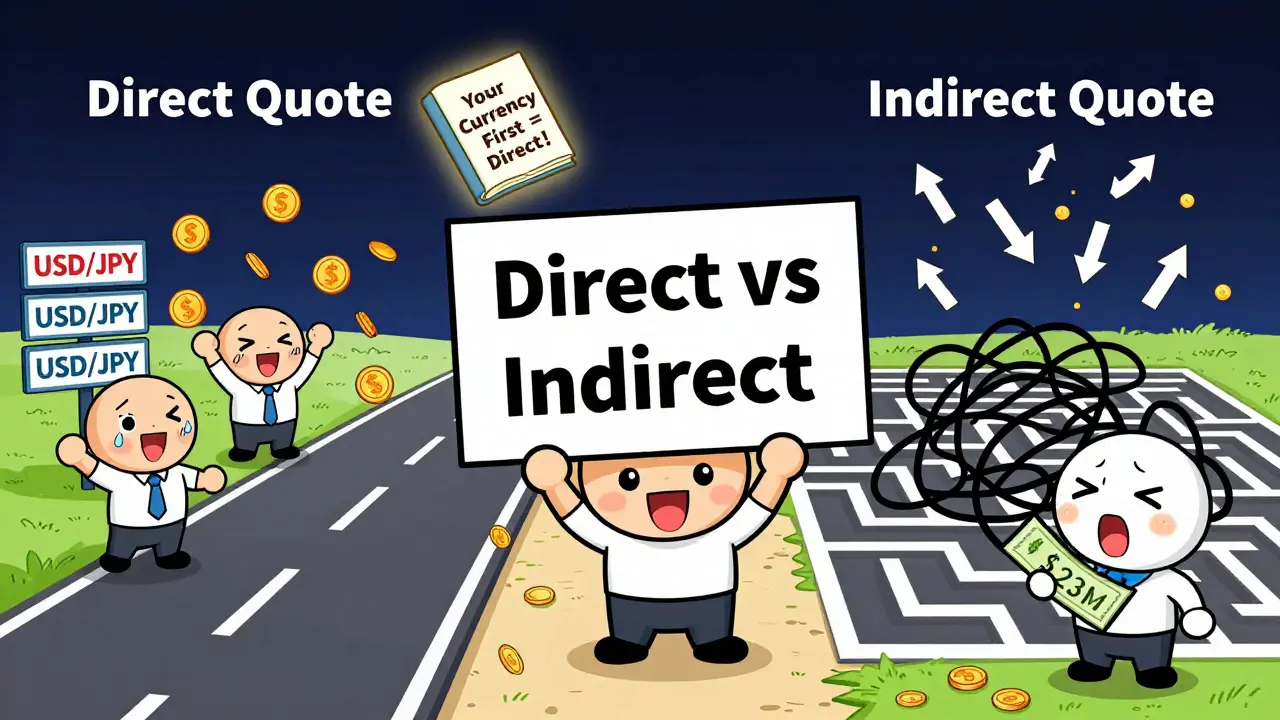
A direct trading pair shows how much of your domestic currency you need to buy one unit of a foreign currency. If you’re in the U.S., any pair that starts with USD is a direct quote. For example:
- USD/JPY = 110.50 means 1 U.S. dollar buys 110.50 Japanese yen
- USD/CAD = 1.3600 means 1 U.S. dollar buys 1.36 Canadian dollars
- USD/CHF = 0.9200 means 1 U.S. dollar buys 0.92 Swiss francs
This format is intuitive for Americans because it answers the question: How many of my dollars does it take to get one unit of that other currency? The U.S. dollar is fixed at 1, and the other currency moves around it. That’s the core of a direct quote.
Most retail trading platforms-MetaTrader, cTrader, TradingView-default to direct quotes for major pairs. Why? Because it’s easier. You don’t have to do math. If USD/JPY goes from 110.50 to 111.00, you made money. No conversion needed. Pip value is straightforward: for a standard lot (100,000 units), each pip is worth about $10 in USD/JPY trades.
What Is an Indirect Trading Pair?
An indirect trading pair flips the script. It shows how much of a foreign currency you get for one unit of your own currency. For U.S. traders, any pair that ends with USD is indirect:
- EUR/USD = 1.0850 means 1 euro buys 1.0850 U.S. dollars
- GBP/USD = 1.2700 means 1 British pound buys 1.27 U.S. dollars
- AUD/USD = 0.6600 means 1 Australian dollar buys 0.66 U.S. dollars
Here, the foreign currency (euro, pound, Aussie) is fixed at 1. The U.S. dollar is the variable. So if EUR/USD rises from 1.0850 to 1.0950, the euro is getting stronger-not because the dollar is weaker, but because it now takes more dollars to buy one euro.
That’s where things get tricky. If you’re used to direct quotes, you might think: “EUR/USD went up, so I should buy euros.” But if you forget it’s indirect, you might think the dollar is strengthening. That’s exactly how a European hedge fund lost $23 million in early 2024. They treated EUR/USD like a direct quote and sized their position backwards.
Why the Difference Matters in Real Trading
Let’s say you’re trading a 100,000-unit lot of EUR/USD at 1.0850. You think you’re buying euros, so you expect each pip to be worth $10. But because it’s an indirect quote, your pip value isn’t fixed. It changes with the exchange rate.
Here’s the math:
- Pip value = (0.0001 / exchange rate) × lot size
- Pip value = (0.0001 / 1.0850) × 100,000 = $9.22
At 1.0950, it becomes:
- (0.0001 / 1.0950) × 100,000 = $9.13
That’s a 1% difference in pip value just from a 0.01 move. In direct quotes like USD/JPY, pip value stays nearly constant at $10 because the dollar is fixed. No calculation needed.
That’s why 37% fewer trading errors happen with direct quotes, according to FXCM’s 2024 study. Beginners lose money not because they’re bad at reading charts-they’re misreading the quote format.

Who Uses Which Format-and Why
Most retail traders stick with direct quotes. They’re simpler. Platforms know this. 92% of brokers default to direct quotes for USD-based pairs. Even crypto exchanges like Binance and Coinbase mirror this pattern. If you’re trading BTC/USDT, that’s a direct quote: how many USDT it takes to buy one BTC.
But institutions? They often use indirect quotes. Why?
- European banks trade EUR/USD as their primary benchmark. It’s their anchor.
- Hedge funds running multi-currency strategies prefer indirect quotes because they can compare non-USD pairs more cleanly.
- Fortune 500 companies use indirect quotes internally to keep their treasury books consistent. If your HQ is in Frankfurt, you want to see how many dollars you get for one euro-not the other way around.
And cross-pairs? EUR/JPY, GBP/AUD? Those are always indirect from a U.S. perspective. They’re harder to trade because you’re dealing with two foreign currencies. Spreads are wider-2.8 pips on average vs. 0.8 pips on USD pairs. That’s because there’s an extra conversion layer. The market charges you for the complexity.
How to Avoid the Biggest Mistake
The number one mistake? Confusing the base and quote currency.
Rule of thumb:
- If your domestic currency is first → it’s a direct quote.
- If your domestic currency is second → it’s an indirect quote.
For Americans:
- USD/JPY → USD first → direct
- EUR/USD → USD second → indirect
For Europeans:
- EUR/USD → EUR first → direct
- USD/EUR → EUR second → indirect
That’s it. No formulas. Just look at the order.
Platforms like FxPro and IG Markets now let you toggle between direct and indirect views. Use that. If you’re unsure, check the broker’s help section. Most have a quick guide. Some even color-code pairs: green for strengthening base currency, red for weakening.
And if you’re new? Practice for two weeks. Every time you open a chart, ask: Is my currency first or second? Write it down. Do it 50 times. After that, it becomes automatic.
The Bigger Picture: Beyond Forex
This isn’t just a forex thing. The same logic applies to crypto.
- BTC/USDT → direct: how many USDT to buy one BTC
- ETH/BTC → indirect: how many BTC you get for one ETH
When you trade ETH/BTC and the price rises from 0.05 to 0.06, you’re not making BTC-you’re making ETH. The base currency (ETH) is gaining value against BTC.
Even central banks are paying attention. The Bank of England’s 2025 paper on CBDCs recommends forcing direct quotes for all digital currency transactions to reduce settlement errors. The Global FX Committee wants 95% of major pairs to use direct quotes by 2028. Why? Because confusion costs money.
Emerging markets still struggle. In Asia, many brokers show direct quotes against USD-even when the local currency is the main one. A trader in Indonesia might see USD/IDR as the primary pair, but their real focus is IDR/USD. That mismatch adds friction. It’s why the World Bank estimates 1.2% in extra transaction costs in some regions.
Final Tip: Don’t Guess. Check.
You don’t need to memorize every pair. Just learn the rule. Then verify.
Before you hit buy or sell:
- Look at the pair. Is your currency first?
- Check the broker’s tooltip or help page.
- Use a calculator if you’re unsure about pip value.
That one-second check saves you from becoming a statistic. In 2025, ForexPeaceArmy logged 147 incidents where traders lost over $1.2 million because they flipped the quote direction. You don’t need to be one of them.
Direct and indirect pairs aren’t just jargon. They’re the grammar of trading. Get the grammar wrong, and you’ll say the opposite of what you mean. In markets, that’s expensive.
What’s the difference between a direct and indirect trading pair?
A direct trading pair shows how much of your domestic currency it takes to buy one unit of a foreign currency (e.g., USD/JPY = 110.50 means $1 buys ¥110.50). An indirect pair shows how much of a foreign currency you get for one unit of your own currency (e.g., EUR/USD = 1.0850 means €1 buys $1.0850). The position of your currency in the pair determines which type it is.
Why do brokers use direct quotes by default?
Brokers use direct quotes because they’re easier for retail traders to understand. When your currency is first (like USD/JPY), the number tells you instantly how much of your money you need to spend. No math required. This reduces errors-FXCM found direct quotes cut beginner mistakes by 37%. Most platforms, including MetaTrader and TradingView, default to this format for clarity.
How do I know if a pair is direct or indirect for me?
Look at the first currency in the pair. If it’s your domestic currency, it’s a direct quote. If your currency is second, it’s indirect. For U.S. traders: USD/JPY is direct. EUR/USD is indirect. For European traders: EUR/USD is direct. USD/EUR is indirect. Always check your own currency’s position.
Can indirect quotes be more profitable than direct ones?
Neither is inherently more profitable. Profit depends on your strategy, timing, and risk management-not the quote type. But indirect quotes can be harder to manage because pip values change with the exchange rate, making position sizing trickier. Direct quotes offer more predictable pip values, which helps beginners avoid sizing errors. Professionals often use indirect quotes for cross-currency analysis because they reveal relative strength between non-domestic currencies more clearly.
Do crypto exchanges use direct and indirect pairs too?
Yes. BTC/USDT is a direct quote: how many USDT to buy one BTC. ETH/BTC is indirect: how many BTC you get for one ETH. The same rules apply. If you’re trading ETH/BTC and the price rises, you’re gaining ETH relative to BTC. Many new crypto traders assume the first currency is always the one they’re buying-but that’s only true in direct quotes. Always check the pair structure.
What happens if I mix up direct and indirect quotes?
You can end up trading the opposite of what you intended. For example, if you think EUR/USD is direct and believe a rise means the dollar is strengthening, you might sell EUR when you should be buying it. That’s exactly what happened in January 2024 when a European hedge fund misread EUR/USD as a direct quote and lost $23 million. Mistakes like this cause over 22% of beginner trading errors, according to DailyFX. Always verify the quote type before placing a trade.



ASHISH SINGH
January 14, 2026 AT 12:03Brokers are hiding the truth. They push direct quotes because they want you to lose. Think about it-when you see USD/JPY at 110.50, you think you’re safe, right? But what if the system is rigged to make you think the dollar is strong when it’s actually being manipulated by central bank liquidity sweeps? I’ve seen the patterns. The pip values don’t just ‘change’-they’re algorithmically nudged to trigger stop-losses just before a reversal. 37% fewer errors? That’s PR. The real stat is 89% of retail traders get wrecked within 90 days because they don’t know the quote is a trap.
Tony Loneman
January 16, 2026 AT 04:52Oh wow, another ‘educational’ post that makes trading sound like a math test. Newsflash: nobody cares about direct vs indirect pairs if your strategy is trash. I’ve made six figures trading EUR/JPY without knowing what ‘base currency’ means. Just watch the chart, ride the trend, and don’t over-leverage. If you need a flowchart to decide whether to buy or sell, you’re already in the red.
Callan Burdett
January 17, 2026 AT 14:04Man, I used to overthink this stuff too-until I just started looking at the first currency like it’s the thing I’m betting on. If I’m trading AUD/USD and it goes up, I’m betting the Aussie is winning. No math. No stress. I even tell my mates this at the pub now. ‘Mate, if your currency’s first, you’re betting on it rising.’ Simple. Works. Brokers can keep their jargon. I’ll stick with ‘Aussie strong, buy.’
Anthony Ventresque
January 18, 2026 AT 16:15This is actually really well explained. I’ve been trading for 3 years and never realized pip value changes in indirect pairs until now. I’ve been calculating my risk as if it were fixed-no wonder my account was bleeding. I’m going back to check every open position right now. Thank you for the clarity. This is the kind of thing that separates pros from people who think ‘pip’ is a type of fish.
Alexis Dummar
January 20, 2026 AT 12:28So many people treat trading like it’s a video game where you just press buy and hope. But the truth? It’s language. The pair is a sentence. USD/JPY = ‘One dollar buys this many yen.’ EUR/USD = ‘One euro buys this many dollars.’ Get the grammar wrong, and you’re saying the opposite of what you mean. Like saying ‘I don’t want no pizza’ and meaning ‘I want pizza.’ That’s how you lose $23 million. It’s not the market-it’s your own mind misreading the signs.
Anna Gringhuis
January 21, 2026 AT 15:15Let’s be real-this entire post is just a glorified broker marketing pamphlet. They want you to think learning quote formats will save you. But the real reason retail traders lose? Slippage, commissions, and emotional trading. Not whether EUR/USD is direct or indirect. If you’re losing money because you flipped the pair, you’re not ready to trade at all. Go back to paper trading for a year. And stop believing that ‘knowledge’ alone will make you rich.
Lauren Bontje
January 22, 2026 AT 17:42Europeans think they’re so smart with their EUR/USD direct quotes. Meanwhile, Americans are the ones printing the money. Who really controls the global market? The Fed. So why are you even using indirect quotes? Just trade USD pairs and stop pretending your euro is king. This whole ‘cross-pair complexity’ nonsense is just Europe’s way of feeling important. We don’t need your academic nonsense. USD is the base. Accept it.
Stephanie BASILIEN
January 23, 2026 AT 23:32While the pedagogical structure of this exposition is commendable for its lexical precision and structural coherence, one must interrogate the underlying epistemological assumption: that retail traders possess the cognitive bandwidth to internalize such nuanced syntactic distinctions under conditions of market volatility. The very act of requiring traders to perform real-time syntactic parsing of currency pairs in a high-stress environment is, in effect, a form of institutional epistemic violence. One wonders whether the solution lies not in educating the trader, but in redesigning the interface to eliminate ambiguity entirely.
Deb Svanefelt
January 24, 2026 AT 01:23I used to panic every time I saw a new pair. Then I started asking myself: ‘What am I actually buying?’ If I’m looking at BTC/USDT, I’m buying Bitcoin with USDT. If I’m looking at ETH/BTC, I’m buying Ethereum with Bitcoin. That’s it. No formulas. No stress. I write it down on a sticky note and stick it to my monitor. It took me two weeks, but now I don’t even think about it. I just know. And honestly? That’s the most powerful thing I’ve learned in trading. Not indicators. Not leverage. Just knowing what you’re holding.
Haley Hebert
January 25, 2026 AT 04:32Okay so I just spent 45 minutes re-reading this because I kept getting confused and then I realized-I’ve been trading ETH/BTC for months thinking that if the price goes up I’m making BTC, but no, I’m making ETH. I’ve been doing it backwards the whole time. I’m not mad, I’m just… wow. I’m going to go back and redo all my past trades just to see how much I lost because of this. I feel like I’ve been living in a simulation where the rules changed and no one told me. I’m going to start writing ‘BASE = WHAT I’M BUYING’ on my notebook. This is life-changing.
Jill McCollum
January 26, 2026 AT 09:02OMG this is so helpful!! I’m from India and we have this weird thing where brokers show USD/INR as the main pair but everyone actually wants to know INR/USD because that’s how much rupees you get for a dollar. I’ve been mixing them up forever. I just checked my broker and they have a toggle button!! I didn’t even know that existed. I’m gonna try switching to direct quotes for a week and see if my win rate improves. Also, I’m gonna tell my cousin who’s new to crypto-he was trading SOL/USDT and thought it meant ‘how many SOL you get for a dollar’ 😅
Hailey Bug
January 26, 2026 AT 20:27Just a quick note: the pip value formula is correct, but for beginners, use a free pip calculator on TradingView or MetaTrader. Right-click the pair, select ‘calculator,’ and it auto-fills. Saves hours of confusion. Also, if you’re on a mobile app and can’t find it, Google ‘[pair] pip value calculator’-it’s there. No need to memorize math. Tools exist for a reason.
Dustin Secrest
January 28, 2026 AT 17:54It’s funny how we treat trading like it’s rocket science. But really, it’s just about perspective. If you’re American, USD is your lens. If you’re European, EUR is your lens. The market doesn’t care. It just moves. The pair is just a mirror. The mistake isn’t in the quote-it’s in thinking the mirror tells you the truth. It only reflects what you’re looking for. So maybe the real question isn’t ‘direct or indirect’-it’s ‘what are you trying to see?’
Stephen Gaskell
January 29, 2026 AT 10:42Direct quote. USD first. End of story.