If you’ve ever tried to trade crypto on Kraken and got blocked, you’re not alone. The exchange doesn’t randomly shut people out - it follows a strict, complex map of legal restrictions that change constantly. As of early 2026, Kraken blocks trading in at least 14 countries entirely and imposes dozens of state- and asset-specific rules across dozens more. This isn’t about limiting users. It’s about survival. Kraken operates in over 190 countries, but it only stays open in those places by obeying local laws - even when those laws are messy, conflicting, or constantly changing.
Where Kraken Completely Blocks Trading
Kraken won’t let you open an account or trade anything if you’re in one of these sanctioned countries: Afghanistan, Belarus, Cuba, Iran, Iraq, North Korea, Syria, Libya, Sudan, South Sudan, Democratic Republic of the Congo, Russia (including Crimea, Donetsk, and Luhansk), and the Central African Republic. These are not arbitrary choices. They’re dictated by U.S. Treasury sanctions and global anti-money laundering rules enforced by FinCEN, the EU, and the UN.
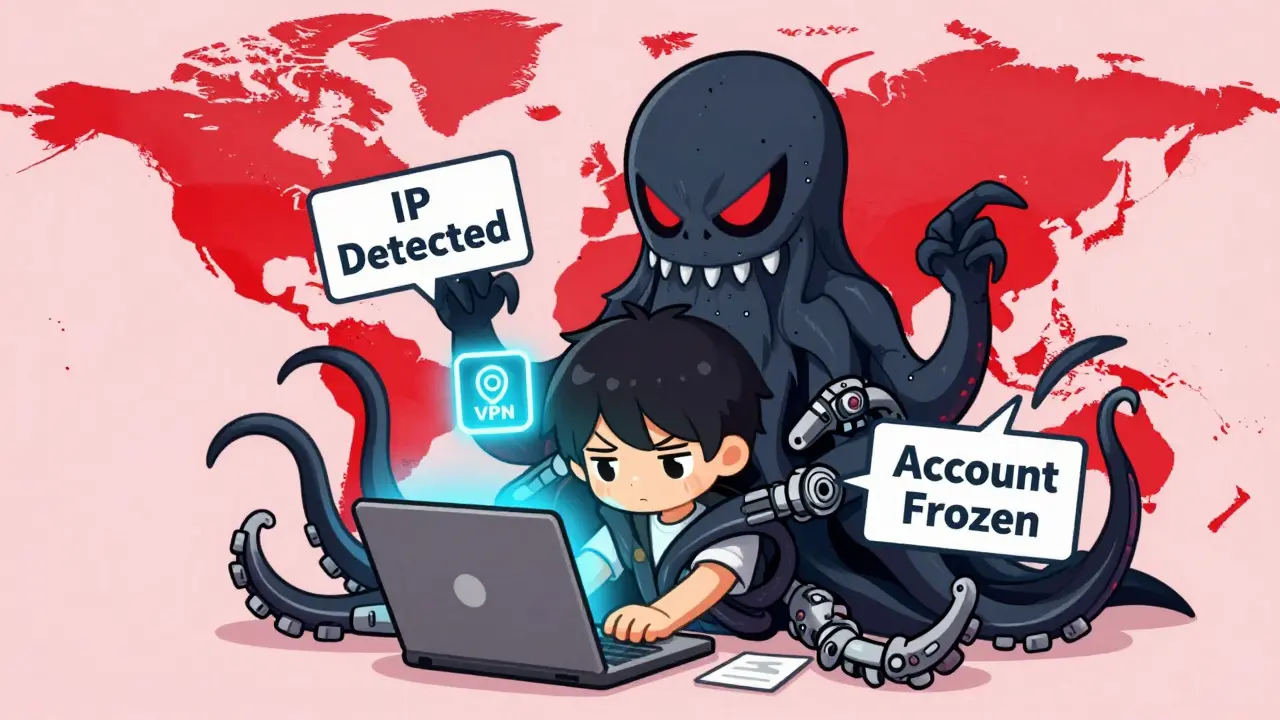
Even if you have a VPN and a fake ID, Kraken’s systems catch you. The platform uses real-time IP tracking, device fingerprinting, and document verification to detect location spoofing. If you’re caught trying to bypass these blocks, your account gets frozen - and your funds stay locked until you prove you’re in a permitted region. There’s no appeal. No warning. Just silence.
U.S. Residents: A Patchwork of Bans
The United States is the biggest market for Kraken - but also the most complicated. Kraken doesn’t treat all U.S. states the same. Here’s what you can’t do depending on where you live:
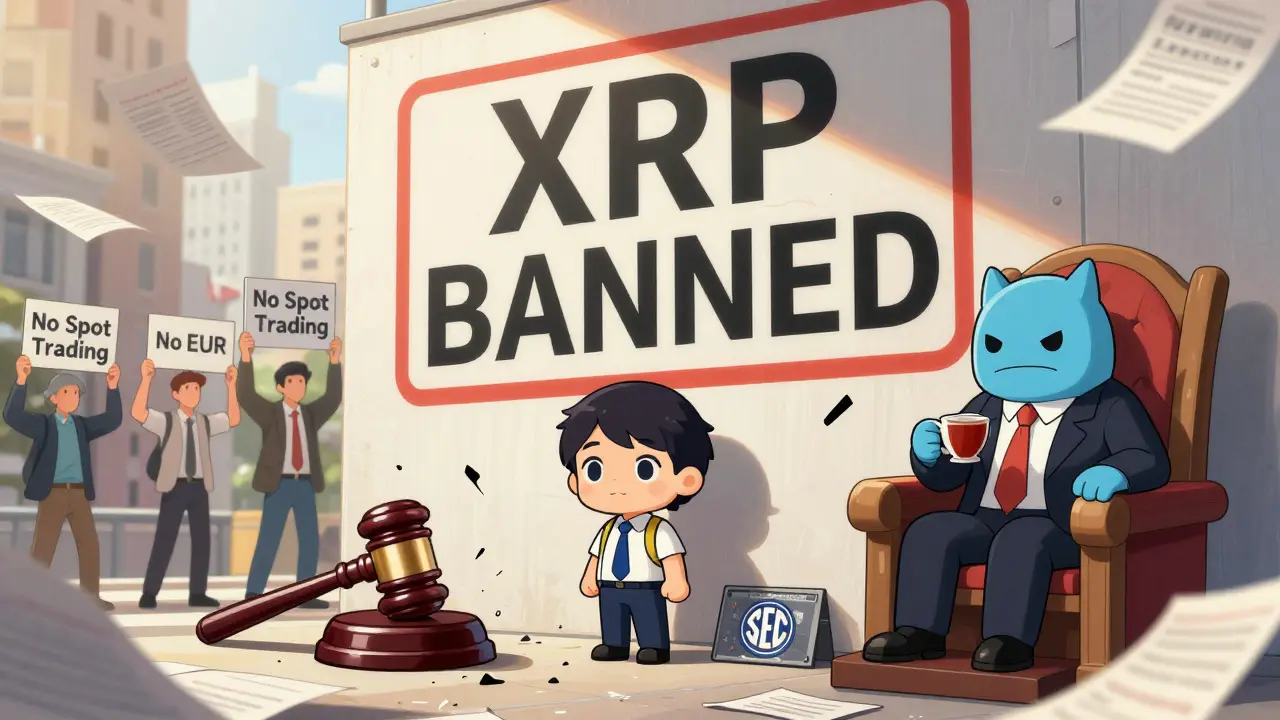
- All U.S. residents: Cannot trade XRP. This has been true since the SEC’s 2020 lawsuit against Ripple. Even if you bought XRP before, you can’t sell it on Kraken.
- New York and Washington State: No access to spot trading. Only pre-verified accounts are allowed, and even those are on hold pending regulatory approval.
- New Hampshire and Texas: You can’t hold, fund, or trade in EUR. That’s right - even if you have euros in your bank account, Kraken won’t let you convert them.
- All U.S. and Canadian users: Can’t trade EWT, GRT, or FLOW tokens. These were delisted after regulatory pressure from the SEC and FINTRAC.
- Margin trading: U.S. users can only hold margin positions for 28 days. In Europe or Asia, you can hold them for a full year.
These aren’t technical limits. They’re legal ones. Kraken has been fined by the CFTC and the U.S. Treasury for past violations. Now, it’s playing it safe - even if that means alienating its biggest user base.
Europe’s Stablecoin Purge
In early 2025, Kraken made a shocking move: it removed five major stablecoins from its European platform. Tether (USDT), PayPal USD, TrueUSD, Tether EURt, and TerraClassic USD are no longer tradable on Kraken for users in Austria, Cyprus, Czechia, Malta, Portugal, Spain, and Sweden - and several other MiCA-compliant countries.
This wasn’t a market decision. It was a regulatory one. The EU’s Markets in Crypto-Assets (MiCA) law, which took full effect in January 2025, requires all crypto platforms to prove that stablecoins are fully backed, audited, and compliant with ECB standards. Kraken chose to remove them entirely rather than risk fines or losing its license.
The timeline was brutal:
- February 13, 2025: Reduced to reduce-only mode (you could only sell, not buy)
- February 27, 2025: Sell-only mode
- March 17, 2025: All margin positions closed
- March 24, 2025: Spot trading ended
- March 31, 2025: Final conversion to fiat or other assets
Users were furious. USDT is used by over 70% of crypto traders in Europe. Many lost access to liquidity overnight. Kraken didn’t apologize. It sent an email. That’s it.
Australia and Japan: Privacy Coins and Paperwork
Australian users face one clear rule: no privacy coins. That means no Monero (XMR), no Dash, and no Zcash (ZEC). The Australian Transaction Reports and Analysis Centre (AUSTRAC) requires all crypto platforms to track every transaction. Privacy coins make that impossible.
Japanese users have their own set of hurdles. To trade JPY on Kraken, you need to submit a government-issued ID, proof of address, and sometimes even a tax statement. Kraken’s Japanese subsidiary must comply with the Financial Services Agency’s strict reporting rules. The result? Account verification can take up to a week - compared to minutes in the U.S. or Canada.
How Kraken Knows Where You Are
Kraken doesn’t guess. It verifies. Every time you log in, it checks:
- Your IP address - down to the neighborhood level
- Your device ID - even if you switch browsers
- Your government ID - uploaded during onboarding
- Your bank account details - linked to your country of residence
- Your transaction history - if you suddenly start trading from a blocked country, the system flags it
They’ve caught users using VPNs, fake documents, and even proxy servers. One Reddit user tried to access Kraken from Russia using a Canadian account. His entire portfolio was frozen. He appealed. Kraken responded: “Your account was opened under false pretenses.” No refund. No explanation.

Why Kraken Doesn’t Just Leave These Countries
You might wonder: Why not just stop serving these places? Why not ignore the rules and keep trading?
Because Kraken’s entire business model depends on being seen as trustworthy. It’s one of the only crypto exchanges with a U.S. banking license (its Wyoming SPDI charter). It’s regulated by the FCA in the UK, FINTRAC in Canada, and the FSA in Japan. If it broke rules in one country, it could lose access to all of them.
That’s why Kraken doesn’t negotiate. It doesn’t lobby. It doesn’t argue. It just blocks. And it does it fast. When the U.S. added Sudan to its sanctions list in 2023, Kraken blocked Sudanese users within 72 hours. No fanfare. No announcement. Just silence.
What’s Next? More Blocks, Not Less
Don’t expect these restrictions to loosen. In fact, they’ll get tighter. The EU is rolling out new reporting rules for crypto wallets. The U.S. Congress is debating a bill that would require all exchanges to block users from any country on OFAC’s sanctions list. Australia is pushing for mandatory KYC on peer-to-peer trades.
Kraken’s strategy is clear: be the most compliant exchange on earth. Even if it means losing customers. Even if it means confusing users. Even if it means angering its biggest market - the U.S.
For institutions, hedge funds, and regulated entities, that’s a feature. For retail traders? It’s a headache. But in 2026, compliance isn’t optional. It’s the only way to survive.
Can I use a VPN to access Kraken if I’m in a blocked country?
No. Kraken actively detects and blocks VPN traffic. If you’re caught using a proxy, your account will be frozen immediately. Funds may be held indefinitely, and repeated attempts can lead to permanent account termination. There is no workaround.
Why can’t I trade XRP on Kraken even if I bought it before?
The SEC sued Ripple in 2020, claiming XRP is an unregistered security. Kraken, like most U.S.-regulated exchanges, stopped trading XRP to avoid legal liability. Even if you owned XRP before, you can’t sell it on Kraken. You can only withdraw it to an external wallet.
Why did Kraken remove USDT in Europe?
The EU’s MiCA regulation requires stablecoins to be fully backed, audited, and approved by regulators. Kraken chose to remove USDT and four other stablecoins rather than risk non-compliance. They didn’t have time to meet the new standards, and they didn’t want to lose their European license. This move affected over 30 countries.
Can I still use Kraken if I live in New York?
Not for spot trading. New York residents can only apply for pre-verification, which is currently on hold. Kraken is waiting for regulatory approval from the NYDFS. Until then, no deposits, no trades, no withdrawals. You’re locked out.
Are there any countries where Kraken is fully unrestricted?
Yes - but they’re rare. Canada, Germany, the Netherlands, and Singapore offer the broadest access. Even there, some assets are restricted (like privacy coins in Canada). But you can trade most major cryptocurrencies, use margin, and fund in local currency without major hurdles.
Will Kraken ever lift these restrictions?
Only if the laws change. Kraken doesn’t make these decisions based on demand. It follows regulators. If the SEC drops its case against Ripple, XRP trading might return. If MiCA is revised to allow USDT, it could come back to Europe. But until then, expect more blocks - not fewer.


Trenton White
February 25, 2026 AT 03:41Don B.
February 26, 2026 AT 23:11Arya Dev
February 28, 2026 AT 11:20Leslie Cox
March 1, 2026 AT 18:56Andrew Hadder
March 3, 2026 AT 16:26Robert Conmy
March 4, 2026 AT 23:57McKenna Becker
March 6, 2026 AT 01:57precious Ncube
March 7, 2026 AT 16:14Amita Pandey
March 8, 2026 AT 01:01Jan Czuchaj
March 9, 2026 AT 17:18George Suggs
March 10, 2026 AT 14:15Dianna Bethea
March 10, 2026 AT 15:39KingDesigners &Co
March 10, 2026 AT 22:26Felicia Eriksson
March 11, 2026 AT 19:17Patrick Streeb
March 12, 2026 AT 08:22Tracy Whetsel
March 12, 2026 AT 12:27Alyssa Herndon
March 12, 2026 AT 22:13Ifeanyi Uche
March 13, 2026 AT 04:01Jeff French
March 13, 2026 AT 17:55Kenneth Genodiala
March 15, 2026 AT 15:09Michael Rozputniy
March 17, 2026 AT 14:53Megan Lavery
March 19, 2026 AT 07:25Mae Young
March 19, 2026 AT 22:22