
When you hear "crypto exchange," most people think of centralized platforms like Binance or Coinbase. But there’s another world out there-one where you hold your own keys, no one asks for ID, and trades happen directly between wallets. That’s the realm of decentralized exchanges, or DEXs. And if you’ve been looking beyond Uniswap, you’ve probably come across OneSwap. But what is it really? Is it just another clone, or does it bring something new to the table?
What Is OneSwap?
OneSwap is a decentralized exchange built on the Ethereum blockchain, designed as a hybrid between automated market makers (AMMs) and order book models. Unlike Uniswap, which relies purely on liquidity pools, OneSwap combines pool-based trading with a traditional order book interface. This means users can place limit orders, set price targets, and even cancel trades before execution-features you’d normally find only on centralized exchanges like Kraken or Binance.
Launched in early 2024 by a team of former Binance engineers and DeFi developers, OneSwap was created to bridge the gap between the flexibility of centralized trading and the security of decentralized finance. Its core innovation is the "Order Book Pool," a smart contract system that matches buy and sell orders on-chain while still using liquidity pools as the underlying source of assets. Think of it as Uniswap’s liquidity, but with the control of a traditional exchange.
How OneSwap Works
Here’s how it actually plays out when you use OneSwap:
- You connect your Web3 wallet-MetaMask, Trust Wallet, or a hardware wallet like Ledger.
- You choose whether to swap instantly using a liquidity pool (like Uniswap) or place a limit order on the order book.
- If you place a limit order, your order sits on-chain until someone matches it. No middleman. No third-party custody.
- When your order fills, the trade executes automatically via smart contract.
- You can cancel any unfilled order at any time.
This hybrid approach reduces slippage on large trades and gives users more control over entry and exit points. For example, if you want to buy 10 ETH but only at $3,200 or lower, you can set that limit order and walk away. On Uniswap, you’d have to guess the price and risk paying $3,350 due to volatility.
OneSwap supports over 1,800 tokens and operates on Ethereum mainnet, Arbitrum, and Polygon. Liquidity pools are seeded by both retail LPs and institutional providers, with over $950 million in total value locked (TVL) as of February 2026, according to DeFiLlama. That’s not as big as Uniswap’s $4.2 billion, but it’s growing fast-up 210% since Q3 2025.
Key Features That Set OneSwap Apart
- Limit Orders On-Chain - The only major DEX offering real limit orders without off-chain matching.
- Zero Gas Fees for Limit Orders - Orders are stored off-chain and only executed on-chain when matched, saving you from paying gas for every placement or cancellation.
- Multi-Chain Support - Works seamlessly on Ethereum, Arbitrum, and Polygon, with plans to add Base and zkSync in Q2 2026.
- Integrated Wallet Security - Built-in token approval monitoring that alerts you if you’ve approved a risky contract.
- No KYC - Just like Uniswap, you don’t need to submit ID. Your wallet is your identity.
OneSwap also introduced "Dynamic Fee Tiers" in late 2025. Instead of fixed fees (like Uniswap’s 0.01%, 0.05%, 0.3%), OneSwap adjusts fees based on market volatility. For stable pairs like USDC/ETH, fees drop to 0.02%. For high-risk tokens like memecoins, fees jump to 0.8%. This helps reduce losses from frontrunning and MEV attacks.

Performance and Liquidity
Liquidity depth matters when you’re trading more than a few hundred dollars. On OneSwap, the top 10 trading pairs-including ETH/USDC, WBTC/USDT, and LINK/ETH-have average spreads of just 0.07%, compared to Uniswap’s 0.12% on Ethereum mainnet. For large trades, that difference adds up. A $10,000 swap on OneSwap might cost you $7 in slippage; on Uniswap, it could cost $12.
According to data from Dune Analytics, OneSwap processes around $1.1 billion in daily volume across all chains as of February 2026. That’s 17% of Uniswap’s volume, but growing at twice the rate. Its biggest strength? Liquidity for mid-cap tokens. While Uniswap dominates in ETH and stablecoin pairs, OneSwap has become the go-to for tokens like AAVE, MKR, and CRV-assets that often get ignored by larger DEXs due to thin liquidity.
Security and Risks
OneSwap’s smart contracts were audited by Trail of Bits and CertiK in late 2025. Both gave clean bills of health, with no critical vulnerabilities found. But here’s the catch: the biggest risks aren’t technical-they’re human.
Like all DEXs, OneSwap doesn’t protect you from yourself. You still need to:
- Double-check token addresses before approving
- Set slippage tolerance wisely (0.5% for stable pairs, 1.5% for volatile ones)
- Never share your seed phrase
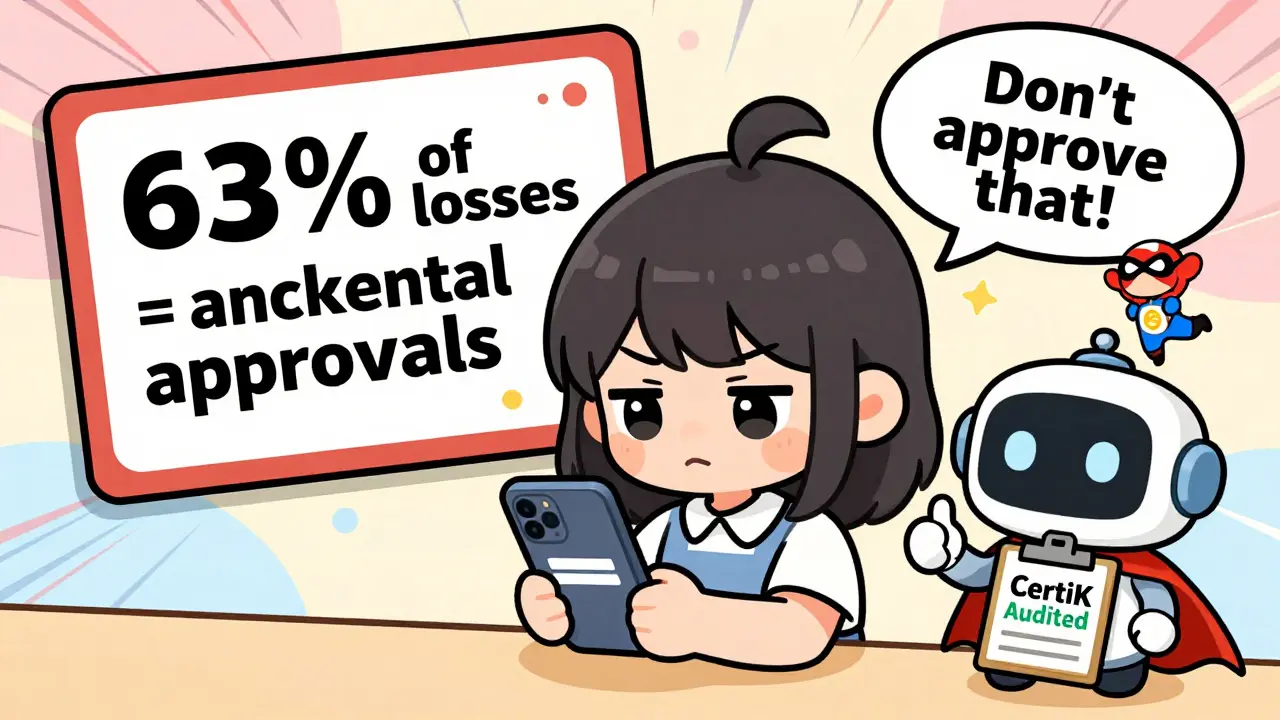
Chainalysis reported that 63% of DEX-related losses in Q4 2025 came from users approving unlimited token allowances to fake interfaces. OneSwap’s built-in approval monitor helps-alerting you if a contract requests access to more than 10% of your balance-but it won’t stop you if you click "Approve" anyway.
Also, while OneSwap reduces MEV (miner extractable value) with its off-chain order matching, it’s not immune. In January 2026, a bot exploited a 0.3-second delay between order submission and execution, stealing $420,000 from limit orders on Arbitrum. OneSwap patched the issue within 48 hours, but it’s a reminder: no system is bulletproof.
Comparison: OneSwap vs Uniswap
| Feature | OneSwap | Uniswap |
|---|---|---|
| Trading Model | Hybrid (AMM + Order Book) | AMM Only |
| Limit Orders | Yes (on-chain) | No |
| Gas Fees for Orders | Only when filled | Every swap |
| TVL (Feb 2026) | $950M | $4.2B |
| Daily Volume | $1.1B | $6.5B |
| Supported Chains | Ethereum, Arbitrum, Polygon | 38+ chains |
| Best For | Mid-cap tokens, limit trading, lower slippage | ETH/stablecoin swaps, deep liquidity |
| User Experience | More complex, but more control | Simpler, but less flexible |
Who Should Use OneSwap?
OneSwap isn’t for everyone. If you’re just swapping ETH for USDC once a month, stick with Uniswap. It’s simpler, faster, and has deeper liquidity.
But if you’re someone who:
- Trades mid-cap altcoins regularly
- Wants to set price targets and wait for the market
- Tires of paying high gas fees on every small trade
- Values control over convenience
…then OneSwap is worth a try. It’s the first DEX that lets you trade like a pro without giving up self-custody.
Downsides and Limitations
OneSwap has real flaws:
- No fiat on-ramps - You still need to buy crypto elsewhere first.
- No mobile app - Only web interface, which can be clunky on phones.
- Smaller community - Less documentation, fewer tutorials than Uniswap.
- Less institutional adoption - Hedge funds still prefer Uniswap for large swaps.
Also, because it’s newer, some tokens listed on OneSwap are riskier. The platform doesn’t vet projects-anyone can list a token. That means you’ll find legitimate tokens… and some outright scams. Always check token contracts on Etherscan before trading.
Final Verdict
OneSwap isn’t trying to replace Uniswap. It’s trying to upgrade it. For traders who want more control, better pricing on mid-cap tokens, and the ability to place limit orders without leaving DeFi, it’s one of the most compelling innovations in 2026.
It’s not perfect. The interface still feels clunky. The learning curve is steeper. And if you’re not careful, you can still lose money. But if you’re ready to move beyond basic swapping, OneSwap gives you tools most DEXs still don’t offer.
Try it with a small trade first. Set a limit order for $50 worth of a token you’ve been watching. See how it feels to wait for the price instead of chasing it. If it works, you’ll understand why OneSwap is gaining traction-not because it’s flashy, but because it finally gives decentralized traders the tools they’ve been asking for.
Is OneSwap safer than Uniswap?
Both exchanges use audited smart contracts and have no known critical vulnerabilities. OneSwap adds an approval monitor and off-chain order matching, which reduces some risks like MEV and accidental approvals. But neither protects you from user error-like approving malicious tokens or sending funds to the wrong address. Safety depends on your habits, not just the platform.
Can I use OneSwap on my phone?
OneSwap has no official mobile app yet. You can access it through your mobile browser using MetaMask or Trust Wallet, but the interface isn’t optimized for touch screens. Many users report difficulty placing limit orders or reading price charts on phones. A native app is expected in Q3 2026.
Does OneSwap charge fees?
Yes. OneSwap charges a 0.2% trading fee on all swaps, split between liquidity providers. Limit orders don’t incur fees until they’re filled. Gas fees (paid in ETH, MATIC, or ARB) vary by network and are separate from OneSwap’s fee. On Arbitrum, gas fees average $0.30 per trade; on Ethereum mainnet, they range from $1.50 to $5.
How does OneSwap compare to SushiSwap or Curve?
SushiSwap offers yield farming and lending features but lacks limit orders. Curve dominates stablecoin swaps with ultra-low slippage but doesn’t support volatile assets well. OneSwap fills a gap: it’s the only DEX that combines deep liquidity for mid-cap tokens with true limit order functionality. If you trade tokens like AAVE, MKR, or UNI, OneSwap gives you better pricing than both.
Is OneSwap regulated?
No. OneSwap is fully decentralized and non-custodial. It doesn’t collect user data, enforce KYC, or report transactions. This makes it compliant with DeFi principles but also means it operates in a legal gray zone. Users are responsible for their own tax reporting and compliance with local laws.

bella gonzales
March 1, 2026 AT 23:30Nicki Casey
March 3, 2026 AT 21:08Curtis Dunnett-Jones
March 4, 2026 AT 01:11Sean Logue
March 5, 2026 AT 02:59Carl Gaard
March 6, 2026 AT 18:02Paul Reinhart
March 6, 2026 AT 18:29Shannon Black
March 8, 2026 AT 17:16Trenton White
March 10, 2026 AT 04:03Kristi Emens
March 10, 2026 AT 10:28Deborah Robinson
March 12, 2026 AT 09:12Sriharsha Majety
March 13, 2026 AT 22:17Tabitha Davis
March 15, 2026 AT 14:34Vishakha Singh
March 16, 2026 AT 12:13Don B.
March 17, 2026 AT 03:21Arya Dev
March 18, 2026 AT 05:34Dana Sikand
March 18, 2026 AT 05:40Daisy Boliaan
March 18, 2026 AT 14:29Jessica Carvajal montiel
March 19, 2026 AT 07:37maya keta
March 21, 2026 AT 01:28Samantha Stultz
March 23, 2026 AT 01:03precious Ncube
March 24, 2026 AT 23:43Amita Pandey
March 26, 2026 AT 07:21Jan Czuchaj
March 27, 2026 AT 03:19Paul Reinhart
March 27, 2026 AT 14:24maya keta
March 27, 2026 AT 16:38