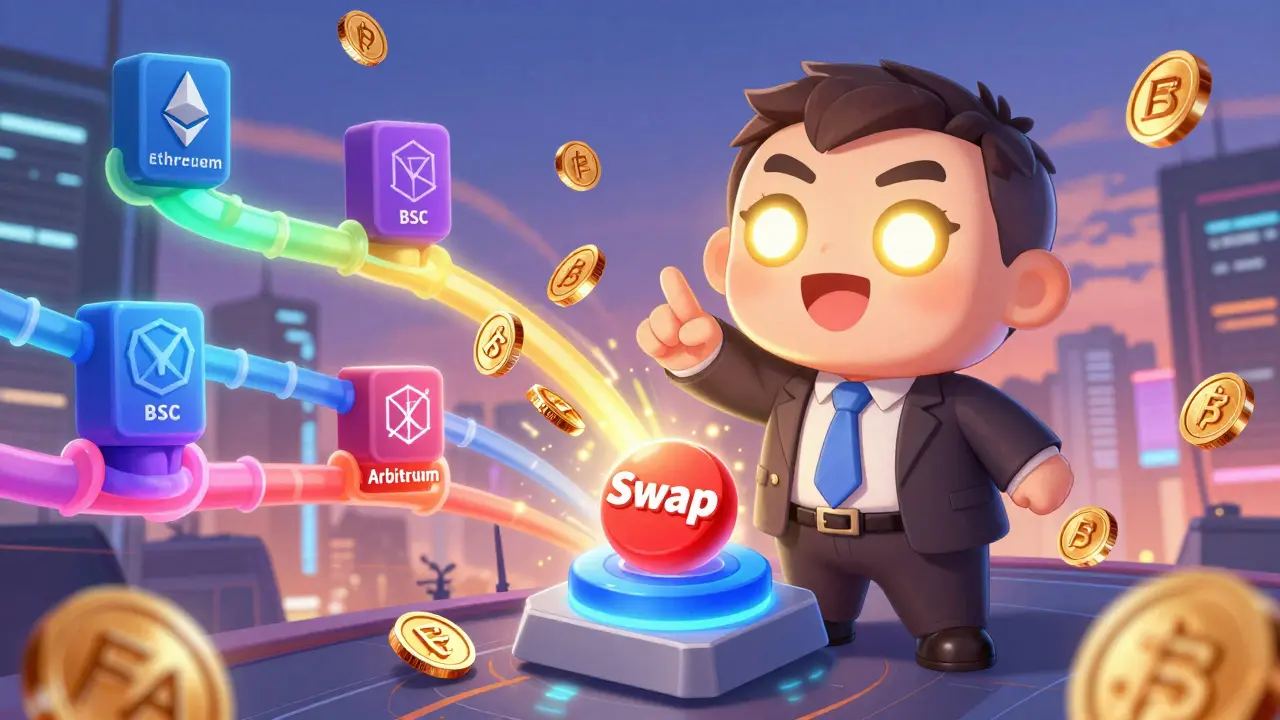
When you're swapping tokens across multiple blockchains, you don't want to jump between five different apps just to get the best rate. That’s where Firebird Finance comes in. It’s not just another crypto exchange-it’s a DeFi aggregator that pulls together over 140 decentralized exchanges into one interface. Think of it like a flight search engine, but for crypto swaps. You input what you want to trade, and Firebird Finance finds the best deal across Uniswap, Curve, WOOfi, Balancer, and dozens more-all in one click.
How Firebird Finance Works
Firebird Finance doesn’t hold your funds or act as a custodian. Instead, it routes your trade through the most efficient DEXs to minimize slippage and maximize your output. Its core technology, called OneSwap, uses an advanced algorithm that scans all connected liquidity pools in real time. It doesn’t just pick the exchange with the highest rate-it factors in gas fees, transaction speed, and network congestion too. For example, if you’re swapping ETH for USDC, it might route half through Uniswap and half through Curve, depending on which combination gives you the most USDC for your ETH.
The platform supports major blockchains like Ethereum, Polygon, Binance Smart Chain, Arbitrum, and Optimism. That means you can swap tokens without having to bridge assets manually between chains. It handles the complexity behind the scenes. You just click, confirm, and done.
The Two Tokens: FBA and HOPE
Firebird Finance runs on two native tokens: FBA and HOPE. FBA is the one you’ll use most. Every time you swap tokens on the platform, you earn FBA as a cashback reward. It’s like getting 0.5% back on every trade, paid in FBA. You can hold it, trade it, or stake it for more rewards. There’s no mystery here-it’s a straightforward incentive to keep trading on the platform.
HOPE is different. It’s designed for governance and fee sharing. You can lock HOPE tokens for periods ranging from one week to four years. In return, you get mHOPE tokens, which give you voting power on platform decisions-like which new DEXs to add or how to adjust fee structures. But here’s the catch: HOPE is currently trading at $0 with zero volume. Both total and circulating supply are listed as zero. That’s not normal. It suggests either no one is buying it, or the token hasn’t been fully launched yet. If you’re hoping to earn a share of trading fees through HOPE, you’re waiting on something that doesn’t seem to exist yet.
Yield Farming and Vaults
Firebird Finance isn’t just about swapping. It also offers Farms-as-a-Service and secure vaults. The Farms feature lets you deposit tokens into automated yield strategies without needing to understand complex staking pools. You pick a farm, stake your asset, and the platform handles the rest-compounding rewards, switching strategies, and rebalancing across chains. It’s designed for users who want passive income without the headache.
The vaults work similarly. You lock up assets like USDT or ETH, and the platform deploys them into DeFi protocols that generate returns. It’s not high-risk gambling-it’s more like a curated selection of proven yield sources. The platform claims to audit these strategies before adding them, but it doesn’t publicly share audit reports. That’s a red flag for cautious users. If you’re serious about DeFi, you’ll want to see third-party security reviews before locking up funds.

Who Is This For?
Firebird Finance is built for two types of users: experienced DeFi traders who want to optimize every swap, and newcomers who want to dip their toes into multi-chain DeFi without getting lost. The interface is clean, with clear buttons and minimal jargon. It claims you can get started in five minutes. That’s true-if you already have a wallet connected and some tokens in it.
But if you’re new to crypto, the concept of cross-chain liquidity, gas fees on different networks, and token approvals might still feel overwhelming. Firebird Finance simplifies the process, but it doesn’t eliminate the learning curve. You still need to understand what slippage is, why you should approve tokens, and how to check your transaction history.
Competition: How Does It Stack Up?
Firebird Finance isn’t alone. 1inch, Kyber Network, ParaSwap, and OpenOcean all do similar things. But Firebird stands out by integrating 140+ DEXs. Most competitors max out at 50-80. That’s a big advantage-more liquidity means better prices. But quantity doesn’t always mean quality. Some of those 140 DEXs are tiny, with low volume and high slippage. Firebird’s algorithm should filter those out, but there’s no public data showing how often it fails.
Also, 1inch and ParaSwap have been around longer. They’ve been audited, have larger user bases, and their tokens actually trade. Firebird’s HOPE token sitting at $0 is a major concern. It makes the whole governance system feel theoretical. If no one is using HOPE, then who’s voting on decisions? And if the fee-sharing mechanism isn’t active, then what’s the real value of locking it?

Community and Trust
On Twitter, Firebird Finance has about 11,700 followers. Not huge, but not tiny either. RootData shows 86% of community votes are bullish. That’s encouraging-but it’s also a small sample. Only 718 people voted. That’s not a representative market signal. And there’s no sign of active development updates, blog posts, or team transparency. No LinkedIn profiles, no GitHub commits, no press releases. That’s unusual for a platform claiming to be a leader in DeFi.
Security is another open question. Firebird Finance says it uses “secure vaults,” but doesn’t name any audits or partnerships with firms like CertiK or Hacken. In DeFi, trust isn’t built on promises-it’s built on proof. No audit? No transparency? That’s a risk.
Is Firebird Finance Worth Using?
If you’re an active DeFi trader who swaps between chains daily, Firebird Finance could save you time and money. The cashback in FBA is real, and the routing is solid. It’s worth trying if you’re already using Uniswap or Curve and want to see if you can get better rates.
But if you’re looking for a safe, long-term DeFi platform with strong tokenomics and proven security, Firebird Finance isn’t there yet. The HOPE token’s zero value is a warning sign. Without active trading, governance, or fee sharing, it’s just a placeholder. And without audits or public team info, you’re trusting code you can’t fully verify.
Use Firebird Finance for swaps. Don’t lock up your funds in vaults or farms unless you’re comfortable with the risk. And don’t buy HOPE hoping for returns-it’s not trading. Stick with FBA for rewards, and keep an eye on whether the platform starts showing real activity.
Final Take
Firebird Finance has the tools to be a top DeFi aggregator. The interface works. The routing is smart. The cashback in FBA is a nice perk. But the platform’s future depends on two things: making HOPE actually useful, and proving it’s secure. Right now, it feels like a promising idea with unfinished pieces. For now, treat it as a tool-not a cornerstone of your DeFi portfolio.

Shayne Cokerdem
March 21, 2026 AT 15:52kavya barikar
March 21, 2026 AT 19:14aravindsai pandla
March 22, 2026 AT 09:06Andrea Zaszczynski
March 22, 2026 AT 09:56Cordany Harper
March 24, 2026 AT 03:02DarShawn Owens
March 25, 2026 AT 17:27Andy Green
March 26, 2026 AT 23:59Zion Banks
March 28, 2026 AT 12:53Kevin Da silva
March 29, 2026 AT 16:43Andrew Midwood
March 31, 2026 AT 05:18Alice Clancy
March 31, 2026 AT 06:45Neil MacLeod
April 1, 2026 AT 21:30John Alde
April 1, 2026 AT 21:43manoj kumar
April 2, 2026 AT 22:57JOHN NGEH
April 4, 2026 AT 03:41Lorna Gornik
April 5, 2026 AT 02:46Joshua T Berglan
April 5, 2026 AT 04:28Kevion Daley
April 7, 2026 AT 02:54Nicolette Lutzi
April 9, 2026 AT 00:20Sam Harajly
April 9, 2026 AT 23:55