By 2025, rollup solutions aren't just a buzzword-they're the backbone of Ethereum's scalability. If you've ever waited minutes for a transaction to confirm or paid $10 in gas fees just to swap tokens, you know why rollups matter. These Layer 2 systems process hundreds of transactions off-chain, then bundle them into a single proof that gets posted back to Ethereum. The result? Faster, cheaper, and smoother interactions without sacrificing security.
What Exactly Is a Rollup?
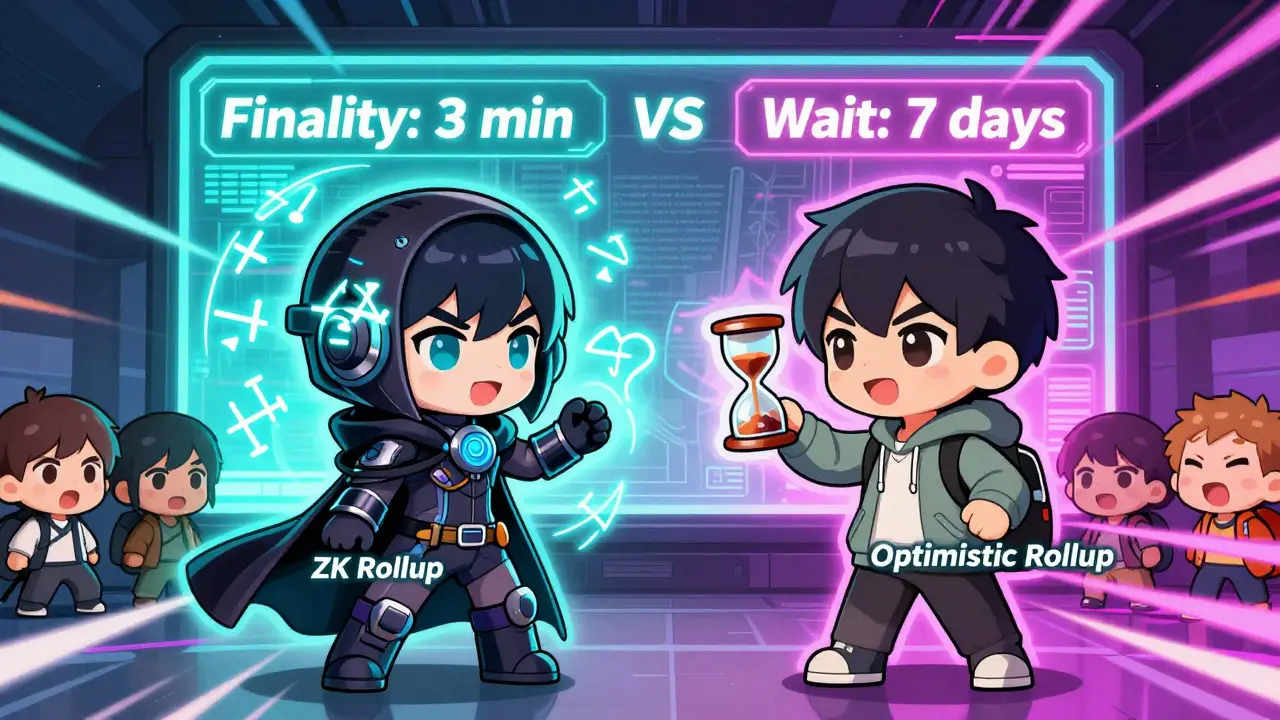
A rollup is like a private club that handles transactions away from the main Ethereum network, then sends a summary back. Think of it as batching your grocery runs instead of driving to the store every time you need milk. The two main types are optimistic rollups and ZK rollups. Optimistic rollups assume transactions are valid unless someone challenges them within a 7-day window. ZK rollups use cryptographic proofs to instantly verify everything is correct-no waiting, no disputes.By Q2 2025, rollups were handling 83% of all non-bridged Ethereum transactions, according to L2Beat. Total value locked (TVL) across all rollups hit $412.6 billion, up from less than $40 billion just two years earlier. That’s not growth-it’s a revolution.
The Four Dominant Rollup Frameworks in 2025
Not all rollups are built the same. Four frameworks dominate the landscape, each with clear strengths:- OP Stack (Optimism Collective): Powers 34% of all active rollups. Used by 63% of Fortune 500 companies for enterprise blockchain projects. Modular, flexible, and supports both optimistic and ZK configurations since its v2.0.1 update in February 2025.
- Arbitrum Orbit: Holds 28% of aggregated TVL. Dominates DeFi with seven of the top ten protocols-including Aave, Uniswap, and Curve-running on it. Its Stylus upgrade in January 2025 let developers write smart contracts in Rust and C++, not just Solidity.
- ZKsync Hyperchain: Captures 22% market share. Best for gaming and NFTs, processing 2.8 million NFT transactions daily. Uses zkEVM with 98.7% EVM compatibility and finality in 3-7 minutes.
- Polygon CDK: Adopted by 16% of rollups. Popular in Southeast Asia and Latin America due to low costs and telecom partnerships. Average transaction fee: $0.035. Finality in just 2 minutes.
How Do They Compare?
| Framework | Market Share | Throughput | Finality Time | Deployment Cost | Best For |
|---|---|---|---|---|---|
| OP Stack | 34% | 2,000-4,500 TPS | 10-15 minutes | 1.2 ETH ($3,600) | Enterprise, custom chains |
| Arbitrum Orbit | 28% | 3,000-4,000 TPS | 1-3 minutes | 0.5 ETH ($1,485) | DeFi, WASM apps |
| ZKsync Hyperchain | 22% | 1,800 TPS | 3-7 minutes | 2.3 ETH ($6,900) | Gaming, NFTs, privacy |
| Polygon CDK | 16% | 1,500-2,500 TPS | 2 minutes | 1.8 ETH ($5,400) | Emerging markets, low-cost apps |
Each framework trades off speed, cost, and complexity. Arbitrum Orbit wins for speed and low deployment cost. ZKsync Hyperchain leads in privacy and NFT throughput. OP Stack gives developers maximum control. Polygon CDK is the go-to for regions with limited infrastructure.
Rollup-as-a-Service (RaaS): The Game-Changer
You don’t need a team of blockchain engineers to launch a rollup anymore. RaaS platforms have flipped the script. Conduit, for example, lets you deploy a custom chain in under 8 minutes for $299/month. No code. No config files. Just a dashboard. In 2025, 82% of early-stage Web3 startups chose Conduit because it cut deployment time from six weeks to 15 minutes.AltLayer takes a different approach: ephemeral chains. Need a high-throughput chain for a one-day NFT drop or a gaming tournament? AltLayer charges $0.04 per transaction-second. They powered the 'Duckchain' NFT drop that handled 1.2 million transactions in 47 minutes without a single failed request. No congestion. No crashes.
Asphere’s no-code platform is even simpler. It reduced deployment complexity by 94%. Founders with zero blockchain experience launched production chains in minutes. But there’s a catch: you lose customization. If you need fine-tuned sequencer logic or custom fee structures, RaaS won’t cut it.
Where the Challenges Still Linger
Despite all the progress, rollups aren’t perfect.- Optimistic rollups still have a 7-day withdrawal period. If you want to cash out, you wait. That’s a bad UX for everyday users.
- ZK rollups need powerful hardware. Proving transactions requires 128GB RAM and 32 cores. That drives up costs by 40-60% compared to optimistic systems.
- Most rollups still rely on a single sequencer node. Danny Ryan from Ethereum Core Devs pointed out at EthCC 2025 that 67% of OP Stack chains use one central sequencer-creating a censorship risk.
- Documentation varies wildly. OP Stack scores 8.7/10. Newer forks like Kroma? Only 6.2/10. You might spend more time reading docs than coding.
Taiko’s 'based sequencing' model tries to fix the sequencer problem by running the sequencer directly on Ethereum. It’s slower and costs 18% more in gas, but it removes a single point of failure. It’s not perfect, but it’s a step toward decentralization.

The Road Ahead: What’s Coming in 2025-2026
The next big shift is Ethereum’s Pectra upgrade, scheduled for September 12, 2025. It increases validator balance limits, which directly boosts rollup throughput by 22-35%. That means even more transactions per second, lower fees, and better user experiences.Conduit plans to add a ZK coprocessor by Q4 2025-letting optimistic rollups generate ZK proofs on demand. AltLayer’s cross-chain messaging protocol launches in August 2025, enabling assets to move between rollups without going back to Ethereum. And Taiko’s full mainnet launch in October 2025 could redefine how we think about sequencing.
Experts like Vitalik Buterin believe ZK rollups are the endgame. By 2026, zkEVMs will match optimistic rollups in ease of use. But for now, the choice isn’t about which is better-it’s about which fits your use case.
Who Should Use What?
- DeFi protocols → Arbitrum Orbit. Speed, low cost, and WASM support make it ideal.
- Gaming and NFTs → ZKsync Hyperchain. Instant finality and privacy features are unmatched.
- Enterprise apps → OP Stack. Flexibility and adoption by major corporations give it credibility.
- Emerging markets → Polygon CDK. Low fees and local partnerships make it accessible.
- Startups without dev teams → Conduit or Asphere. Deploy in minutes, not months.
- Temporary high-load events → AltLayer. Pay only for what you use.
There’s no one-size-fits-all. The best rollup is the one that solves your problem without overcomplicating it.
Final Thoughts
In 2025, rollups aren’t optional-they’re essential. Ethereum’s future depends on them. The market has matured from experimental prototypes to robust, production-ready infrastructure. Whether you’re building a DeFi app, launching an NFT collection, or integrating blockchain into a supply chain, there’s a rollup solution that fits.The real win? You no longer need a PhD in cryptography to use one. Tools like Conduit and Asphere have lowered the barrier so much that non-technical founders are now deploying chains. That’s how you know a technology has gone mainstream.
But don’t get fooled by hype. The ecosystem is still evolving. Sequencing centralization, hardware costs, and interoperability gaps remain real concerns. The winners in 2026 won’t be the ones with the flashiest marketing-they’ll be the ones who solved these problems.
What’s the difference between optimistic and ZK rollups?
Optimistic rollups assume transactions are valid unless challenged within a 7-day window. ZK rollups use cryptographic proofs to verify every transaction instantly. ZK rollups are faster and more secure but require more computational power. Optimistic rollups are cheaper to run but have slower withdrawals.
Are rollups safe?
Yes, because they inherit Ethereum’s security. Even though transactions happen off-chain, the final state is anchored to Ethereum. Fraud proofs (in optimistic rollups) and ZK proofs (in ZK rollups) ensure no one can cheat without being caught. The biggest risk isn’t security-it’s centralized sequencers or poorly coded RaaS platforms.
Can I build my own rollup without coding?
Yes, with Rollup-as-a-Service (RaaS) platforms like Conduit and Asphere. You can deploy a fully functional rollup chain in under 15 minutes using a web dashboard-no Solidity, no CLI, no config files. But if you need custom logic, like unique fee structures or sequencer rules, you’ll still need developers.
Why is Polygon CDK popular in Southeast Asia?
Polygon CDK offers the lowest transaction costs among major rollups-around $0.035 per transaction. It also partners with local telecom providers to reduce data costs for users. In countries where internet access is expensive or unstable, this makes blockchain apps usable for everyday people, not just crypto enthusiasts.
What’s the future of rollups after 2025?
By 2028, experts predict rollups will handle over 95% of Ethereum transactions. The next frontier is recursive ZK proofs, which will let one proof verify many others-boosting throughput to over 1 million transactions per second. Cross-rollup interoperability and decentralized sequencing are the two biggest challenges left to solve.



Phillip Marson
February 23, 2026 AT 00:06Tracy Whetsel
February 23, 2026 AT 09:06Alyssa Herndon
February 23, 2026 AT 14:58Ifeanyi Uche
February 25, 2026 AT 04:37Jeff French
February 26, 2026 AT 07:40Elana Vorspan
February 28, 2026 AT 03:50Danny Kim
February 28, 2026 AT 04:05Cathy Sunshine
March 1, 2026 AT 19:38Shannon Black
March 3, 2026 AT 14:35Richard Cooper
March 3, 2026 AT 15:47Dee Resin
March 5, 2026 AT 09:48Michelle Mitchell
March 7, 2026 AT 06:53christopher luke
March 8, 2026 AT 20:03maya keta
March 10, 2026 AT 15:19precious Ncube
March 12, 2026 AT 00:29Amita Pandey
March 13, 2026 AT 17:04Jan Czuchaj
March 15, 2026 AT 05:41