
Blockchain projects don’t fail because of bad code. They fail because teams don’t talk to each other.
Think about it. A blockchain team isn’t just a group of developers writing smart contracts. It’s a mix of cryptographers, DevOps engineers, product designers, QA testers, and community managers-all working across time zones, often remotely, under tight deadlines. If communication breaks down, even the most elegant whitepaper turns into a pile of unfinished code. That’s where team building and development activity analysis become critical, not optional.
Why Team Building Matters More in Blockchain Teams
Most industries use team building to improve morale. In blockchain, it’s about survival. The tech moves fast. New protocols drop weekly. One misaligned team can waste months building the wrong thing. A 2024 study from the Blockchain Research Institute found that teams with regular, structured collaboration activities completed projects 37% faster than those relying only on Slack and Zoom calls.
Why? Because blockchain work is deeply interdependent. A smart contract developer can’t just write code and hand it off. They need to understand the consensus mechanism the node operators are using. The UX designer needs to know what gas fees users are actually tolerating. Without shared context, everything slows down.
Team building isn’t about trust falls or escape rooms (though those can help). It’s about creating shared mental models. When a developer has had a real conversation with a community moderator over coffee-or even a virtual game of Among Us-they start seeing each other as people, not just roles. That changes how they respond to feedback, how they ask for help, and how they handle conflict.
What Development Activity Analysis Actually Measures
Development activity analysis sounds technical, but it’s really just asking: Are people actually working together?
Most teams track commits, PRs, and deployment frequency. That’s useful-but it’s like judging a soccer team by how many times each player kicked the ball. You miss the passes, the positioning, the teamwork.
Effective analysis looks at three things:
- Communication patterns-Who’s talking to whom? Are junior devs asking senior devs questions, or are they siloed?
- Code review cycles-Are reviews happening quickly? Are they constructive? Or are PRs sitting for days because no one feels comfortable giving feedback?
- Task handoffs-When a feature moves from design to dev to QA, is there a clear handoff? Or does it get lost in a Slack thread?
Tools like GitHub Insights, GitLab Analytics, and linear.co can track these. But data alone doesn’t fix problems. You need to connect the numbers to behavior. For example, if PR review time jumps from 8 hours to 48 hours, is it because someone’s overloaded-or because trust is breaking down?
Real Team Activities That Work for Blockchain Teams
Not all team building works for tech teams. You can’t force a blockchain engineer to do a ropes course and expect better code. The best activities are low-pressure, relevant, and tied to real work.
Here’s what actually moves the needle:
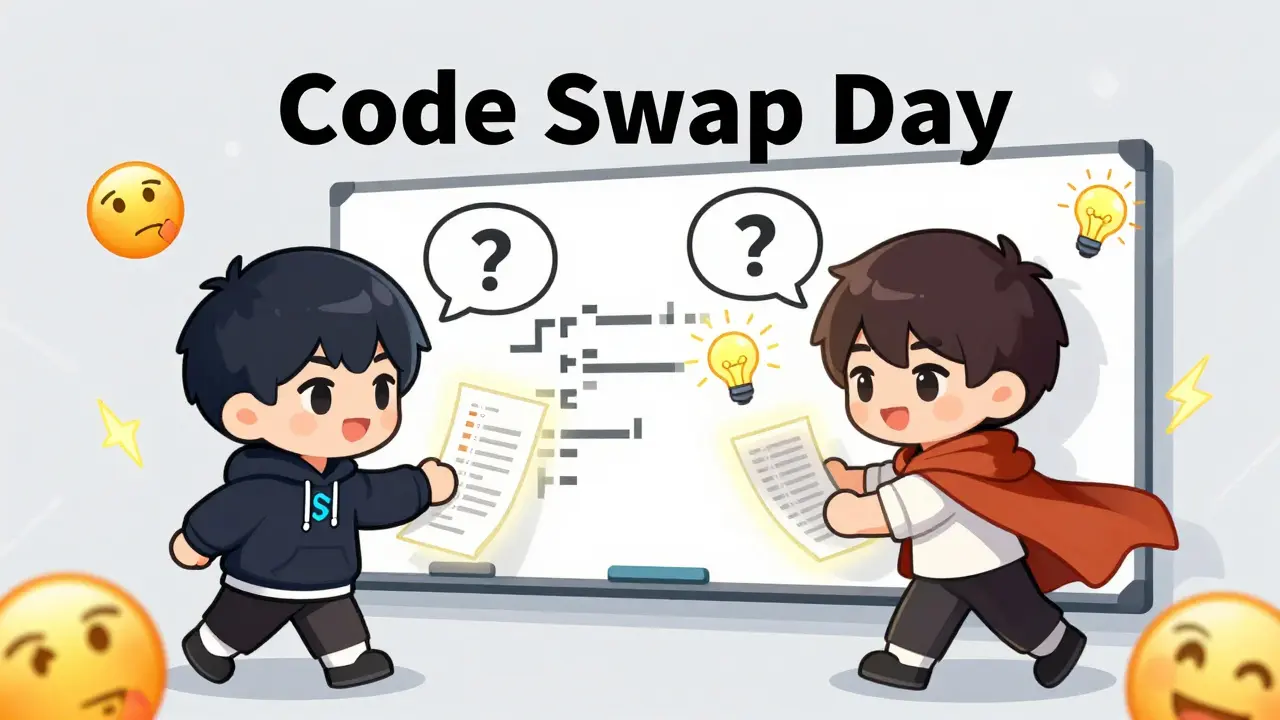
- Code Swap Days-Developers pair up and review each other’s code for a full day. Not to fix bugs, but to understand how someone else thinks. One dev might be used to Solidity’s gas optimization tricks. The other might think in Rust. Seeing different approaches builds empathy and shared vocabulary.
- Protocol Jam Sessions-Grab a whiteboard. Pick a new EIP (Ethereum Improvement Proposal). Spend 90 minutes discussing what it means, how it affects your project, and what questions it raises. No slides. No slides. Just talk. This builds deep technical alignment.
- “Bug Hunt” Scavenger Hunts-Set up a testnet with intentional bugs. Teams race to find and fix them. It’s fun. It’s competitive. And it forces cross-functional collaboration: QA finds the bug, dev fixes it, devops deploys the patch. Everyone wins.
- Remote Coffee Roulette-Use a tool like Donut to randomly pair team members for 15-minute Zoom chats once a week. No agenda. Just: “What’s something you’re excited about outside work?” This breaks down invisible barriers faster than any corporate retreat.
These aren’t “fun extras.” They’re performance tools. A team at Chainlink ran a Code Swap Day and reduced their contract audit time by 60% because developers started anticipating each other’s patterns.
What Doesn’t Work (And Why)
Too many blockchain teams try to copy Silicon Valley’s team-building playbook. Offsites in the mountains. Group yoga. Mandatory fun. It backfires.
Why? Because blockchain teams are often made up of introverted, highly analytical people who value autonomy. Forced socializing feels inauthentic-and worse, it wastes time they could spend coding.
Here’s what to avoid:
- Icebreakers that ask “What’s your spirit animal?”-No one cares.
- One-off events with no follow-up-If you don’t reinforce the behavior, it disappears.
- Activities that don’t reflect real work-If your team never talks about tokenomics, why are you doing a “token economy” board game?
- Ignoring accessibility-Not everyone can climb a wall or stand for hours. Make sure activities include remote, neurodivergent, and physically disabled members.
The most successful teams treat team building like code: iterative, measurable, and optional. They run small experiments. They track results. They drop what doesn’t work.
How to Start Today (No Budget Needed)
You don’t need a $20,000 retreat to fix team dynamics. Start small.
- Run a 15-minute “Team Health Check”-In your next stand-up, ask: “What’s one thing that slowed you down this week?” Don’t solve it. Just listen. Write it down. Do this for two weeks.
- Introduce a “No Meeting Wednesday”-Give everyone space to dive deep. Then, on Thursday, host a 30-minute “What I Learned” circle. One person shares a technical insight, a bug they fixed, or a question they had. No pressure. Just sharing.
- Start a “Code Pairing” Slack channel-Encourage devs to post: “Looking for someone to pair on this ERC-721 upgrade. Free coffee if you join.” It’s low-stakes. It’s voluntary. And it builds connections organically.
- Track one metric-Pick one: average PR review time. Or number of cross-team comments in PRs. Measure it for a month. Then run a simple activity. Measure again. Did it improve?
The goal isn’t to make everyone friends. It’s to make collaboration frictionless. When a developer knows they can DM someone without fear of judgment, when a QA tester feels safe flagging a critical bug without being brushed off-that’s when blockchain projects actually ship.

The ROI of Team Building in Blockchain
Let’s be real: execs care about one thing-ROI. So what’s the return?
Teams that do consistent activity analysis and small-scale team building see:
- 30-50% faster onboarding of new devs
- 40% fewer critical bugs in production
- 25% reduction in developer turnover
- Higher quality code reviews (measured by fewer rework cycles)
A 2025 survey of 210 Web3 teams by Gitcoin found that teams with regular collaboration rituals had 2.3x higher code contribution rates from non-core devs (like community members contributing to docs or testing).
That’s not magic. That’s psychology. Stanford research shows that when people feel they belong to a group working toward a shared goal, they persist longer, even under stress. Blockchain development is stressful. Teams that build belonging don’t burn out-they scale.
What Comes Next
The future of team building in blockchain isn’t about retreats. It’s about embedding collaboration into daily work.
Tools are emerging that auto-analyze team communication patterns. AI can flag when someone’s been left out of a PR discussion. Systems can suggest pairing opportunities based on skill gaps. But tech alone won’t fix culture. People still need to connect.
Start small. Stay consistent. Measure what matters. And remember: the most valuable asset in your blockchain project isn’t your token. It’s your team’s ability to work together.
Are team building activities worth it for remote blockchain teams?
Yes-especially for remote teams. Blockchain work is complex and distributed. Without intentional connection, teams fragment. Simple activities like virtual coffee chats, code pairing, and weekly “what I learned” sessions build trust and reduce miscommunication. Remote doesn’t mean isolated. It just means you have to be more deliberate about connection.
How often should blockchain teams do team building activities?
Monthly is ideal. But don’t wait for a big event. Build micro-rituals into your workflow: a 15-minute team check-in every Monday, a biweekly code swap, or a monthly “bug hunt.” Consistency matters more than frequency. One small, regular activity beats one big annual retreat that everyone forgets about.
Can team building improve code quality?
Directly? Not always. Indirectly? Absolutely. When developers understand each other’s thinking styles, they write clearer code. They leave better comments. They review PRs more thoroughly. Teams that collaborate well produce fewer bugs, faster fixes, and more maintainable code. It’s not about the activity-it’s about the trust it builds.
What if team members hate team building?
Then don’t force it. The worst thing you can do is make it feel like a chore. Instead, offer choice. Let people suggest activities. Make them optional. Focus on low-pressure, work-related interactions-like code pairing or peer feedback sessions-rather than forced games. People will engage when they see the value, not when they’re told to.
How do you measure the success of team building in a blockchain team?
Track practical outcomes: PR review time, number of cross-team comments, onboarding speed, and bug recurrence rates. Also, ask simple questions: “Do you feel comfortable asking for help?” or “Do you understand how your work connects to others’?” Anonymous surveys every quarter give you real data-not just vibes.


SUMIT RAI
December 26, 2025 AT 09:39NIKHIL CHHOKAR
December 26, 2025 AT 21:28Joydeep Malati Das
December 28, 2025 AT 14:13rachael deal
December 29, 2025 AT 08:38Elisabeth Rigo Andrews
December 30, 2025 AT 03:05Bruce Morrison
December 31, 2025 AT 04:38Jordan Fowles
January 2, 2026 AT 00:16Steve Williams
January 2, 2026 AT 10:34prashant choudhari
January 3, 2026 AT 11:18Abhisekh Chakraborty
January 4, 2026 AT 07:06dina amanda
January 5, 2026 AT 17:17Emily L
January 6, 2026 AT 14:55Gavin Hill
January 7, 2026 AT 21:53Khaitlynn Ashworth
January 9, 2026 AT 04:28Mike Pontillo
January 10, 2026 AT 08:50Jake West
January 10, 2026 AT 23:08Shawn Roberts
January 11, 2026 AT 20:02Andrea Stewart
January 13, 2026 AT 18:49