When you place a market order to buy Bitcoin, you expect to get it at the price you see. But what if the next 100 BTC in sell orders vanish the moment your order hits the exchange? That’s not a glitch-it’s what happens when order book depth is shallow. Most traders look at price charts and think they understand the market. They don’t. Order book depth shows you what’s really happening behind the scenes: who’s buying, who’s selling, and how much they’re willing to move at each price level.
What Exactly Is Order Book Depth?
Order book depth is the total volume of buy and sell orders stacked at different prices around the current market rate. Think of it like a grocery store shelf. If there are 100 apples at $1 each, 200 at $1.05, and 500 at $1.10, you know the price won’t jump to $1.10 unless someone buys all 800 apples. That’s depth. In crypto, it’s the same idea-but with Bitcoin, Ethereum, or any token, and the numbers are in thousands or millions of dollars.
Exchanges like Binance, Coinbase, and BitMart show this as a vertical bar on the side of the price chart. On the left, you see buy orders (bids)-people willing to pay for the asset. On the right, sell orders (asks)-people ready to dump their coins. The thicker the bar at a certain price, the more liquidity there is. A deep order book means big orders can be filled without crashing or rocketing the price. A shallow one? Even a $50,000 trade can spike the price 5%.
Why Liquidity Matters More Than Price
Price tells you where something traded last. Depth tells you where it’s likely to go next. Two assets can have the same price but wildly different liquidity. Take BTC/USDT vs. some obscure altcoin. BTC might have $200 million in buy orders within 1% of the current price. That altcoin? Maybe $2 million. If you try to buy $5 million worth of the altcoin, you’ll likely push the price up 15%. With BTC, you barely move the needle.
This is why institutional traders care so much. Fidelity Digital Assets reported in 2024 that 100% of their clients use depth analysis. Why? Because they’re moving millions at a time. A $10 million buy order on a shallow market looks like a pump. On a deep one, it’s a whisper. Depth turns guesswork into strategy.
How Depth Is Measured: Bid Volume, Ask Volume, and Delta
Depth isn’t just one number. It’s broken down into specific intervals:
- Bid Volume 1%: Total buy orders within 1% below the current price.
- Ask Volume 1%: Total sell orders within 1% above the current price.
- Depth Delta: The difference between bid and ask volume. If bids are $120M and asks are $80M, delta is +$40M-buyers are stronger.
- Liquidity Ratio: (Bid - Ask) ÷ (Bid + Ask). A ratio of +0.3 means 30% more buying pressure than selling.
These numbers are tracked at 0.1%, 0.5%, and 1% intervals. Institutional traders watch 0.1% because they’re executing tiny slices of large orders. Retail traders usually look at 0.5% or 1%. A 70:30 buy-to-sell ratio within 0.5% of price? That’s a signal. It means buyers are stacked up, ready to absorb a surge in demand. If that imbalance suddenly drops, watch out-something’s about to break.
The Real-World Impact: Slippage and Price Impact
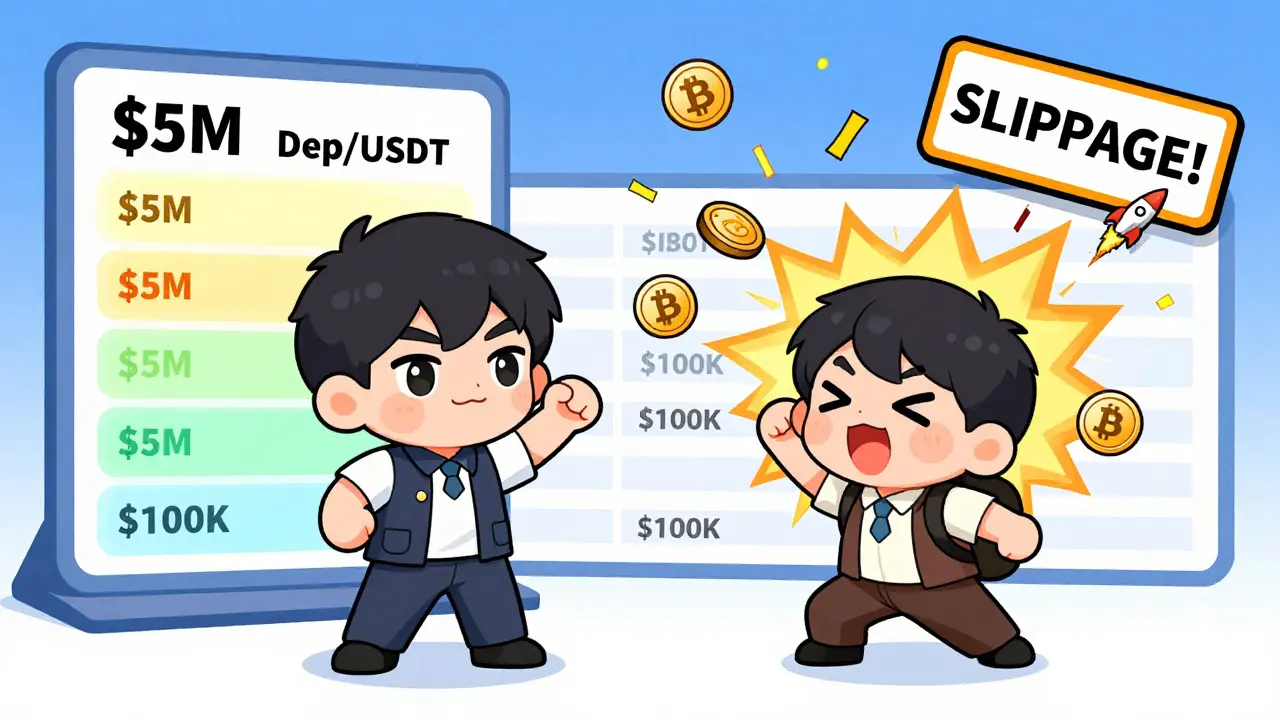
Slippage is when your order fills at a worse price than expected. It happens because the market doesn’t have enough depth. Altrady’s 2024 analysis found traders who used depth metrics cut slippage by 37.2%. Here’s why:
Imagine Coin A has $5,000 BTC in buy orders within 1% of price. You place a $1,000 BTC market buy. The market eats your order like a snack. Price moves 0.3%. Coin B has only $500 BTC in buy orders. Same $1,000 BTC buy? Price jumps 12.7%. That’s not just slippage-that’s a $130,000 loss on a $1 million trade.
Whaleportal’s 2023 case study showed this exact pattern. Deep depth = smooth execution. Shallow depth = price spikes, panic, and losses. If you’re trading more than $10,000 at a time, ignoring depth is like driving blindfolded.
What Depth Doesn’t Tell You (And Why It Can Trick You)
Depth looks like truth-but it’s not always honest. Spoofing is real. Big players place massive buy orders at $60,000 to scare others into buying, then cancel them 300 milliseconds later. The depth chart shows a wall of demand. You rush in. They vanish. Price drops. You’re left holding.
Bookmap’s 2024 data found that 68% of spoofed orders disappear within 800ms. That’s faster than most free platforms update. If you’re using CoinGlass or a basic TradingView chart, you’re seeing data that’s half a second old. By then, the trap is already sprung.
Dark pools are another blind spot. Large institutions trade off-exchange. Their orders never show up in public depth. If 40% of BTC liquidity hides in dark pools (as in U.S. equities), then the public order book is just a fraction of the real picture. Depth can tell you what’s visible-but not what’s coming.

How to Use Depth Like a Pro
Here’s how to turn depth from confusing to profitable:
- Start with BTC/USDT or ETH/USDT. These pairs have the deepest books. Learn here before risking money on altcoins.
- Watch the 0.5% and 1% bands. If bid volume is 3x ask volume, it’s a sign of strong support. If it flips, prepare for a drop.
- Set alerts. Platforms like TradingView let you set alerts for imbalance thresholds (e.g., bid volume > 70% of total depth within 0.5%).
- Combine with volume profile. Depth tells you where orders are. Volume profile tells you where trades actually happened. When both line up, you’ve got high-probability setups.
- Don’t trust free charts during volatility. During a flash crash, depth data can be 1-2 seconds behind. Use platforms with 10-50ms refresh rates if you’re serious.
Reddit user u/CryptoDepthMaster reduced slippage by 28% after setting alerts for 3:1 bid-ask ratios within 0.5%. That’s not luck-it’s using depth as a compass.
The Tools You Need
You don’t need to pay $100/month to start. But you do need the right tools:
- Free: CoinGlass offers solid 1% depth charts and delta visuals. Great for beginners.
- Mid-tier: TradingView Premium ($14.95/month) adds depth heatmaps and alerts. Used by 76% of pros.
- Professional: Bookmap Pro ($99/month) shows real-time order flow with 10ms updates. Used by HFT firms.
Bookmap’s community has 45,000+ active users sharing depth patterns. CoinGlass has 27 free video tutorials. Spend 40 hours learning. You’ll see markets differently.
The Bigger Picture: Where Depth Is Headed
Bitcoin’s 1% depth grew from $18.7 million in 2020 to $214.3 million in 2024. That’s why volatility dropped from 89% to 47%. More depth = more stability. Exchanges now must report depth transparently after SEC rules in late 2024. Spoofing is getting harder.
But the future is smarter. CoinGlass is training AI to spot spoofed orders by their behavior-how fast they vanish, where they appear. Glassnode and Bookmap now overlay depth with on-chain wallet movements. If a whale dumps 1,000 BTC on-chain, and depth at $60K suddenly shrinks? That’s a signal.
By 2027, Gartner predicts 95% of trading platforms will have depth visualization. The question isn’t whether you’ll use it. It’s whether you’re ready when everyone else is.
What does a deep order book mean for traders?
A deep order book means there’s a large volume of buy and sell orders clustered near the current price. This allows big trades to be executed without causing large price swings. For traders, it means lower slippage, more predictable fills, and less risk of sudden price spikes or drops. It’s a sign of a healthy, liquid market.
Is order book depth the same as trading volume?
No. Trading volume measures how much has already been traded in a given time. Order book depth shows what’s waiting to be traded right now. Volume is history. Depth is future potential. Two assets can have the same volume but vastly different depth-meaning one is far easier to trade without moving the price.
Why do some altcoins have shallow order books?
Altcoins often have low trading interest, fewer market makers, and limited institutional backing. Without large players placing consistent buy and sell orders, the depth stays thin. This makes them vulnerable to manipulation-small trades can cause big price moves. That’s why most serious traders avoid them unless they’ve confirmed deep liquidity.
Can order book depth be manipulated?
Yes. This is called spoofing. Traders place large fake orders to trick others into thinking there’s strong demand or supply, then cancel them before execution. These orders often vanish in under a second. Platforms like CoinGlass are now using AI to detect these patterns, but free or slow-refresh charts can still show misleading depth.
How do I know if the depth I’m seeing is real?
Look for persistence. Real liquidity stays in the book for seconds or minutes. Spoofed orders disappear in under 1 second. Watch how the depth changes over time-don’t react to a single snapshot. Also, compare depth across exchanges. If Binance shows $50M in buy orders but KuCoin shows $5M, one is likely unreliable. Use platforms with faster refresh rates (under 100ms) and combine depth with volume profile for confirmation.



Brian T
March 7, 2026 AT 16:32So let me get this straight-you’re telling me I need to pay $99/month just to see if someone’s lying about their buy orders? I’ve been trading for 5 years and I’ve never once cared about depth. I just buy when it’s low and sell when it’s high. The charts don’t lie. This whole thing feels like overengineering a bicycle.
Also, why do people act like depth is some sacred truth? It’s just numbers on a screen. The real market is in the hearts of people panicking or FOMOing. You can’t chart emotion.
Nash Tree Service
March 8, 2026 AT 22:04It is imperative to acknowledge, with the utmost rigor and scholarly precision, that the notion of order book depth as a predictive instrument is fundamentally flawed in its epistemological foundation. One must interrogate the ontological status of the bid-ask spread-is it a reflection of market truth, or merely a performative artifact of algorithmic theater? The very architecture of centralized exchanges betrays the libertarian ideal of price discovery, rendering depth metrics as mere spectacles in a Hegelian dialectic of capital.
Furthermore, the assertion that institutional actors utilize depth for ‘strategy’ is a neoliberal myth propagated by Wall Street apologists. The real power resides in the dark pools, the unregulated corridors where liquidity is hoarded like medieval gold. To trust public depth is to surrender agency to a system designed to extract, not to inform.
Jane Darrah
March 9, 2026 AT 00:43I just had a full-on emotional breakdown reading this because I lost $8k last week on a coin that had ‘$20M depth’ on CoinGlass and then POOF-vanished like my ex’s texts after I said I loved them.
It’s not even the money-it’s the betrayal. I trusted the numbers. I believed the big green bars. I thought the market was saying ‘I got you.’ But no. It was a ghost. A beautiful, shimmering, fake ghost. I cried in my car. I screamed into a pillow. I ate an entire tub of ice cream. And now I’m here, in this thread, begging for someone to tell me I’m not crazy.
Also, I’m switching to Dogecoin. At least with Doge, everyone’s just vibing. No depth. No drama. Just memes and money.
Denise Folituu
March 10, 2026 AT 09:03People who rely on depth are just trying to outsmart the market with spreadsheets. You think you’re smart because you watch delta and liquidity ratios? Newsflash-you’re still just gambling. The real winners? The ones who don’t look at charts at all. They buy Bitcoin because they believe in the tech. They hold through crashes because they know the system is rigged.
And don’t even get me started on Bookmap Pro. $99 a month? For what? A fancy heatmap? You’re not a trader-you’re a data hoarder. You’ve turned investing into a video game where the goal is to stare at lines until you hallucinate patterns.
Wake up. The market doesn’t care about your 0.5% bands. It cares about your fear. And you? You’re scared of your own shadow.
jack carr
March 10, 2026 AT 16:27Hey, just wanted to say-this was actually super helpful. I’ve been trading for a while, but I never really understood why my $5k buys on altcoins were blowing up on me. Now I get it. It’s not me. It’s the market. And honestly? I’m kinda glad I found this. I’m going to start watching depth on BTC first. Maybe even set up some alerts. No more blind trading. Baby steps, right?
Also, CoinGlass free tier is legit. I’ve been using it for a week. No need to drop $15 yet. Just… watching. That’s all.
Nancy Jewer
March 11, 2026 AT 08:42I really appreciate the breakdown of bid-ask delta and liquidity ratio. As someone who’s been trying to transition from retail to semi-institutional trading, this is exactly the kind of framework I’ve been missing. The distinction between volume and depth is crucial, and I’ve seen too many traders conflate them.
One thing I’d add: combining depth with time-and-sales data gives you a clearer picture of order flow. A thick bid wall that’s being slowly eaten away by small, consistent buys? That’s accumulation. A thick bid wall that suddenly spikes and then vanishes? That’s spoofing.
Also, for beginners-don’t skip the 0.1% band. Even if you’re not trading micro-sized orders, seeing how orders behave at the micro level helps you anticipate the macro movement. It’s like reading the wind before the storm.
Julie Potter
March 12, 2026 AT 18:19Ugh. Another ‘depth is the key’ post. Let me guess-you’re using TradingView Premium, have a 4K monitor, and think you’re Warren Buffett because you noticed a 3:1 bid-ask ratio?
Here’s the truth: 95% of this stuff is noise. The real money isn’t made by reading order books. It’s made by being early. By knowing which projects are going to blow up before anyone else. By being in the Telegram groups, the Discord servers, the private calls. The charts? They’re just the funeral pyre after the fire.
If you’re still stuck on depth, you’re still a retail sheep. And I’m not being mean-I’m being honest.
nalini jeyapalan
March 13, 2026 AT 03:55Depth is irrelevant without context. If you’re trading on a centralized exchange with no transparency, you’re already compromised. The real liquidity is in the OTC desks and private block trades. Public order books are theater. The SEC’s 2024 rules? Cosmetic. Exchanges still have backdoors. You think they’re reporting everything? Please. They’re reporting what regulators want to see. Not what’s real.
And don’t get me started on AI detecting spoofing. If the AI is trained on the same data it’s supposed to detect, it’s just reinforcing the lie. You’re not smarter than the system. You’re just better at lying to yourself.
Steven Lefebvre
March 15, 2026 AT 02:11Just wanted to say-this post changed my approach. I used to think depth was just for whales. Turns out, even small traders benefit. I started watching the 1% bid-ask on ETH and noticed a pattern: every time bid volume spiked above 70% for over 30 minutes, price held for hours. I started placing limit orders just below the thick bid zone. Got filled 3x last week. No slippage. No panic.
Also, free tools work. I’ve been using CoinGlass + TradingView’s basic depth. No need for Bookmap yet. Just consistency. That’s the secret. Not the tool. The habit.
Leah Dallaire
March 16, 2026 AT 22:56Of course they’re pushing depth. It’s the new ‘fundamental analysis’ for crypto. They want you to think it’s scientific. But it’s all controlled. The same entities that run the exchanges are the ones feeding you the depth data. The AI ‘spoof detectors’? Built by the same firms that profit from your trading. You’re being trained to play a game where the house always wins.
And dark pools? They’re not ‘hidden’-they’re the real market. The public order book? A decoy. A distraction. Like watching a magician’s left hand while the right hand steals your wallet.
Don’t trust depth. Trust nothing. Especially not the people who sell you tools to ‘understand’ it.
prasanna tripathy
March 18, 2026 AT 01:07Bro, I’m from India, and I’ve been trading since 2019. We don’t have access to Bookmap or premium tools here. But guess what? We still make money.
Here’s what I do: I look at volume on CoinMarketCap, check the top 3 exchanges, and see where the biggest trades are happening. If Binance has $50M in buy orders and KuCoin has $2M? I assume Binance is the real one. I don’t need 0.1% bands. I need common sense.
Also, I use Telegram groups to find out if a coin is being pumped by a group. Depth won’t tell you that. People will.
Stop overcomplicating. The market isn’t a math problem. It’s a human problem.
James Burke
March 19, 2026 AT 19:07This is solid. I’ve been trying to explain this to my cousin for months. He’s all ‘just buy the dip’ and I’m like ‘bro, what dip? There’s $300k in sell orders right under price and zero bids above it.’
One thing I’d add: depth isn’t just about price. It’s about timing. If you see a big bid wall holding for 10+ minutes, that’s a sign of accumulation. If it starts shrinking slowly? That’s distribution. You don’t need fancy tools. Just watch. Be patient. Wait for the move to confirm.
Also, don’t forget-depth changes fast. Don’t stare at it like it’s a crystal ball. Check it. Act. Move on.
Jonathan Chretien
March 20, 2026 AT 02:39Finally, someone who gets it. I’ve been saying this for years. Depth is the only true indicator. Price is a lie. Volume is a distraction. But depth? That’s the soul of the market.
I use Bookmap Pro. $99/month? Worth every penny. I’ve made more in one month using depth patterns than I did all last year with MACD and RSI. I even caught a spoof on Solana last week-watched a $12M bid appear, then vanish in 0.4 seconds. I shorted it 200ms later. Made 14% profit.
And yes, I’m one of those people who watches depth like it’s a live concert. I’m not a trader-I’m a symphony conductor. Every bid, every ask, a note. And when the orchestra falls out of tune? I strike.
Bill Pommier
March 20, 2026 AT 03:11It is a matter of public record that the assertion of ‘depth as predictive’ is a gross misrepresentation of market mechanics. The data presented in this article is cherry-picked from proprietary platforms with undisclosed latency. The 37.2% slippage reduction claim? Unverified. No peer-reviewed study supports it. Altrady? A private company with no transparency.
Furthermore, the claim that ‘institutions use depth’ is misleading. Institutions use proprietary liquidity aggregation systems that integrate dark pool data, off-chain signals, and macroeconomic indicators. Public order books are irrelevant to them.
This post is not educational. It is a marketing funnel disguised as analysis. You are being sold a fantasy. And you are buying it.
Nick Greening
March 22, 2026 AT 01:43Depth? Please. I traded through 2018, 2021, and 2022. I’ve seen every ‘indicator’ come and go. The only thing that matters? Fear and greed. The order book doesn’t tell you that. Twitter does. Reddit does. Crypto Twitter bots screaming ‘TO THE MOON’ while the bid wall collapses? That’s your signal.
And don’t even get me started on ‘deep liquidity’ on BTC. It’s all a front. The real volume is in perpetual futures. You think $200M in spot depth matters when $5B is sitting in BTC/USDT futures? Nah. The real game is in leverage. Depth is just the wallpaper.
Brian T
March 23, 2026 AT 17:01Yeah, but what if the whale just dumped 1000 BTC on Binance and then canceled the buy wall? You think depth shows that? Nah. It shows what’s left after the whale’s done. You’re not predicting. You’re reacting to ghosts.
Just buy when it’s 20% below ATH. Sell when it’s 50% above. That’s it. No tools. No charts. Just math. And common sense.
James Burke
March 24, 2026 AT 07:16That’s the thing-depth doesn’t predict. It informs. You don’t have to trade it. Just use it to avoid traps. If you see a $10M bid wall that’s been there for 30 minutes and then suddenly drops 80% in 2 minutes? That’s your cue to wait. Not to buy. Not to sell. Just to pause.
It’s not about winning. It’s about not losing. And that’s worth more than any ‘to the moon’ tweet.