Ever stumbled upon a ticker symbol like BSCS on a crypto chart and wondered what the fuss was about-or if there even was any fuss? You aren't alone. In the sprawling, often chaotic world of decentralized finance (DeFi), new tokens pop up daily, promising to be the next big infrastructure play. BSCS stands for Binance Smart Chain Station, also known as BSC Station. It launched in April 2021 with a bold vision: to become an "all-in-one" incubation hub for new blockchain projects on the Binance Smart Chain (BSC). But fast forward to mid-2026, and the reality looks quite different from the hype.
This guide cuts through the noise. We'll break down what BSCS actually does, how its token works, and why its market status today matters more than its original promises. Whether you're holding some bags or just curious about micro-cap altcoins, understanding the current landscape of BSCS is crucial before making any moves.
What Exactly Is BSC Station?
At its core, BSC Station is a protocol built on top of Binance Smart Chain. Think of it not as a standalone blockchain, but as a suite of tools designed to help other projects launch and grow. When it debuted, the pitch was simple: why use five different platforms when one can do it all? BSC Station aimed to combine Initial DEX Offerings (IDOs), Initial NFT Offerings (INOs), yield farming, NFT auctions, and a decentralized exchange (DEX) into a single ecosystem.
The idea was to create "economy infrastructure" for both retail users and institutions. New startups could raise capital and gain liquidity without jumping between fragmented services. Users could stake their tokens, farm yields, and trade non-fungible tokens (NFTs) within the same interface. On paper, this full-stack approach solved a real fragmentation problem in the early days of the BSC ecosystem.
BSCS Tokenomics: Supply and Circulation
Understanding a token's economics is vital, especially for smaller caps where data can get messy. Here are the hard numbers for the BSCS token:
- Maximum Supply: 500,000,000 BSCS tokens. This fixed cap means no infinite inflation, which is a common red flag in many meme coins.
- Total Supply: Approximately 418 million tokens have been issued so far.
- Circulating Supply: Estimates hover around 255 million to 270 million tokens, meaning roughly half of the max supply is actively in the market.
However, navigating BSCS data requires caution. Different tracking platforms sometimes show conflicting figures. Some aggregators list much lower circulating supplies or undefined maximums due to incomplete data feeds. Always cross-reference multiple sources when checking live stats, as discrepancies are common for low-volume assets.
Current Market Status: The 2026 Reality Check
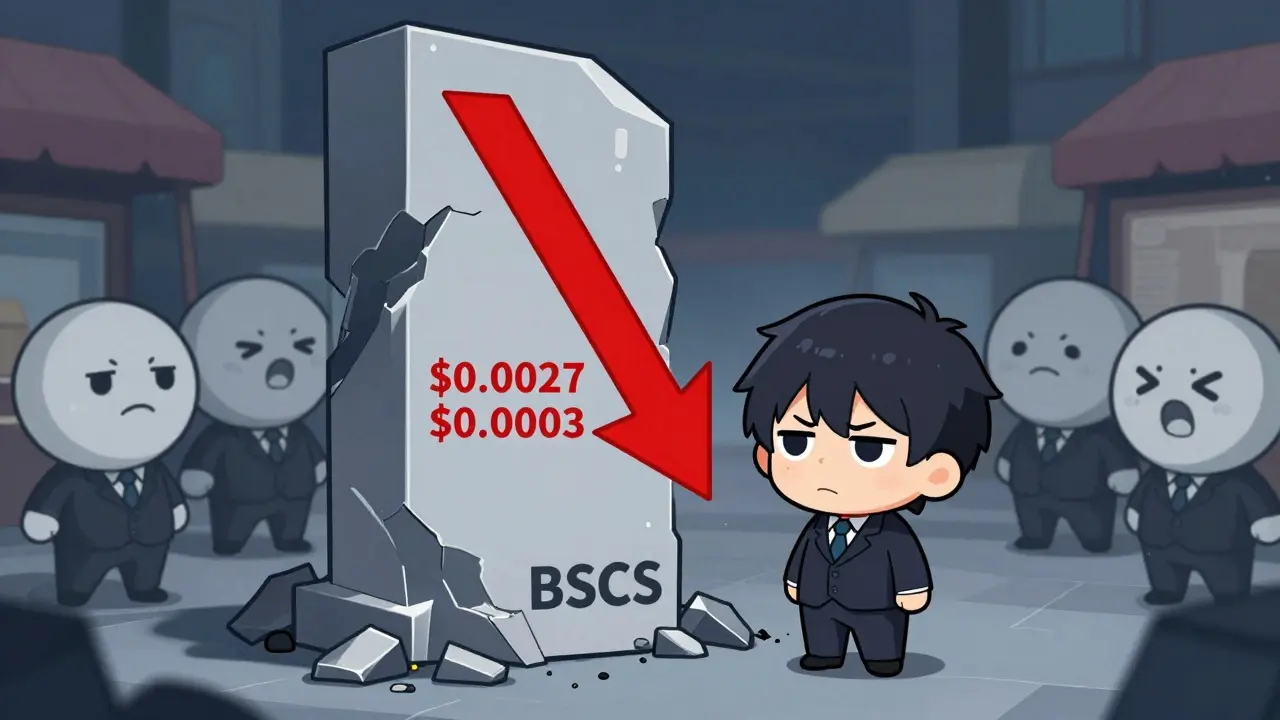
If you look at charts from 2021 or even 2025, BSCS looked like a rising star. But by July 2026, the picture has shifted dramatically. The token has experienced significant contraction in value and interest.
| Metric | May 2025 Snapshot | July 2026 Snapshot |
|---|---|---|
| Price per Token | $0.0027 USD | $0.0003 USD |
| Market Cap | ~$694,000 USD | ~$76,000 USD |
| 24-Hour Volume | ~$17,000 USD | ~$13 - $45 USD |
| Market Rank | #3,800 range | #4,700 range |
The drop in daily trading volume is the most telling metric here. With volumes often dipping below $50 USD in a day, liquidity is extremely thin. This means buying or selling even a modest amount of BSCS could cause massive slippage-your trade might move the price significantly against you. For context, major DeFi protocols handle millions in volume daily; BSCS is currently operating in the micro-cap, high-risk zone.
How Does BSCS Work Technically?
BSCS isn't a Layer 1 blockchain itself. It operates entirely on the Binance Smart Chain, leveraging its EVM-compatible environment. This allows BSC Station to deploy smart contracts that interact seamlessly with other BSC-based apps.
The protocol uses the BSCS token as a utility asset. Historically, this meant using BSCS to pay for launchpad fees, stake in yield farms to earn rewards, or bid in NFT auctions. Because it sits on BSC, transactions are generally fast and cheap compared to Ethereum mainnet, which was part of its initial appeal for small-scale project launches.
However, the lack of recent technical updates or major partnerships suggests development momentum has slowed. While the codebase remains active enough to keep listings updated on trackers, there are no visible signs of large-scale institutional adoption or new feature rollouts in 2026.
Risks and Considerations for Investors
Before interacting with BSCS, you need to weigh the risks carefully. Here is what you should know:
- Liquidity Risk: With such low volume, exiting a position can be difficult. You might find yourself unable to sell at your desired price because there simply aren't enough buyers.
- Data Discrepancies: As noted earlier, different sites report different supply and market cap figures. This lack of standardized data makes fundamental analysis harder.
- Competition: The DeFi space is crowded. Larger launchpads and NFT marketplaces have captured most of the user base, leaving niche players like BSC Station struggling for visibility.
- No Major Exchange Listings: BSCS is primarily traded on decentralized exchanges (DEXs). It lacks support on major centralized exchanges (CEXs), limiting access for mainstream investors.
There are also no publicly available security audits from top-tier firms in recent years. In DeFi, unverified smart contracts carry inherent risk. Always assume that if something goes wrong technically, recourse is limited.

Is BSCS Still Relevant?
For the average crypto enthusiast looking for stable growth or heavy utility, BSCS likely doesn't fit the bill in 2026. Its role as a foundational infrastructure provider hasn't materialized at scale. Instead, it exists as a speculative asset with a passionate but small community.
That said, micro-caps can surprise. If the team behind BSC Station announces a major partnership, a new product line, or lists on a larger exchange, volatility could spike again. But right now, it serves more as a case study in how quickly market sentiment can shift in the crypto world.
If you are already holding BSCS, monitor the wallet balances closely and consider the opportunity cost. If you are thinking of buying, proceed with extreme caution. Only invest what you can afford to lose entirely, given the illiquid nature of the asset.
Final Thoughts
BSCS started with a strong mission to unify DeFi and NFT infrastructure on Binance Smart Chain. While the technology worked, the market moved on to bigger, more liquid platforms. Today, it stands as a reminder that in crypto, execution and community retention matter just as much as the initial idea. Keep an eye on official channels for any unexpected developments, but manage your expectations realistically based on current metrics.
What is the current price of BSCS in 2026?
As of mid-July 2026, the BSCS token trades at approximately $0.0003 USD. Prices fluctuate rapidly due to low liquidity, so check live data on trusted aggregators before trading.
Is BSCS a good investment right now?
BSCS is considered a high-risk, micro-cap asset. With very low trading volumes and declining market cap, it carries significant liquidity risk. It is not suitable for conservative investors and should only be approached by those comfortable with potential total loss.
Where can I buy BSCS tokens?
BSCS is primarily available on decentralized exchanges (DEXs) that support the Binance Smart Chain, such as PancakeSwap. It is not currently listed on major centralized exchanges like Binance or Coinbase.
What is the maximum supply of BSCS?
The maximum supply of BSCS is capped at 500,000,000 tokens. This fixed limit prevents infinite inflation, though the circulating supply is currently around 255-270 million tokens.
Does BSC Station still offer IDO and NFT services?
While the platform was designed to offer IDOs, INOs, and NFT auctions, activity levels have dropped significantly. Users should verify the current functionality of specific modules directly on the BSC Station website before attempting to use them.