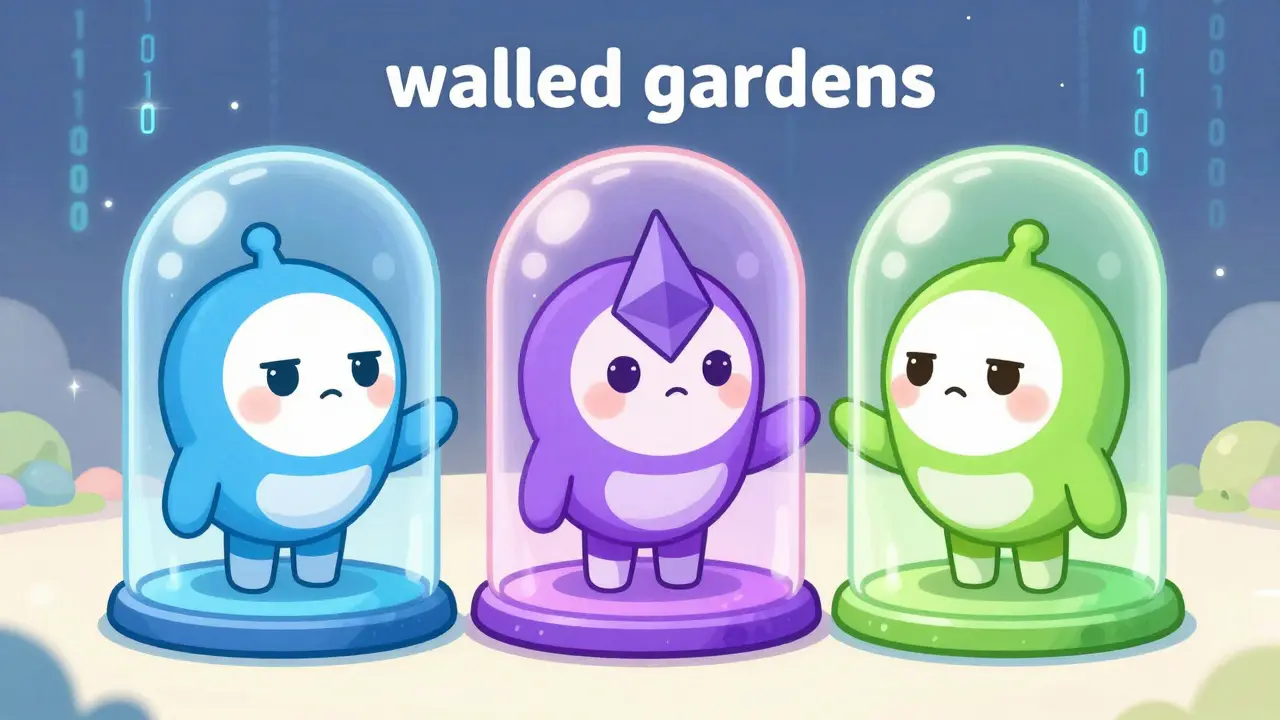
Imagine if your email only worked with other people using the same provider, or if you couldn't send money between different banks without a week of paperwork. That's exactly how blockchains started. For years, networks like Bitcoin and Ethereum existed as "walled gardens"-isolated ecosystems that couldn't talk to each other. If you wanted to move an asset from one to another, you were essentially stuck. cross-chain interoperability is the technology that breaks those walls down, allowing different blockchains to share data and value without needing a middleman to hold your hand.
When we talk about interoperability, we aren't just talking about sending a coin from point A to point B. We're talking about a future where a smart contract on Solana can trigger an action on Ethereum, or a piece of data from a private corporate chain can verify a transaction on a public one. It is the "internet of blockchains," transforming a fragmented landscape into a single, fluid web of value.
The Core Problem: Liquidity Fragmentation
Why do we even need this? Right now, the blockchain world suffers from a massive "composability crisis." When liquidity is split across ten different chains, no single chain has enough depth to handle massive trades efficiently. This fragmentation creates friction for users and limits the growth of decentralized apps (dApps). If you have assets on three different networks, you're managing three different wallets and paying three different sets of gas fees just to move your own money.
Interoperability solves this by creating a unified ecosystem. Instead of forcing every user into one giant blockchain (which would lead to congestion and high fees), we can have many specialized chains-some for fast gaming, some for secure finance, some for identity-that all communicate seamlessly. This allows developers to build applications that leverage the best features of multiple networks simultaneously.
How It Works: The Technical Approaches
There isn't just one way to connect blockchains. Depending on whether you prioritize speed, security, or decentralization, you'll see different architectures in play. Here are the most common methods used today.
Blockchain Bridges
Blockchain Bridges is a mechanism that connects two different blockchain networks by locking assets on one chain and minting a representative version on the other . For example, if you move ETH to Solana via a bridge like Wormhole, your original ETH is locked in a smart contract on Ethereum, and "wrapped" ETH is issued to you on Solana. While convenient, this introduces custodial risk; if the bridge's locking contract is hacked, the wrapped assets become worthless.
Atomic Swaps
If bridges feel too risky, Atomic Swaps offer a peer-to-peer alternative. These use hash time-locked contracts (HTLCs) to ensure a trade happens entirely or not at all. Think of it like a digital escrow: "I'll give you my Bitcoin only if you give me your Litecoin within 60 minutes; otherwise, we both get our coins back." This eliminates the need for a third party and removes the risk of one person stealing the funds.
Protocol-Level Standards
Some ecosystems build connectivity directly into their DNA. The Inter-Blockchain Communication (IBC) protocol, used extensively by the Cosmos Network, defines a standard set of rules for how chains should talk. It's like a universal language for blockchains. Because it's baked into the protocol, it's generally more reliable than a third-party bridge, though it usually requires chains to use the same consensus engine, like Tendermint.
Oracle-Based Messaging
For a more flexible, "blockchain-agnostic" approach, we have solutions like Chainlink's Cross-Chain Interoperability Protocol (CCIP). Unlike IBC, CCIP doesn't require chains to be built on the same framework. It uses a network of decentralized oracles to verify and pass messages between completely different environments (like a private bank chain and the public Ethereum network). This makes it an enterprise favorite, as seen in pilots with Swift.
| Solution | Primary Mechanism | Key Advantage | Major Trade-off |
|---|---|---|---|
| IBC | Light Client / Protocol | High reliability (97.3%) | Requires Tendermint consensus |
| CCIP | Decentralized Oracle | Enterprise-grade security | Higher gas costs (avg 0.045 ETH) |
| Wormhole | Lock-and-Mint Bridge | Wide network support (14+ chains) | Higher custodial risk |
| Atomic Swaps | HTLCs (P2P) | No counterparty risk | Slower, limited to simple swaps |

The Risks: Why It Isn't Perfect Yet
If this sounds like a magic bullet, remember that moving data between chains is incredibly dangerous. The most glaring issue is the "security gap." Different chains have different consensus rules. Bitcoin's Proof-of-Work takes about 10 minutes to reach finality, while Solana can do it in 2.6 seconds. If a cross-chain message is sent based on a transaction that later gets reversed due to a chain reorganization (a "re-org"), you end up with a critical security failure.
We've seen this play out in the real world. In February 2022, Wormhole suffered a $325 million exploit, proving that bridges are often the weakest link in the security chain. Even more recently, in July 2024, THORChain lost $4.8 million due to a messaging vulnerability. These aren't just "glitches"; they are systemic risks that institutional investors are terrified of.
Then there's the programming language barrier. Writing a smart contract in Solidity (Ethereum) is completely different from writing one in Rust (Solana) or Go (Cosmos). Creating a bridge that can translate a complex logical command from one language to another without introducing bugs is a monumental task for developers.

The Future: Intent-Based Routing and ZK-Bridges
We are moving away from the "clunky bridge" era. The next frontier is intent-based routing. Instead of a user manually picking a bridge and managing assets on two chains, they simply state their "intent": "I want 100 USDC on Arbitrum using my funds on Polygon." The network then finds the most efficient, cheapest, and safest path to make that happen in the background.
We're also seeing the rise of Zero-Knowledge (ZK) bridges. By using ZK-proofs, a chain can prove that a transaction happened on another chain without needing to trust a third-party oracle or lock up massive amounts of collateral. Research from Stanford indicates that these ZK-proofs can reduce verification costs by up to 89%, making cross-chain movement cheaper and faster for everyone.
By 2027, it's expected that the majority of enterprise blockchain projects will rely on these capabilities. We are shifting from a world of "which blockchain is better?" to a world where the blockchain you use is invisible, and only the service you're accessing matters.
Is cross-chain interoperability the same as a blockchain bridge?
Not exactly. Interoperability is the broad goal-the ability for chains to communicate. A bridge is just one specific tool used to achieve that goal. While bridges focus on moving assets, interoperability also includes moving data, triggering smart contracts across chains, and sharing state.
Which is safer: IBC or CCIP?
It depends on your needs. IBC is generally more reliable for chains within the Cosmos ecosystem because it uses light client verification. CCIP is designed for broader, enterprise-grade use and includes advanced risk management like anomaly detection and circuit breakers, which are crucial for institutional finance.
Why do some cross-chain transfers take so long?
This is usually due to "finality." The destination chain must wait until the source chain's transaction is deeply buried in the block history to ensure it won't be reversed by a chain re-org. This is why moving funds from Bitcoin (10-minute blocks) takes much longer than moving funds between Layer-2s.
What is the risk of using a "wrapped" token?
The risk is custodial. A wrapped token is only as valuable as the original asset locked in the bridge's vault. If the bridge is hacked and the original assets are stolen, the wrapped tokens you hold become unbacked and essentially worthless.
Can I use cross-chain interoperability without a wallet?
Currently, you need a compatible wallet to sign transactions. However, the industry is moving toward "account abstraction," which will allow you to interact with these protocols through a more traditional user interface, hiding the complex cross-chain movements from the end user.
Next Steps for Users and Developers
If you're a regular user, the safest way to explore this is through established DEXs like Osmosis that use native protocols like IBC. Always double-check the liquidity of the bridge you're using and avoid keeping large amounts of assets in "wrapped" form for long periods.
For developers, the path depends on your target audience. If you're building for the Cosmos ecosystem, start with the IBC documentation. If you're building an enterprise application that needs to touch multiple EVM chains or traditional finance systems, Chainlink's CCIP SDK is the current industry standard. Expect a learning curve of roughly 2 to 6 months to fully master custom cross-chain logic.



Prachi Bhadarge
April 20, 2026 AT 12:57Oh sure, just trust the bridge with your entire life savings. What could possibly go wrong?
I've seen enough 'secure' bridges vanish into thin air to know that wrapped tokens are basically just digital IOUs from people who might get hacked tomorrow.
Sandeep Bhoir
April 20, 2026 AT 14:01Sure, because the industry is just famous for its flawless security track record.
Atomic swaps are a nice dream, but actually finding a peer to swap with who isn't a bot or a scammer is the real challenge here.
Robert Preston
April 20, 2026 AT 19:22If you're looking to get started, I'd highly recommend spending some time with the IBC documentation if you're in the Cosmos space. It's a bit of a steep climb initially, but understanding how light clients actually verify state is the only way to truly grasp why it's more secure than a standard lock-and-mint bridge.
Keri Pommerenk
April 21, 2026 AT 22:08this is a great breakdown of a complex topic thanks for sharing
Luke George
April 21, 2026 AT 23:35Funny how this 'internet of blockchains' always seems to benefit the big players and the central entities they claim to replace. They want us to believe in this seamless web while they build backdoors into these messaging protocols. It's all just a way to keep us in a different kind of walled garden, just with more fancy names like CCIP to make it sound corporate and safe. Just follow the money and you'll see who actually owns the 'infrastructure' they're pushing on us.
Shantal Sanjur
April 22, 2026 AT 23:14Imagine actually believing that ZK-proofs are the magic bullet for everything.
The sheer arrogance of thinking a mathematical proof solves the human element of greed and bridge exploits is honestly hilarious. We're just trading one set of vulnerabilities for another and calling it progress.
Sean Mitchell
April 24, 2026 AT 09:59The prose here is almost tolerable, but the sheer optimism regarding 2027 is simply exhausting.
One can only hope that by then we'll have stopped pretending that 'intent-based routing' isn't just a fancy term for 'trusting a third-party solver with your keys'.
Thomas Jewett
April 25, 2026 AT 18:18It is an absolute travesty that the American spirit of innovation is being diluted by these globalist protocols that try to homogenize every single chain into one boring soup of value and we really need to start prioritizing US-based infrastructure over these random international standards that dont even care about our national security interests in the long run!! Someone has to stand up and say that the fragmentation is actually a feature because it prevents a single global failure from wiping out everything weve built here in the states.
Michael Harms
April 26, 2026 AT 03:00Keep pushing forward guys! It's awesome to see the tech evolving. Even if it's scary now, the shift toward making the blockchain invisible is exactly what we need for the next billion users to actually care about this stuff.
Trudy Morse
April 28, 2026 AT 00:27Connectivity is just a mirror of human longing. We want to connect because isolation is an illusion.
Kevin Lư
April 29, 2026 AT 16:18Haha, I'm just here for the chaos when the next bridge blows up. But for real, the idea of 'invisible blockchain' is pretty cool, almost makes me want to actually use a dApp again.
Saurav Bhattarai
April 30, 2026 AT 19:12Only a complete amateur would think that 'enterprise-grade' means anything other than 'we have a lawyer who says this is okay'.
The arrogance of thinking CCIP is the 'standard' when it's basically just a corporate middleman is peak comedy. India is leading the real dev work while the US just markets the vaporware.
Abhinav Chaubey
May 2, 2026 AT 09:16The technical superiority of the Indian dev community is obvious here. We don't need these bloated Western standards when we can build lean, mean, and efficient protocols. The fact that the author even mentions Swift as a success is a joke-Swift is a dinosaur that's just trying to survive by clinging to blockchain buzzwords.
siddharth narula
May 3, 2026 AT 23:43One must ponder if the pursuit of interoperability is not merely a pursuit of vanity. 🌟 We seek to unify that which is naturally diverse, perhaps ignoring the wisdom found in the boundaries themselves. 📜
Yuhan Mo
May 4, 2026 AT 21:35The latency issues mentioned regarding finality are quite significant. From a systems architecture perspective, the trade-off between safety and liveness is the core friction here. Using ZK-proofs to mitigate the verification overhead is a sound approach to reduce the trust assumptions usually required by cross-chain messengers.
Karen Mogollon Gutierrez
May 5, 2026 AT 12:18The sheer audacity of suggesting a learning curve of only six months for a developer to master cross-chain logic is an absolute insult to the profession!
It is an utter travesty to oversimplify the complexities of asynchronous cross-chain state transitions for the sake of a 'guide'. This is practically negligence!
Tracy Sperandio
May 5, 2026 AT 22:37Let's get pumped about this! The potential for a seamless web of value is absolutely electrifying!
Imagine the creative explosion when we can mix and match the best features of every chain like a digital buffet! Total game changer!
Ankit Sindhu
May 6, 2026 AT 18:56For anyone struggling with the concepts, just think of it as translating languages. You don't need to know every word of Rust to use a service that was built with it, as long as the 'translator' (the interoperability layer) is reliable. Take it one step at a time.
Adam Mann
May 8, 2026 AT 00:26I really love how this is all coming together! It's like we're building a giant bridge for everyone to walk across. At first, it might seem a bit scary and some parts might be wobbly, but if we all help each other out and keep learning, we can make it a safe place for everyone. I remember when I first started with crypto, I was so confused by all the different names, but seeing it become one big happy family of networks is just wonderful. Let's just be kind to each other and keep exploring this wild new world together, because there's enough room for all of us to succeed regardless of which chain we prefer!
Anna Grealis
May 8, 2026 AT 16:17The 'invisible' part is what scares me.
Once it's invisible, how do you even know where your money is? It's just another layer for them to hide the glitches and the thefts behind a pretty UI. Typo or not, the whole system is a house of cards waiting for a breeze.