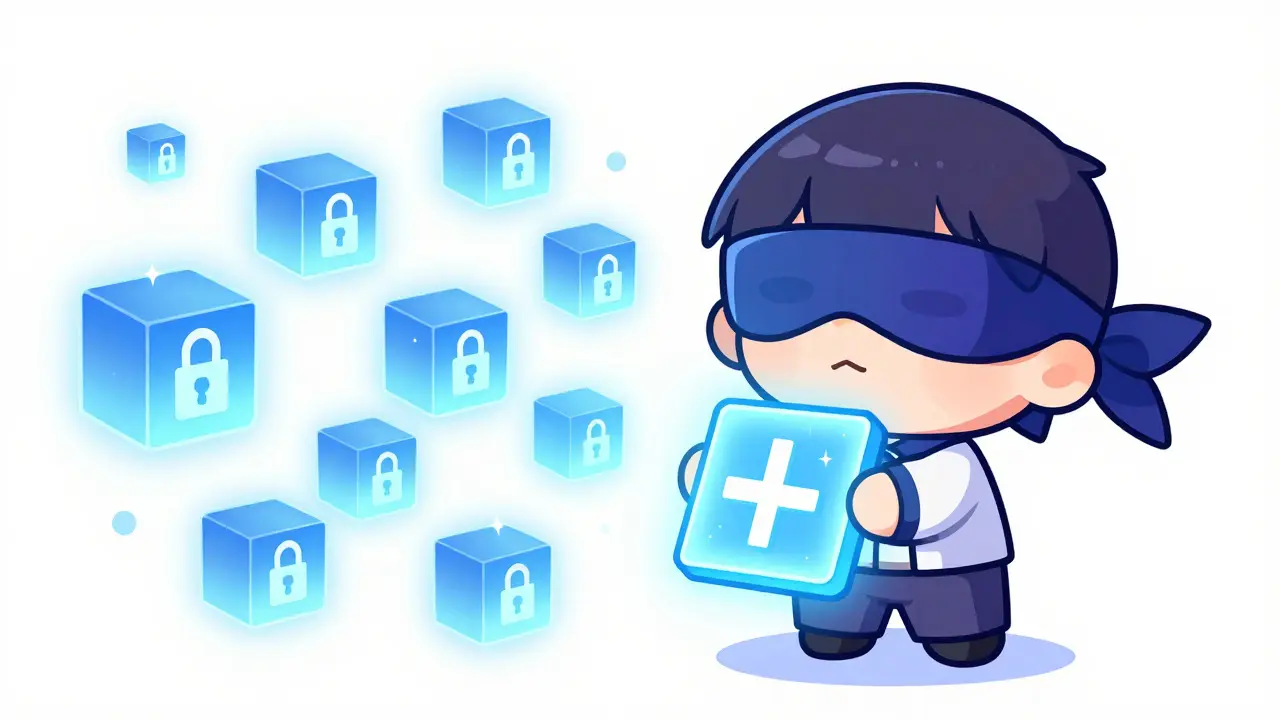
Imagine if you could give a calculator a math problem using your bank balance, and the calculator could tell you the answer without ever actually seeing how much money you have. That sounds like magic, but it is exactly what Nillion is a decentralized secure computing network that allows data to be processed without ever being decrypted. Also known as the NIL network, it aims to solve the biggest headache in the digital age: how to use sensitive data without risking a leak. Most blockchains are like glass boxes-everyone can see what is happening inside. Nillion is different. It introduces a concept called "blind computation," which ensures that your private information remains a secret even while it is being worked on. This makes Nillion NIL crypto more than just another token; it is the fuel for a system that decentralizes trust for high-value data.
The Secret Sauce: How Blind Computation Works
In a normal computer system, if you want to analyze a piece of data, you have to decrypt it first. This creates a "danger zone" where a hacker or a rogue employee can steal the plain text. Nillion eliminates this window of vulnerability. Through blind computation, the network performs calculations on encrypted data. The data stays masked from the moment it is stored until the result is delivered.
To make this happen, Nillion uses Privacy-Enhancing Technologies (PETs), a category of cryptographic tools that protect data privacy during processing . Two heavy hitters in this category are Multi-Party Computation (MPC), which splits data among different nodes so no single party sees the whole picture, and Homomorphic Encryption (HE), which allows mathematical operations to be performed directly on ciphertexts. By combining these, Nillion ensures that the nodes doing the work are "blind" to the actual information they are processing.
Breaking Down the Nillion Architecture
Nillion isn't just one single program; it is a layered stack designed to keep things fast and secure. If you think of it as a city, the layers work like this:
- The Processing Layer: This is where the actual "magic" happens. It uses complex algorithms to run the blind computations.
- The Coordination Layer (NilChain): Think of this as the city's administration. NilChain is the blockchain-like environment that handles payments, node communication, and governance . It doesn't store the data itself; it just manages the traffic.
- The Connectivity Layer: This is the gateway. It allows Nillion to talk to other blockchains and external systems, making it useful for developers who aren't building exclusively within the Nillion ecosystem.
A major shift happened in early 2026 when the project migrated to an Ethereum Layer 2. By moving away from its original Cosmos roots, Nillion tapped into the massive Ethereum developer pool. They also introduced Nillion Blacklight, a verification layer that lets the community run permissionless nodes, making the network even more decentralized.
| Feature | Standard Blockchain | Nillion (NIL) |
|---|---|---|
| Data Visibility | Publicly viewable (usually) | Always Encrypted (Blind) |
| Processing Method | Decrypt $\rightarrow$ Compute $\rightarrow$ Re-encrypt | Compute on encrypted data |
| Trust Model | Trust in consensus/code | Decentralized trust for data |
| Primary Use Case | Transactions & Smart Contracts | Secure Data Processing & AI |

The Role of the NIL Token
You can't have a decentralized network without a way to pay the people providing the hardware. That is where the NIL Token is the native utility and governance cryptocurrency of the Nillion ecosystem . With a total supply of 1 billion tokens, NIL does several jobs at once.
First, it handles the bills. If a company wants to run a blind computation on its medical records, it pays a fee in NIL tokens. These fees go to the nodes that provide the computational power. Second, NIL is used for staking. By locking up their tokens, holders help secure the Coordination Layer. This follows a delegated proof-of-stake model, meaning if you stake your NIL, you get a say in how the network evolves through governance voting.
The market journey for NIL has been a rollercoaster. After its launch, reports from CoinDesk in March 2025 showed a 12% dip in value within the first 24 hours, even after being listed on exchanges like Bithumb. However, long-term interest remains high because the tech solves a real problem: the AI data hunger.
Real-World Use Cases: Why This Matters
It is easy to get lost in the cryptography, but the practical applications are where Nillion actually wins. The most exciting frontier is Artificial Intelligence, computer systems able to perform tasks that normally require human intelligence . Right now, AI is a privacy nightmare-you have to feed your data into a central server to get an answer. Nillion allows for "Private Personalized AI," where an AI can learn from your specific health or financial data without that data ever leaving your control or being seen by the AI provider.
Beyond AI, Nillion is eyeing other sectors:
- Healthcare: Hospitals could collaborate on research by computing shared data patterns without ever exposing individual patient identities.
- DeFi (Decentralized Finance): Trading can become more secure when the underlying data is masked, preventing "front-running" and other predatory tactics.
- DePIN (Decentralized Physical Infrastructure Networks): Nillion can act as the secure backend for IoT networks, ensuring that data from smart sensors in agriculture or supply chains isn't intercepted.

Potential Pitfalls and Things to Watch
No technology is perfect. Blind computation is computationally expensive. Performing math on encrypted data is significantly slower than doing it on plain text. While Nillion's architecture optimizes this, there is always a trade-off between absolute privacy and raw speed.
Additionally, the success of NIL depends heavily on developer adoption. The migration to Ethereum Layer 2 was a smart move to attract builders, but the network needs a "killer app"-a reason for millions of people to use blind computing daily-to truly move from a niche technical marvel to a global standard.
What exactly is blind computation?
Blind computation is a process where data is processed while remaining encrypted. Unlike traditional computing, where data must be decrypted to be analyzed, Nillion uses cryptography to allow nodes to perform calculations on "masked" data. This means the nodes providing the service never see the actual information they are processing.
How is NIL different from a regular coin like Ethereum?
While Ethereum is a general-purpose platform for smart contracts and apps, NIL is specifically designed for secure computation. It doesn't just record transactions; it provides the infrastructure to process sensitive data privately. Think of Ethereum as a digital ledger and Nillion as a secure, blind digital vault that can also do math.
Can I stake NIL tokens?
Yes, NIL token holders can stake their coins to help secure the Coordination Layer. This is done through a delegated proof-of-stake model, which allows you to earn rewards and participate in the governance of the network.
Is Nillion still based on Cosmos?
No. In early 2026, Nillion completed a strategic migration to an Ethereum Layer 2. This move was intended to give the project access to a larger ecosystem of developers and tools, though it retains its core blind computing capabilities.
What are the main risks of investing in NIL?
The primary risks include the technical complexity of the project, the potential for slower processing speeds compared to centralized systems, and the volatility of the crypto market. Additionally, the token's value depends on how many developers actually build apps using Nillion's secure computing layers.
Next Steps for Users
If you are a developer, the first stop is exploring Petnet to see how to integrate privacy-enhancing technologies into your app. For investors, keep an eye on the growth of the Nillion Blacklight layer-the more permissionless nodes that join, the more decentralized and robust the network becomes. If you're just curious about privacy, look for the first wave of "Private AI" apps that leverage NIL to handle your data without spying on you.



John and Lauren Busch
April 15, 2026 AT 16:59Sure, because waiting ten times longer for a calculation is exactly what the world needs right now.
Robert Preston
April 17, 2026 AT 02:25The bottleneck here is definitely the computational overhead of MPC and HE. While the privacy gains are massive, we need to see benchmarks on latency before this scales for real-time DeFi applications. It's a significant step forward for sensitive data, but the trade-off is real.
Alex Long
April 18, 2026 AT 00:37Too much tech talk. It's just another coin that'll dump.
Shantal Sanjur
April 19, 2026 AT 14:26Oh, absolutely! Let's just trust a 'blind' network with our medical records while the developers probably have a back door anyway. Such a revolutionary idea, if you enjoy being a lab rat for an L2 migration that probably just happened to pump the token. Please, tell me more about how 'secure' it is while we all ignore the fact that the energy cost for this kind of encryption is a total joke.
Kim Smith
April 20, 2026 AT 02:38it really makes you think about the nature of trust in the digital age dont it... like we've always been forced to trade our privacy for convenience but maybe this is a way to finally break that cycle although i wonder if the actual implementation of these PETs is truly decentralized or if there's some hidden layer of control that we just dont see because the math is so complex that only three people in the world actually understand it and the rest of us are just following the hype train of the NIL token without really grasping the metaphysical shift in how data ownership works in a post-privacy world where the blind compute is the only thing keeping us from total surveillance.
Tracy Sperandio
April 20, 2026 AT 02:46This is an absolute game-changer for the AI landscape! 🚀 Imagine the synergy when private data meets blind computation-it's a symphony of security and innovation that we've been waiting for! Let's push these boundaries and redefine what's possible in the decentralized web!
Luke George
April 21, 2026 AT 22:06L2 migration is just a way to tie it to the Ethereum whale's wallet. The real control is always behind the scenes.
Chintu Parikh
April 23, 2026 AT 15:03I find the integration of Multi-Party Computation quite fascinating. It is truly an honor to witness such technological progression in the realm of data privacy. I believe this will foster a great deal of collaboration between healthcare institutions globally, provided the implementation remains transparent and accessible to all stakeholders involved in the process.
Gaurav Undirwade
April 25, 2026 AT 09:54One must question the morality of such systems. If data is processed blindly, who is held accountable for the outcomes of the computation? The pursuit of privacy must not supersede the necessity of ethical oversight and transparency in the digital domain.
Shannon Kelly Smith
April 25, 2026 AT 23:59Keep grinding, devs! 🛠️ This is exactly the kind of infrastructure we need to make Web3 actually useful for the average person. If you're just getting into this, check out the documentation for Blacklight! 🌟
Michael Harms
April 27, 2026 AT 07:38Love the vibe of this project! It's all about empowering the user to keep their own keys and their own data. Totally a win-win for everyone if they can get the speed issues sorted out.
nikki krinkin
April 28, 2026 AT 03:53It's nice to see a project focusing on the actual utility of data rather than just speculation.
Kaitlyn Wu
April 29, 2026 AT 23:52We need to be very clear about the boundaries of what 'blind' actually means here. It's not a magic shield. The security depends on the honesty of the node distribution, and if a majority of nodes are compromised, the privacy model could theoretically collapse. Stay critical.
Ankit Sindhu
April 30, 2026 AT 02:46I'm seeing a lot of skepticism, but let's remember that every major tech shift starts with these 'inefficiencies.' The transition from Cosmos to Ethereum L2 shows they're listening to the community.
Sean Douglas
May 1, 2026 AT 17:50The sheer audacity of claiming a 12% dip is just a 'rollercoaster' is absolutely heartbreaking. My portfolio is weeping tears of blood while we discuss the 'metaphysical shift' of a network that basically asks us to trust a blind calculator with our life savings. It's a tragic comedy in the making, really.
Gillian Kent
May 2, 2026 AT 03:19i think its cool how they try to make it work across differnt chains even if there are some typos in the docs sometimes lol
Anna Grealis
May 3, 2026 AT 03:38They say its decentralized but the nodes are probably all in one data center in virginia. typical.
Ian Chait
May 4, 2026 AT 00:48Absolute rubbish. This is just more obfuscation for the globalists to hide their tracks using fancy jargon like 'homomorphic encryption' to trick the masses into thinking their data is safe while the state-level actors just bypass the whole thing with a quantum leap. Total shambles.
Nishant Goyal
May 4, 2026 AT 07:58Solid tech. Worth watching.
nathan jones
May 4, 2026 AT 14:48Cool concept. Hope it works.
Karen Mogollon Gutierrez
May 6, 2026 AT 03:16It is truly an affront to my sensibilities that such a critical flaw as computational latency is brushed aside as a mere 'trade-off.' One must wonder if the architects of this system possess any shred of competence, or if they are simply orchestrating a grand facade to lure the gullible into a digital abyss of inefficiency. The sheer lack of urgency regarding the processing speeds is nothing short of a catastrophe.
Mike Kempenich
May 6, 2026 AT 22:10I'm optimistic that the L2 move will bring in the talent needed to fix those speed issues. Every great project has a rough start, but the utility here is too good to ignore. Let's give it time to mature!