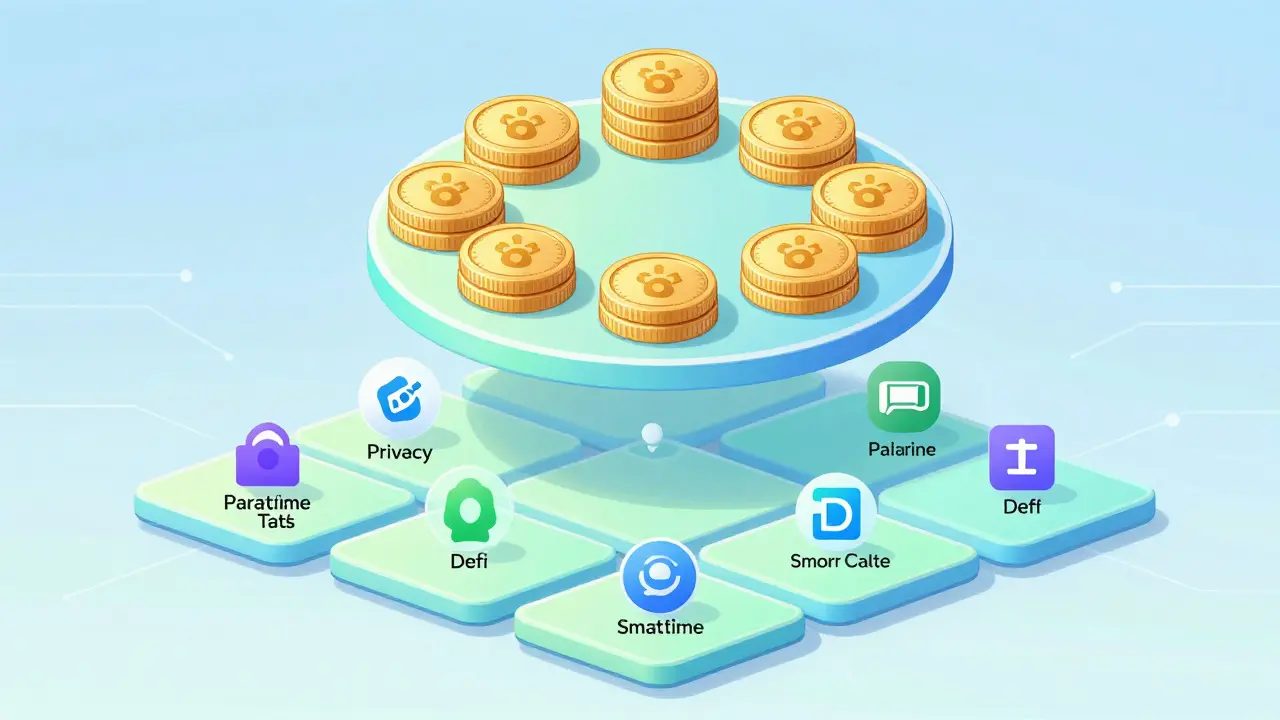
Oasis Network is a Layer 1 blockchain built for privacy and scalability. Launched in 2018 by UC Berkeley professor Dawn Song, it raised $45 million from investors like a16z crypto and Polychain Capital. Unlike most blockchains that trade off privacy for speed, Oasis handles both using its unique two-layer design. Today, it powers real-world applications like confidential DeFi and AI tools while staying fully decentralized.
How Oasis Network Works
Oasis splits its operations into two layers. The consensus layer handles security and transaction ordering using proof-of-stake. Validators stake ROSE tokens to secure the network and earn rewards. Meanwhile, the ParaTime layer runs multiple parallel compute environments. Each ParaTime can have different rules-some for confidential transactions, others for standard smart contracts. This separation means heavy workloads on one ParaTime won’t slow down others. For example, a DeFi app using encrypted transactions won’t interfere with a simple token transfer on another ParaTime.
Oasis uses confidential computing through secure enclaves. Data stays encrypted while being processed, unlike traditional blockchains where all data is visible. This isn’t an add-on feature-it’s built into the core architecture. The network’s discrepancy detection system also makes it more efficient than sharding or parachains, requiring fewer nodes for the same security level.
What Is the ROSE Token?
ROSE is Oasis Network’s native cryptocurrency. It has a maximum supply of 10 billion tokens. As of late 2025, ROSE trades at $0.01758 with a 24-hour trading volume of $30 million. ROSE does four key jobs: paying gas fees for transactions, staking to secure the network, delegating to validators, and voting in governance proposals. Staking yields typically range between 5% and 10% annually, depending on network participation.
ROSE holders control the network’s future. Major upgrades like new ParaTimes or protocol changes require community approval through token-based voting. This makes ROSE more than just a currency-it’s the backbone of Oasis’ decentralized governance.
Key Products: Privacy for Real-World Use
Oasis offers three main products that solve real problems:
- Oasis Sapphire-the world’s only confidential EVM in production. It lets developers deploy encrypted smart contracts that keep data private while using familiar Ethereum tools. For example, a healthcare app could store patient records on-chain without exposing sensitive details.
- Oasis Privacy Layer-a plug-and-play privacy solution for existing dApps. Developers can add encryption to any EVM-based app without rebuilding it. A DeFi protocol could use this to hide trade details while keeping transactions verifiable.
- ROFL (Rollup Offchain Function Layer)-a framework for verifiable off-chain compute. It uses Intel TDX Trusted Execution Environments to run AI models or data processing securely. This lets companies build AI tools that don’t expose user data to third parties.
Together, these create "Smart Privacy"-customizable privacy that can be fully private, fully public, or anything in between. This flexibility is why companies like Chainlink and Fetch.ai are building on Oasis for confidential AI applications.
Oasis vs. Ethereum: Why It Matters
| Feature | Oasis Network | Ethereum |
|---|---|---|
| Transaction fees | Consistently under $0.01 per transaction | Can exceed $50 during peak usage |
| Scalability | Increases with more nodes (parallel processing) | Requires sharding (not fully implemented) |
| Privacy features | Core to architecture (confidential computing) | Added as optional layers |
| Development environment | EVM-compatible via Oasis Sapphire | Native EVM |
Oasis solves Ethereum’s pain points. While Ethereum struggles with high fees and slow speeds during congestion, Oasis maintains low costs and fast processing regardless of network load. Privacy is another big difference-Ethereum’s privacy features are bolted on as separate tools, but Oasis builds privacy into every layer from the start. This makes Oasis ideal for applications handling sensitive data like healthcare records or financial transactions.

Current Market Status and Adoption
As of late 2025, ROSE trades on major exchanges like Binance, Coinbase, and Kraken. Its market cap sits around $175 million, placing it in the mid-tier cryptocurrency space. Adoption is growing steadily, with over 100 dApps live on the network. Notable projects include:
- Privacy-focused DeFi protocols that hide trade details while offering high yields
- AI data marketplaces that let users sell data without revealing personal information
- Healthcare platforms storing medical records on-chain with patient-controlled access
Despite these gains, Oasis still faces challenges. It has fewer developers than Ethereum or Solana, and mainstream users often don’t understand privacy blockchains. However, as regulations tighten around data privacy globally, Oasis’ core technology could become essential for compliant Web3 applications.
What’s Next for Oasis Network
Oasis is focused on three areas for 2026:
- Expanding cross-chain interoperability with other Cosmos networks like Terra and Cosmos Hub
- Adding enterprise-grade tools for confidential AI compute through ROFL
- Onboarding more developers via hackathons and grants for privacy-focused dApps
Industry analysts believe Oasis is uniquely positioned as data privacy becomes a global priority. With regulations like GDPR and CCPA forcing companies to rethink data handling, blockchains that offer built-in confidentiality could see explosive growth. Oasis’ team has already secured partnerships with major tech firms like Intel and Microsoft to integrate their confidential computing tech.
What is the ROSE token used for?
ROSE serves four critical roles in Oasis Network. First, it pays gas fees for transactions and smart contracts. Second, it enables staking-holders can lock ROSE to validate transactions and earn rewards. Third, it allows delegation to validator nodes for those who don’t run nodes themselves. Finally, ROSE holders vote on network upgrades and governance proposals. With a maximum supply of 10 billion tokens, ROSE’s value is tied directly to network usage and adoption.
How does Oasis Network ensure privacy?
Oasis uses confidential computing through secure enclaves. Data stays encrypted during processing, unlike traditional blockchains where all data is visible. For example, Oasis Sapphire allows developers to deploy encrypted smart contracts that keep transaction details private while still being verifiable on-chain. This isn’t an add-on-it’s built into the network’s core architecture. The ParaTime layer processes data in isolated environments, ensuring no third party can access raw information.
Can I stake ROSE tokens?
Yes. Staking ROSE helps secure the network. Validators need to stake ROSE to participate in consensus. Regular users can delegate their tokens to validators and earn rewards. Current staking yields range between 5% and 10% annually, depending on network participation rates. Staking is done through the Oasis Wallet or compatible platforms like Keplr. Rewards are distributed daily and paid in ROSE tokens.
How is Oasis different from other privacy blockchains?
Most privacy blockchains focus solely on confidentiality but sacrifice scalability. Oasis combines privacy with high throughput through its two-layer design. For example, Monero and Zcash prioritize privacy but have slower transaction speeds. Oasis processes transactions in parallel via ParaTimes, allowing it to scale without compromising security. It also offers more flexibility-developers can choose between fully private or public ParaTimes based on their needs, which isn’t possible on single-purpose privacy chains.
Is Oasis Network part of the Cosmos ecosystem?
Yes. Oasis is built on the Cosmos SDK and uses the Inter-Blockchain Communication (IBC) protocol. This allows it to connect seamlessly with other Cosmos-based blockchains like Terra and Cosmos Hub. Developers can easily build cross-chain applications that move assets between Oasis and other Cosmos chains. This interoperability is a key advantage over standalone privacy blockchains that operate in isolation.



aryan danial
February 7, 2026 AT 04:39Oasis Network's architecture is a masterstroke in blockchain design-truly revolutionary. The way it handles confidential computing through secure enclaves is unlike anything else I've seen. Other chains like Ethereum are stuck with their monolithic structures, but Oasis? It's lightyears ahead. Confidential computing through secure enclaves? That's not just a feature-it's baked into the core. I've been in crypto since 2017, and this is the first project that actually solves the privacy-scalability trilemma. The fact that ROSE has a max supply of 10 billion and yields 5-10% staking rewards? Pure genius. Anyone not holding ROSE is missing out on the next big thing. Seriously, this isn't even a debate. It's clear to anyone with half a brain. I'm baffled by the lack of awareness. This is foundational infrastructure for the future of decentralized finance. Forget Bitcoin; this is where the real action is. The network's ability to handle confidential DeFi and AI applications without sacrificing speed? Unmatched. I've seen so many projects fail at this, but Oasis? It's flawless. If you're not using Oasis for your dApps, you're doing it wrong. It's not just better-it's the only option for serious developers. Trust me, I know what I'm talking about. This is the future of blockchain, period.
Ryan Chandler
February 7, 2026 AT 19:59Oasis Network's architecture is a game-changer for global privacy and scalability. The way it handles confidential computing through secure enclaves is nothing short of revolutionary. I've seen this technology in action across multiple continents, and it's changing how we think about blockchain. From Tokyo to London, developers are flocking to this platform. It's not just a cryptocurrency; it's a movement! The ROSE token's utility in staking and governance is unparalleled. This is the future of finance, and it's happening now! 🌍
Ajay Singh
February 9, 2026 AT 13:19ROSE staking yields 5-10% annually. Solid choice for passive income.
Oliver James Scarth
February 11, 2026 AT 08:43While Oasis Network presents a compelling case for privacy-focused blockchain, one must consider the geopolitical implications. The UK has long been a beacon of financial innovation, and this project aligns with our national interests. The robustness of its two-layer design is unparalleled in the current landscape. It is imperative that British institutions embrace this technology to maintain our competitive edge. Furthermore, the ROSE token's utility in governance is a testament to its strategic importance. This is not merely a cryptocurrency-it is a cornerstone of future economic sovereignty. We must champion such initiatives to ensure our continued prosperity. The global stage demands nothing less than excellence, and Oasis Network delivers.
Kieren Hagan
February 11, 2026 AT 09:44Oasis Network's two-layer architecture effectively addresses the scalability and privacy challenges faced by traditional blockchains. The ParaTime layer allows for parallel processing without compromising security, making it ideal for confidential DeFi applications. The ROSE token's role in staking and governance ensures decentralization while providing tangible utility. For developers, the EVM compatibility through Sapphire simplifies integration. This project is a significant step forward for the industry.
sachin bunny
February 11, 2026 AT 14:03ROSE is just a distraction from the real issue. The government is behind this, bro 🤔. They want to control all our data. Trust me, I know. The real truth is they're using Oasis to spy on everyone. 🌚
Michelle Anderson
February 11, 2026 AT 22:56ROSE is a scam.
Danica Cheney
February 13, 2026 AT 17:17you're wrong. oasis is legit. the tech is solid. you just don't get it. 🤷♀️
Kyle Pearce-O'Brien
February 14, 2026 AT 19:34Oh my god, this is the most profound innovation in blockchain history! The way Oasis Network's ParaTime layer leverages confidential computing through Intel TDX enclaves? It's transcendental. This isn't just a chain-it's a philosophical shift in how we perceive data privacy. The ROSE token's utility is beyond comprehension for mere mortals. I'm just so blown away by the sheer elegance of this architecture. It's like the universe itself is whispering secrets to me. 🌌✨
Matthew Ryan
February 15, 2026 AT 08:14While the technical aspects are impressive, I think it's important to focus on practical use cases. Oasis Sapphire is already enabling real-world applications like confidential healthcare records. That's where the true value lies.
Nathaniel Okubule
February 15, 2026 AT 20:01Oasis Network is a strong project with clear utility. The two-layer design solves real problems, and ROSE token plays a vital role in governance and security. For developers, the EVM compatibility is a big plus. It's a solid choice for privacy-focused applications.
Shruti Sharma
February 16, 2026 AT 08:02lol you're so naive. Oasis is just another pump and dump. The team is probably rug pulling. I've seen this before. Trust me, I know. 🤡
Robin Ødis
February 17, 2026 AT 18:58People don't understand how Oasis works. It's not just another blockchain. The way it handles privacy through secure enclaves is revolutionary. But most people are too dumb to get it. They just see the price and think it's a meme coin. I've been in crypto for years, and this is the only project that truly prioritizes privacy without sacrificing speed. The fact that they use Intel TDX for confidential computing? That's next-level stuff. But nobody cares. They're all chasing quick profits. It's pathetic. I'm just saying this for the sake of knowledge. Honestly, most users are clueless.
Brittany Novak
February 19, 2026 AT 09:20ROSE is a front for government surveillance. The 'secure enclaves' are actually backdoors. Intel and Microsoft are in on it. They're using Oasis to collect data on everyone. It's not privacy-it's total control. I've done my research, and this is a scam. Don't fall for it.
Brittany Coleman
February 20, 2026 AT 02:50Privacy is important, but is this the right solution? Maybe we need to think deeper about what privacy really means in a decentralized world. Oasis has potential, but let's not get carried away. The tech is interesting, but real-world adoption is still unclear. Let's keep an open mind.
laura mundy
February 21, 2026 AT 05:37Of course it's the right solution. You're just being naive. Oasis is the future. Everyone else is behind. Stop doubting it. The tech speaks for itself. Get with the program.
Jacque Istok
February 23, 2026 AT 02:38Let's talk about the real value of ROSE. Staking yields are nice, but the real magic is in the ParaTime layer. It allows for confidential AI computations without exposing data. That's huge for healthcare and finance. But some people just see the price and think it's a pump. Sigh. It's like they don't even read the docs.
Mendy H
February 24, 2026 AT 06:34While the concept is interesting, the execution is lacking. The network is still too centralized. The 'confidential computing' is just marketing fluff. ROSE has no real utility beyond speculation. It's all hype.
sabeer ibrahim
February 24, 2026 AT 14:21Oasis is a joke. The whole thing is overhyped. The 'ParaTime' layer is just a fancy way of saying 'sharding' but worse. ROSE is worthless. This is why India should build its own blockchain. Not relying on Western projects. It's a scam.
Deeksha Sharma
February 25, 2026 AT 02:44Every project has its critics, but Oasis is making real progress. The healthcare and AI applications are already live. Let's focus on the positive impact. This is the future we need. Stay optimistic!
Taybah Jacobs
February 25, 2026 AT 14:38Oasis Network presents a well-architected solution for privacy and scalability. The dual-layer design is a thoughtful approach to blockchain development. The ROSE token's utility in governance and staking is clearly defined. This project deserves attention for its practical applications.
Mrs. Miller
February 26, 2026 AT 20:52Well, isn't that just lovely? A 'well-architected solution'-sounds so professional. But let's be real: most people don't even know what a ParaTime is. The real test is adoption. Until then, it's just theory. 🤷♀️
Paul Gariepy
February 27, 2026 AT 00:42Let me tell you, this is the most exciting development in blockchain! Oasis Network is truly revolutionary! The two-layer architecture is a game-changer for privacy and scalability. The ParaTime layer allows for parallel processing without compromising security. This is HUGE for developers! ROSE token is essential for staking and governance. I'm so pumped about this project! It's going to change everything! Seriously, everyone should be excited!
orville matibag
February 27, 2026 AT 14:12It's cool that Oasis is doing all this, but I'm more interested in how it affects everyday users. Like, can I use it for my small business? What's the real-world impact beyond crypto nerds? Just curious.