
Imagine handing over a $20 bill to buy coffee. You can’t hand that same physical bill to someone else five minutes later because you no longer have it in your pocket. But what happens when money exists only as data? If I send you a digital file representing one Bitcoin, why can’t I just copy-paste that same file and send it to my friend Charlie at the exact same time?
This isn’t just a theoretical glitch; it is the core vulnerability that almost killed digital cash before Bitcoin was even invented. It is called the double-spending problem, and solving it was the single biggest hurdle Satoshi Nakamoto had to clear to make decentralized money work.
The Core Issue: Why Digital Money is Tricky
In the physical world, scarcity is enforced by nature. A gold bar is heavy. A paper bill takes up space. You cannot be in two places at once. In the digital world, however, information is fluid. A text message can be copied and sent to a thousand people instantly without losing its original form. This ease of duplication is great for sharing memes but terrible for storing value.
If a digital currency system lacks a central authority to check who owns what, a user could theoretically create two transactions spending the same funds simultaneously. Let’s look at a concrete scenario:
- Alice has 1 Bitcoin (BTC) in her wallet.
- She sends 1 BTC to Bob to buy a laptop.
- At the exact same second, she sends that same 1 BTC to Charlie to pay for dinner.
- Without a way to verify which transaction happened first or if both are valid, the network might accept both. Alice now owes nothing, Bob and Charlie think they have been paid, and the total supply of Bitcoin has effectively increased by one coin out of thin air.
This creates inflation, destroys trust, and renders the currency worthless. Before blockchain technology, every attempt to create digital cash failed because this problem remained unsolved. Systems either relied on a central bank to say "no" or collapsed under fraud.
How Centralized Systems Handle It (And Why Crypto Needed More)
You might wonder, "Doesn’t Visa solve this?" Yes, but not through cryptography. When you swipe your credit card, Visa acts as the trusted intermediary. They maintain a single, authoritative ledger. When you try to spend money, Visa checks their database: "Does this person have enough balance? Has this specific transaction ID already been processed?" If the answer is yes, they approve it. If no, they decline it.
The catch is trust. You have to trust Visa, your bank, and the government behind them to keep that ledger accurate and honest. If those institutions fail, corrupt, or censor transactions, your money is at risk. The goal of cryptocurrency was to remove that middleman entirely. But removing the referee makes the game chaotic unless you invent a new way to enforce rules.
The Blockchain Solution: A Shared Ledger
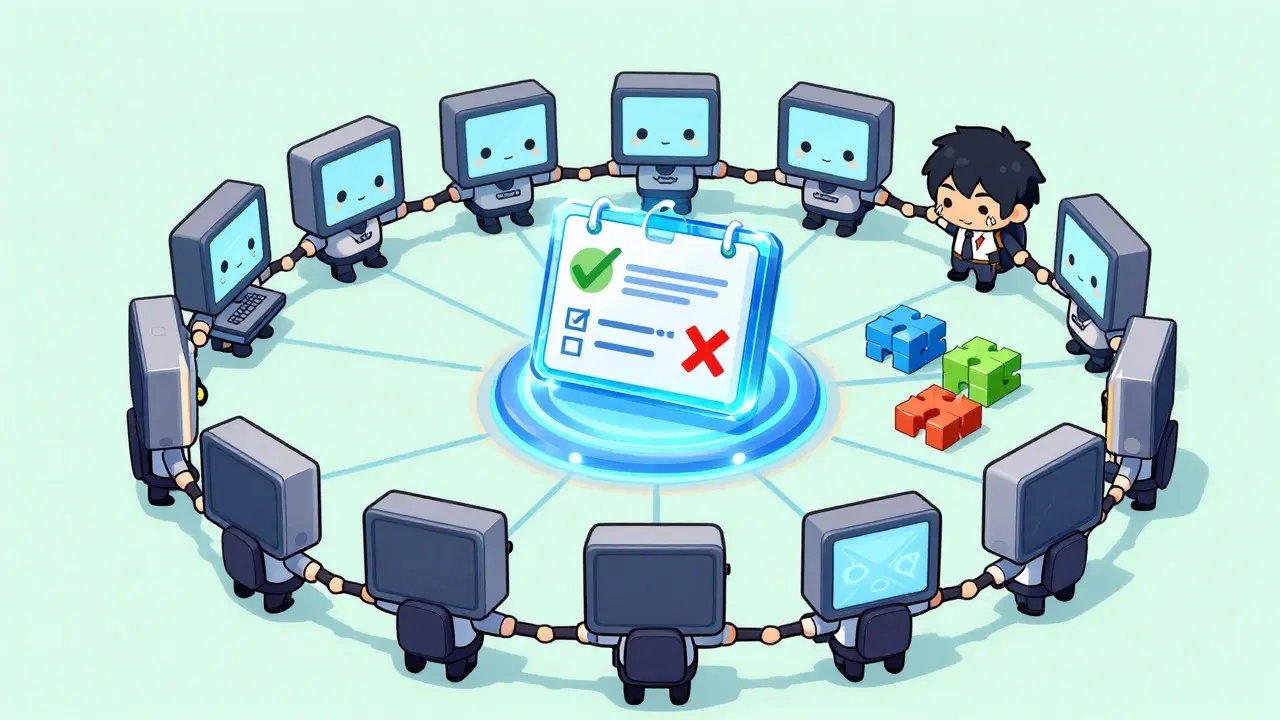
The breakthrough came with the invention of the blockchain. Instead of one company holding the record of who owns what, thousands of computers (nodes) around the world hold identical copies of the ledger. This is a distributed public ledger.
Here is how it stops double-spending in practice:
- Broadcasting: When Alice tries to send 1 BTC to Bob, her computer broadcasts this transaction to the entire network.
- Validation: Every node receives this request. They immediately check their own copy of the ledger. They ask: "Has Alice already spent this specific unit of Bitcoin?"
- Consensus: If the ledger shows Alice still holds that coin, nodes mark the transaction as "valid." If another transaction from Alice trying to spend the same coin appears, nodes flag it as a conflict.
- Grouping: Miners collect these valid transactions into a "block."
- Confirmation: Once the block is added to the chain, the transaction is confirmed. The ledger updates globally. Alice’s balance drops, Bob’s rises. The old state is gone forever.
Because everyone sees the same history, there is no ambiguity. If Alice tried to send that same coin to Charlie while the network was processing the payment to Bob, the nodes would see the conflict. Only one transaction can be included in the next block. The other is rejected.
The Role of Proof-of-Work and Confirmations
Simply having a shared list isn't enough. What if a hacker controls 51% of the computers and lies about the ledger? This is where the economic engine of Bitcoin, known as Proof-of-Work (PoW), comes in.
To add a new block to the blockchain, miners must solve a complex mathematical puzzle. This requires massive amounts of electricity and computing power. It is expensive and slow. This cost is the security deposit. To double-spend a coin after it has been confirmed, a malicious actor would need to:
- Outspend the entire rest of the network in computing power.
- Race against all other honest miners to rewrite the blockchain history.
- Create a longer version of the chain that excludes the legitimate transaction.
As more blocks are added on top of the transaction containing your payment, the energy required to reverse it grows exponentially. This is why merchants often wait for "confirmations." One confirmation means the transaction is in a block. Six confirmations mean six blocks have been built on top of it. At that point, reversing the transaction would cost billions of dollars in hardware and electricity, making it economically irrational to cheat.
| Feature | Centralized (Visa/Banks) | Decentralized (Bitcoin) |
|---|---|---|
| Trust Model | Trust the institution | Trust the math/code |
| Verification Speed | Near-instant | Minutes to hours (depending on confirmations) |
| Single Point of Failure | Yes (Server outage/Hack) | No (Distributed nodes) |
| Cost of Fraud | Legal/Financial penalties | Massive computational energy costs |
| Censorship Resistance | Low (Can freeze accounts) | High (Permissionless) |
Why This Matters for You as a User
Understanding the double-spending problem helps you use crypto safely. While the network is secure, the window between sending a transaction and it being fully confirmed is where risks exist. This is known as the "mempool" phase.
For small purchases, like buying coffee, a merchant might accept a transaction with zero confirmations because the risk of a double-spend attack on a $5 latte is negligible. The attacker would waste more money on fees than they would gain. However, for large transactions, such as buying a house or high-value electronics, always wait for multiple confirmations. Most wallets show this status clearly. Never consider a transaction "final" until the network has agreed on it.
Additionally, different cryptocurrencies handle this differently. While Bitcoin uses Proof-of-Work, others like Ethereum now use Proof-of-Stake (PoS). In PoS, validators lock up their own coins as collateral. If they try to validate a fraudulent double-spend, their stake is slashed (destroyed). The principle remains the same: make cheating more expensive than honesty.

Common Misconceptions About Double-Spending
There is a lot of noise online about crypto security. Let’s clear up two common myths.
Myth 1: "Double-spending is common and easy."
In reality, successful double-spends on major networks like Bitcoin are extremely rare. They usually happen only on smaller, less secure networks with low hash rates, or through social engineering scams where a user is tricked into signing a conflicting transaction off-chain. On the mainnet, the economic barriers are too high.
Myth 2: "Once sent, it’s instant and irreversible."
It is irreversible eventually, but not instantly. There is a propagation delay. If you send money, the recipient doesn’t truly "have" it until the network confirms it. During that brief window, the transaction is pending. Understanding this lag prevents panic when a payment seems stuck.
Summary: The Foundation of Trustless Money
The double-spending problem is not just a technical bug; it is the philosophical heart of cryptocurrency. Solving it allowed humans to transfer value over the internet without asking permission from a bank, government, or corporation. By combining a transparent public ledger with an economic incentive structure (mining or staking), blockchain technology turned fragile digital data into robust, scarce assets.
When you hold Bitcoin or any other major cryptocurrency, you are holding a piece of software that successfully solved a decades-old computer science challenge. You don’t need to understand the code to benefit from it, but knowing that the network is constantly verifying that your coins haven’t been copied gives you the confidence to transact freely.
Can Bitcoin really be double-spent?
Theoretically, yes, but practically, it is nearly impossible on the main network. To double-spend Bitcoin, an attacker would need to control more than 51% of the network's computing power to rewrite the blockchain history. Given the immense cost of hardware and electricity required to outpace global miners, it is economically unviable for anything other than very small, unconfirmed transactions.
How many confirmations do I need to avoid double-spending?
For small everyday purchases, one confirmation (roughly 10 minutes on Bitcoin) is usually sufficient. For larger transactions, such as buying goods worth thousands of dollars, waiting for six confirmations is the industry standard. After six blocks, the probability of a reorganization (reversal) becomes statistically negligible.
What is the difference between double-spending and counterfeiting?
Counterfeiting involves creating new, fake coins that didn't exist before (like printing fake $20 bills). Double-spending involves taking existing, valid coins and trying to spend them twice. Blockchain cryptography prevents counterfeiting through digital signatures, while the consensus mechanism (Proof-of-Work/Stake) prevents double-spending by agreeing on a single history of ownership.
Do all cryptocurrencies face the double-spending problem?
Yes, every decentralized digital currency must solve this problem to function. However, the method varies. Bitcoin uses Proof-of-Work, while Ethereum and Cardano use Proof-of-Stake. Some newer protocols use Delegated Proof-of-Stake or Byzantine Fault Tolerance variants. All aim to achieve the same result: a single, agreed-upon truth about who owns what.
Why does transaction speed matter for double-spending?
Slower transaction speeds allow more time for the network to reach consensus. Fast payments are convenient but carry a slightly higher risk during the confirmation window. If a network processes transactions instantly without a buffer period for validation, it becomes more vulnerable to race attacks where conflicting transactions are broadcast simultaneously. Security often trades off with speed.



Nick Wengel
July 25, 2026 AT 04:08Hey everyone, just wanted to share that in many parts of the world we still rely on cash because it is simple and does not need electricity. This article explains well why digital money needs these complex rules. It is interesting to see how different cultures view trust in systems.
Lisa Chong
July 26, 2026 AT 17:36The elites are watching us through every transaction br they want to track our spending habits under the guise of security. Satoshi was a front man for the cabal who wanted to replace gold with something they could control remotely. Wake up sheeple before your wallets are frozen by the central bank digital currency agenda. The blockchain is a surveillance tool disguised as freedom.
Alicia Hull
July 27, 2026 AT 13:28You really think this is about freedom? Please. The government wants total control over your assets. They will use this tech to freeze accounts if you dissent. It is all part of the great reset plan to enslave humanity through financial dependency. Do not trust the code trust your gut.
Johan Otto
July 28, 2026 AT 04:05Boring stuff. Who cares about double spending when the real issue is inflation caused by greedy bankers? I just want my coffee without reading a textbook.
Anuj Kashyap
July 29, 2026 AT 10:38🤔 The concept of scarcity in a digital realm is fascinating. We create value from consensus rather than physical constraint. It mirrors social contracts where truth is agreed upon by the community rather than imposed by authority. Perhaps this reflects a deeper human desire for transparent interaction 🌐
Tracy Marshall
July 31, 2026 AT 07:23They are lying to you about the energy usage br it is a conspiracy to destroy the planet while enriching mining farms owned by shadowy corporations. The proof of work is a trap designed to make you dependent on their infrastructure. Always question the narrative presented by mainstream crypto influencers.
Guy Davis
August 1, 2026 AT 18:53Moral decay starts when we remove accountability from transactions. People should face consequences for bad debts not hide behind anonymous ledgers. This tech encourages irresponsibility.
KEITH WONG
August 2, 2026 AT 02:56Listen up noobs. You guys dont get it. Bitcoin is the only real money because it has math behind it unlike fiat which is just printer ink. If you hold altcoins you are an idiot. HODL or lose everything 💎🙌
Natalie Lucas
August 3, 2026 AT 07:53Yay so exciting! I love learning new things about money. It makes me feel smart and empowered. Keep sharing these awesome tips everyone lets gooooo!
Curtis Johnson
August 5, 2026 AT 02:06Oh wow this is such a big topic. Everyone has such strong opinions. Lets just try to understand each other ok. Peace and love to all the miners out there working hard.
Steven Briggs
August 5, 2026 AT 14:55I guess it works for some people. I prefer keeping my cash in a safe though. Less stress.
Hamza k
August 5, 2026 AT 19:27What a spectacular display of technological hubris! To think we can replace centuries of banking tradition with lines of code written by anonymous geeks. It is either genius or madness and honestly I cannot decide which thrills me more.
Kim Kay
August 5, 2026 AT 19:54Hi friends. Just wanted to say its important to learn about this stuff. Mistakes happen but we can fix them together. Be kind to each other in the comments please.
Brad Semp
August 7, 2026 AT 07:44The common masses fail to grasp the elegance of cryptographic verification. While you debate trivialities, the sophisticated investor understands that decentralized consensus is the apex of financial engineering. Read the whitepaper if you must pretend to know anything.
Korn Arrieta
August 8, 2026 AT 07:20This analysis is superficial at best. You ignore the systemic risks of network partitions and the inherent vulnerability to quantum computing attacks. The author presents a sanitized view that ignores the brutal reality of distributed systems failure modes. True security requires redundancy beyond mere hash power.
Jackie D
August 9, 2026 AT 00:00So like do you think this means banks will disappear soon? I mean its kinda wild how computers check everything now. Makes me wonder if we need middlemen at all anymore.
Ruth Williams
August 10, 2026 AT 15:07Adequate summary for the layperson. However, one must acknowledge that the reliance on Proof-of-Work is increasingly untenable given environmental concerns. The shift towards Proof-of-Stake is not merely technical but moral. Those clinging to PoW are obstinate relics of a wasteful era.
Sophie Nakasako
August 11, 2026 AT 20:38I find it incredibly empowering to understand how we can trust strangers with our money. It opens up so many possibilities for global cooperation. Has anyone here tried using stablecoins for cross-border payments yet?
Kristy Morrow
August 13, 2026 AT 09:40Trust is an illusion anyway. The system is rigged regardless of whether it is centralized or decentralized. You are just trading one master for another. Enjoy your digital chains.
John Harman
August 15, 2026 AT 09:02Look I have been mining since 2011 and let me tell you nothing has changed except the price went up. The tech is solid stop worrying about double spends and start buying dip.
Heather Austin
August 16, 2026 AT 16:05hey guys just a quick tip if you are new to this always check the block explorer yourself dont just trust what the wallet says. i learned that the hard way once lol. its pretty cool how you can verify everything yourself tho. gives me peace of mind knowing i am not relying on a bank server being online. hope this helps someone out there