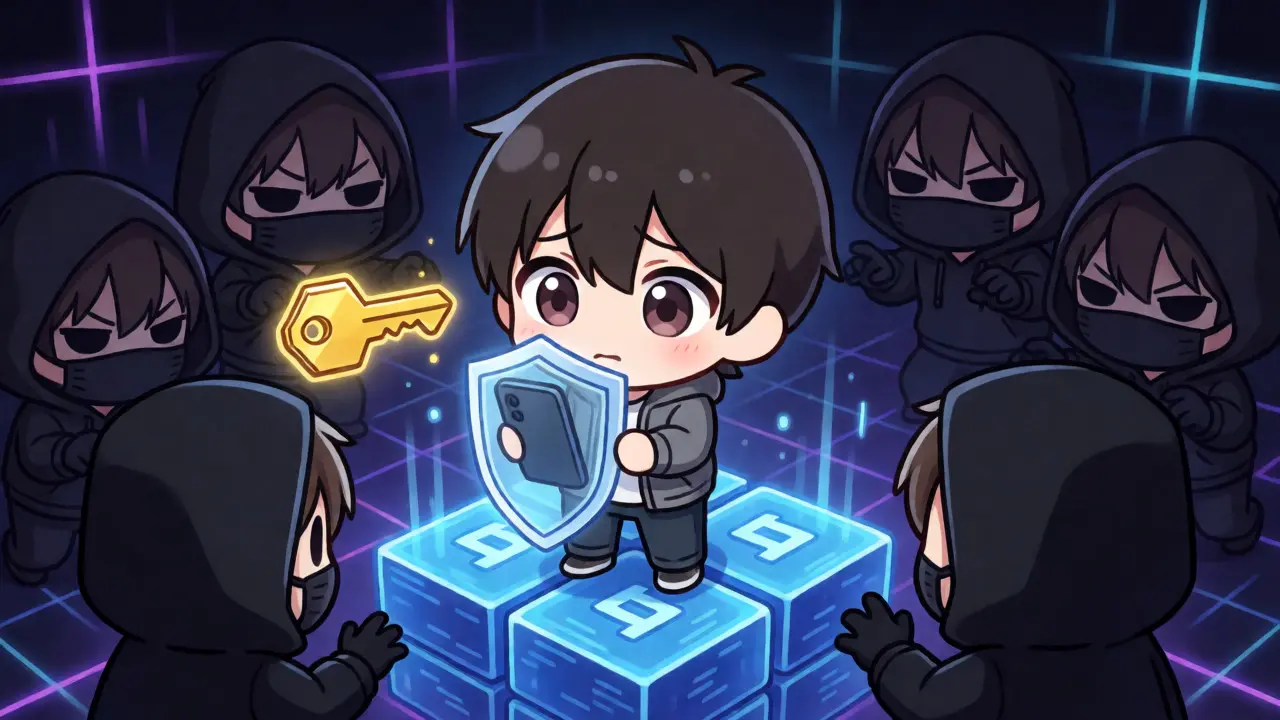
You think you're safe because you use two-factor authentication. You enter your password, check your phone for a code, and hit send. But in the world of blockchain, where private keys are everything, that extra step might not be enough. If an attacker steals your phone number via SIM swapping or tricks you into approving a push notification, your funds vanish. This is why Multi-Factor Authentication (MFA) has become the new standard for serious crypto holders. Unlike basic 2FA, which uses exactly two factors, MFA allows for three, four, or more layers of verification. It’s not just about adding steps; it’s about diversifying how you prove who you are.
The Critical Difference Between 2FA and MFA
People often use these terms interchangeably, but they aren’t the same thing. Think of 2FA as a specific subset of MFA. Two-factor authentication requires exactly two distinct categories of credentials. Multi-factor authentication is a broader framework that can include any number of factors, as long as they come from different categories. Why does this distinction matter? Because relying on just two points of failure leaves gaps. If you use a password and an SMS code, you have two factors. But if an attacker compromises both through social engineering or malware, you’re locked out-or worse, they’re in.
MFA scales up this protection. A robust MFA setup for a crypto exchange might require a strong password, a hardware token like a YubiKey, and a biometric scan. That’s three factors. If one fails, the others hold the line. The Cybersecurity and Infrastructure Security Agency (CISA) explicitly labels single-factor authentication as bad practice. They argue that passwords alone are too vulnerable to phishing and brute-force attacks. While CISA doesn't mandate a specific number of factors beyond "multiple," industry best practices suggest moving beyond the bare minimum of two when dealing with high-value assets like Bitcoin or Ethereum.
Understanding the Five Pillars of Authentication
To build a true MFA strategy, you need to understand what counts as a factor. There are five recognized categories. Mixing them up is key. Using two things from the same category-like two different passwords-isn't real MFA; it's just double-entry.
- Something You Know: Passwords, PINs, or secret answers. These are easy to forget or guess.
- Something You Have: Hardware tokens, mobile devices, or smart cards. These are physical objects.
- Something You Are: Biometrics like fingerprints, facial recognition, or voice patterns. These are hard to steal but can be spoofed.
- Somewhere You Are: Location data. Does the login request come from Wellington, New Zealand, or suddenly from Moscow?
- Something You Do: Behavioral biometrics. How do you type? What’s your typical mouse movement pattern?
A strong MFA implementation combines factors from at least three of these pillars. For example, logging into a cold wallet interface might require a password (knowledge), a fingerprint scan (biometric), and confirmation from a hardware device held in your hand (possession). This triad makes remote attacks exponentially harder.
| Method | Security Level | Vulnerability | User Experience |
|---|---|---|---|
| Password Only | Low | Phishing, Brute Force | Fast |
| 2FA (SMS) | Medium | SIM Swapping, SS7 Attacks | Slow |
| 2FA (App) | High | Malware on Device | Medium |
| MFA (Hardware + Biometric) | Very High | Physical Theft, Spoofing | Slower |
| MFA (Behavioral AI) | Adaptive | Data Privacy Concerns | Seamless |

Why Blockchain Demands Stronger Security
In traditional banking, if someone hacks your account, you call the bank. They reverse the transaction. In blockchain, transactions are immutable. Once your Bitcoin moves to an attacker’s address, it’s gone. No customer service will help you. This finality drives the need for MFA beyond simple 2FA.
Consider the threat of SIM Swapping. Attackers trick mobile carriers into porting your phone number to their device. If you rely on SMS-based 2FA, they now receive your codes. With MFA using a hardware token, the attacker needs your physical key, not just your phone number. Another risk is adversary-in-the-middle attacks, where hackers intercept session cookies. Even if they bypass your first factor, additional verification steps tied to specific devices or locations can block the session.
Remote work has also changed the landscape. Logging in from a coffee shop in London versus your home office in Wellington adds context. Modern MFA systems analyze this location data. If you usually log in from NZ but suddenly try to access your portfolio from a new IP address in Asia, the system can demand extra proof. This contextual awareness is something basic 2FA lacks.
Implementing MFA Without Losing Your Mind
Security shouldn't make you want to throw your computer out the window. If MFA is too annoying, users find workarounds-like writing down backup codes on sticky notes attached to the monitor. To avoid this, focus on usability alongside security.
Start by ditching SMS for authentication apps or hardware keys. Apps like Authy or Google Authenticator generate time-based one-time passwords (TOTP) locally, meaning no signal is needed. Hardware keys, such as those supporting FIDO2 standards, offer the highest resistance to phishing. They don’t transmit reusable secrets over the network. Instead, they use cryptographic challenges unique to each site.
For highly sensitive accounts, consider adding behavioral analytics. Some enterprise-grade solutions monitor how you interact with the platform. If your typing speed drops dramatically or you paste a password instead of typing it, the system flags it as anomalous. While this sounds like sci-fi, it’s becoming common in fintech. It adds a layer of friction only when necessary, keeping daily logins smooth while catching sophisticated attacks.

Pitfalls to Avoid in Your MFA Setup
Even with MFA, mistakes happen. Here are common traps crypto users fall into:
- Reusing Backup Codes: Store recovery codes offline, ideally on metal plates or paper in a safe. Never save them in cloud notes or screenshots on your phone.
- Trusting Email Verification Too Much: If your email account isn’t secured with its own MFA, an attacker can reset your crypto exchange password via email link. Secure your email first.
- Ignoring Device Hygiene: An MFA prompt on a compromised device is useless. Malware can capture screen inputs or approve push notifications automatically. Keep your OS updated and run regular scans.
- Over-Reliance on Biometrics: Fingerprints can be lifted from glasses. FaceID can be fooled by twins or photos. Always pair biometrics with another factor.
Remember, MFA is a chain. Its strength depends on the weakest link. If you use a weak password alongside a strong hardware key, the password remains a vulnerability. Use a password manager to generate complex, unique strings for every account.
The Future: Adaptive and Passwordless
We are moving toward passwordless authentication. Technologies like passkeys allow you to authenticate using your device’s built-in biometric sensors without ever typing a password. This reduces the attack surface significantly. No password means no credential stuffing.
Artificial intelligence will play a bigger role in MFA decisions. Instead of rigid rules, AI models will assess risk in real-time. Is this login consistent with your history? Is the device trusted? Should we ask for extra verification? This adaptive approach balances security and convenience, ensuring that low-risk actions remain fast while high-risk ones get scrutinized.
Is MFA better than 2FA for cryptocurrency?
Yes, generally speaking. MFA allows for more than two factors, providing deeper defense-in-depth. Since crypto transactions are irreversible, the extra layers reduce the chance of unauthorized access compared to standard 2FA setups.
Can I use two passwords for MFA?
No. Both passwords fall under the "something you know" category. True MFA requires factors from different categories, such as combining a password (knowledge) with a hardware token (possession).
What is the most secure MFA method?
FIDO2-compliant hardware security keys combined with biometric verification are currently considered among the most secure methods. They resist phishing and require physical possession of the device.
Does MFA slow down trading?
It can add seconds to the login process, but modern implementations like passkeys or biometric approvals are nearly instant. For frequent traders, optimizing the workflow is crucial to maintain speed without sacrificing security.
Should I enable MFA on my email?
Absolutely. Your email is often the master key to resetting passwords on other services. If your email is compromised, attackers can bypass your crypto exchange’s 2FA by requesting a password reset. Secure your email with MFA first.