
Imagine walking into a store, buying a coffee with cash, and then somehow convincing the cashier that you never handed over the money. You keep the coffee, you keep your cash, and the store loses both. This isn’t magic; it’s double spending, and in the world of cryptocurrency, it’s the primary goal of a 51% attack.
For years, many people believed that blockchain technology was unhackable by design. Satoshi Nakamoto, the creator of Bitcoin, assumed that acquiring half of the network’s computing power would be impossible due to the sheer scale required. But as the crypto landscape exploded with thousands of alternative coins (altcoins), this theoretical risk became a very real, documented nightmare for several projects. Today, we aren't talking about hypothetical scenarios. We are looking at the actual moments when hackers seized control of entire networks, rewrote history, and stole millions.
How a 51% Attack Actually Works
To understand why these attacks happen, you first need to grasp how Proof-of-Work (PoW) blockchains maintain order. In PoW systems like Bitcoin or Ethereum Classic, miners compete to solve complex mathematical puzzles. The first miner to solve the puzzle gets to add the next block of transactions to the chain and is rewarded with new coins. The rule is simple: the longest valid chain is the true one.
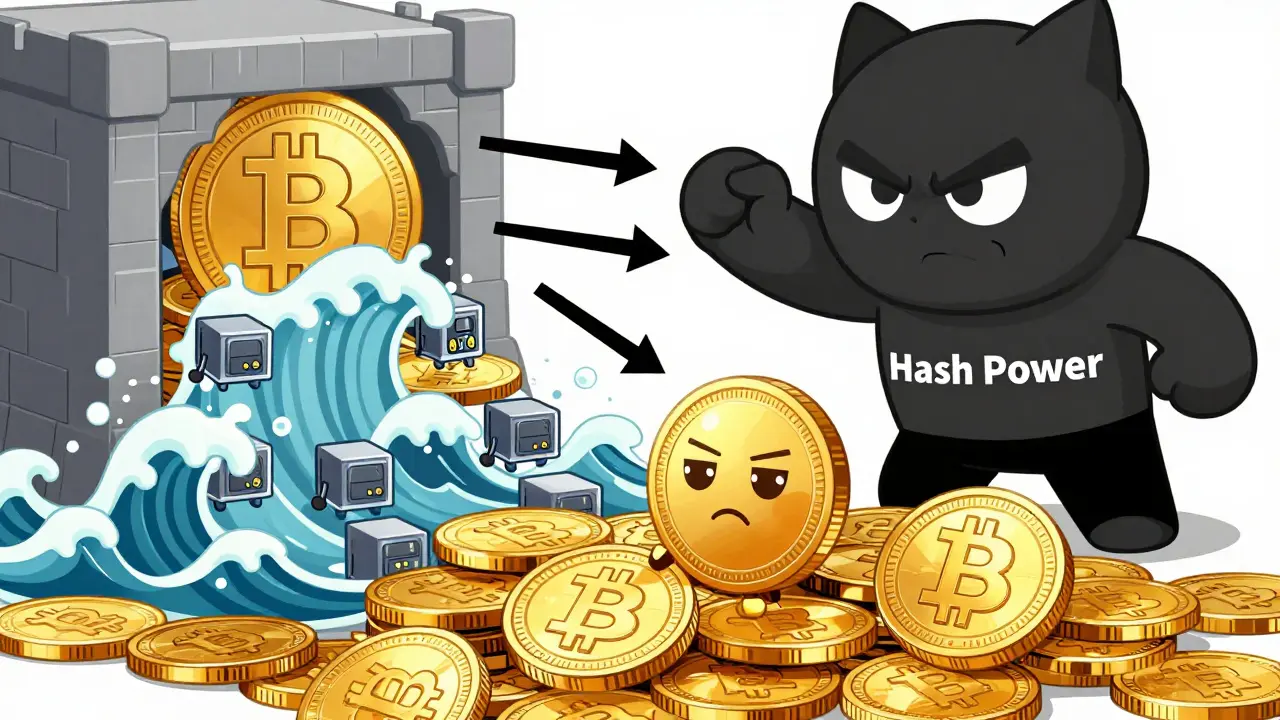
A 51% attack occurs when a single entity or group gains control of more than 50% of the network’s total mining hash rate. With this majority, they don’t just mine faster; they dictate reality. Here is the step-by-step process an attacker follows:
- Gain Control: The attacker rents or buys enough mining hardware to outpace all other honest miners combined.
- Create a Secret Chain: They start mining their own version of the blockchain privately. This secret chain excludes certain transactions-specifically, the ones where they deposited funds into an exchange.
- Execute the Transaction: Simultaneously, they send those same coins to a public exchange, sell them for stablecoins or fiat currency, and withdraw the cash.
- Release the Attack: Once the exchange confirms the deposit and releases the funds, the attacker reveals their secret, longer chain. Because it is longer, the network accepts it as the truth.
- Double Spend Complete: The original deposit transaction disappears from the ledger. The attacker still has their original coins, plus the cash they withdrew. The exchange is left holding the bag.
This mechanism allows attackers to reverse confirmed transactions, censor legitimate users, and effectively halt the network. It is not a bug in the code; it is a flaw in the economic distribution of power.
Ethereum Classic: The Repeated Victim
If there is a poster child for 51% attacks, it is Ethereum Classic (ETC). Ethereum Classic is a decentralized platform that emerged from a hard fork of the original Ethereum blockchain in 2016 following the DAO hack. ETC maintains the original Ethereum ledger but operates on a Proof-of-Work consensus mechanism, making it vulnerable to hash rate dominance.
In early 2019, Ethereum Classic suffered its first major 51% attack. A malicious actor controlled more than half of the network’s nodes. Coinbase, one of the largest cryptocurrency exchanges, detected suspicious activity in real-time. Their monitoring systems identified unusual transaction patterns indicative of blockchain reorganization attempts. To protect user funds, Coinbase immediately froze all trading of Ethereum Classic. This incident highlighted a critical point: even if the blockchain itself is compromised, centralized exchanges can act as a defensive layer by halting withdrawals.
However, the attackers didn’t stop there. In August 2020, Ethereum Classic faced three separate 51% attacks within a single month. The financial losses reached millions of dollars. The severity of these repeated assaults was so damaging that some exchanges publicly discussed delisting ETC entirely. These events proved that without sufficient mining diversity, a network remains perpetually exposed, regardless of its historical significance or community support.

Bitcoin Gold: A Textbook Case Study
Bitcoin Gold (BTG) is a cryptocurrency created in late 2017 as a fork of Bitcoin, designed to make mining more accessible using graphics processing units (GPUs) rather than specialized ASIC chips. When BTG launched, it aimed to decentralize mining away from industrial farms. Unfortunately, this ambition made it a prime target.
Bitcoin Gold suffered multiple successful 51% attacks shortly after its inception. The vulnerability stemmed from its relatively small network hash rate compared to Bitcoin’s massive infrastructure. Attackers exploited a phenomenon known as "hash rate switching." Miners operating on larger networks could temporarily redirect their computational power to Bitcoin Gold because it used a compatible mining algorithm. By pooling resources from larger coins, attackers overwhelmed BTG’s native miners.
The MIT Digital Currency Initiative cited Bitcoin Gold as a textbook example of how smaller cryptocurrencies fall prey to this threat. They noted that only a small fraction of miners from a large coin like Bitcoin need to switch to a smaller coin to achieve 51% control. For Bitcoin Gold, the cost of renting this hash power was significantly lower than the potential profit from double-spending, creating a lucrative business model for cybercriminals.
| Cryptocurrency | Consensus Mechanism | Estimated Cost to Attack (Hourly) | Vulnerability Level |
|---|---|---|---|
| Bitcoin (BTC) | Proof-of-Work | Millions of USD | Extremely Low |
| Litecoin (LTC) | Proof-of-Work | Thousands of USD | Moderate |
| Ethereum Classic (ETC) | Proof-of-Work | Hundreds of USD | High |
| Bitcoin Gold (BTG) | Proof-of-Work | Hundreds of USD | High |
The Economics of Renting Hash Power
You might assume that launching a 51% attack requires billions of dollars in custom-built mining rigs. While that is true for Bitcoin, it is no longer true for many altcoins. The rise of "mining-as-a-service" platforms has democratized access to computational power, inadvertently lowering the barrier to entry for criminals.
In July 2025, blockchain security expert Karsten Nohl analyzed the current economics of these attacks. He revealed that attacking Bitcoin would require controlling approximately 204 exahashes per second (EH/s). At current market rates, renting this capacity costs several million dollars per hour. Given Bitcoin’s market cap and liquidity, such an attack would likely crash the price before any profit could be realized, making it economically irrational.
Contrast this with Litecoin or smaller coins. Despite Litecoin having a multi-billion dollar market capitalization, Nohl’s analysis showed it could be attacked for only a few thousand dollars by amassing more computational resources than the existing chain. This disconnect between market value and network security is dangerous. Investors often equate high market cap with safety, but in Proof-of-Work systems, safety is determined solely by hash rate distribution. If a coin has low mining competition, its price tag offers no protection against takeover.
Beyond Theft: Market Manipulation and DoS Attacks
While double-spending is the most direct form of theft, 51% attacks serve other malicious purposes. Attackers can use their control to manipulate market sentiment. By launching an attack, they create chaos and uncertainty. Traders panic, selling off their holdings, which drives the price down. Sophisticated attackers often establish short positions before the attack begins, profiting from the price drop caused by their own sabotage.
Additionally, attackers can execute Denial of Service (DoS) attacks. By refusing to include legitimate transactions in their blocks, they can freeze the network. Users cannot send or receive funds. Honest miners find their blocks constantly orphaned (rejected) because the attacker’s chain grows faster. This effectively shuts down the blockchain, rendering it useless until the attacker decides to stop. The Cloud Security Alliance emphasized in a 2020 report that these are not "someday maybe" threats but active, "here and now" risks facing distributed ledger technologies.
Defenses and Future Outlook
So, how do networks protect themselves? For giants like Bitcoin, the defense is economic deterrence. The cost of attack exceeds the potential reward. Furthermore, Bitcoin has a vast number of independent nodes and a highly vigilant community. Any sudden shift in hash rate or mining pool concentration triggers immediate alerts. Emergency protocol upgrades can be deployed if necessary.
For smaller networks, defenses are weaker. Exchanges have adapted by increasing confirmation requirements. Instead of crediting a deposit after one block confirmation, they may wait for ten or twenty confirmations. This makes double-spending harder because the attacker must maintain their secret chain longer, increasing the cost and risk of detection. However, this slows down user experience and does not prevent the attack entirely.
Some networks are moving away from Proof-of-Work to Proof-of-Stake (PoS) or hybrid models to eliminate hash rate-based vulnerabilities. In PoS, validators stake their own coins to secure the network, making an attack economically self-destructive since the attacker would devalue their own holdings. Until smaller PoW chains migrate or increase their mining diversity, they remain sitting ducks for anyone willing to rent a few terahashes of power.
Can Bitcoin suffer a 51% attack?
Theoretically, yes, but practically, it is nearly impossible. Bitcoin’s hash rate is measured in exahashes per second. An attacker would need to control over 204 EH/s, requiring hundreds of millions of dollars in hardware and electricity costs. The expense far outweighs any potential profit from double-spending, serving as a strong economic deterrent.
What happened during the Ethereum Classic 51% attack in 2020?
In August 2020, Ethereum Classic experienced three separate 51% attacks within one month. Attackers reversed transactions totaling millions of dollars. The repeated breaches severely damaged trust in the network, leading some exchanges to consider delisting the asset. It highlighted the ongoing vulnerability of low-hash-rate Proof-of-Work chains.
How much does it cost to launch a 51% attack?
The cost varies drastically by network. As of 2025, attacking Bitcoin costs millions of dollars per hour. However, attacking smaller coins like Ethereum Classic or Bitcoin Gold can cost as little as a few hundred to a few thousand dollars when renting hash power from mining pools. This affordability makes smaller altcoins frequent targets.
Why did Bitcoin Gold get hacked so easily?
Bitcoin Gold used a mining algorithm similar to Bitcoin but had a much smaller dedicated mining community. Attackers were able to redirect hash power from larger networks to overwhelm Bitcoin Gold’s limited defenses. This demonstrated that sharing an algorithm with a secure coin does not guarantee security if your specific network lacks sufficient independent miners.
Can exchanges prevent 51% attacks?
Exchanges cannot prevent the attack on the blockchain itself, but they can mitigate the damage. By implementing strict confirmation requirements and monitoring for unusual reorganization patterns, exchanges can freeze funds before attackers successfully withdraw stolen assets. Coinbase successfully used this method during the 2019 Ethereum Classic attack.



Bijan Das
May 23, 2026 AT 00:41another day another crypto scam. you guys really think this is news? it's just math for people who failed algebra.
Larry Port
May 23, 2026 AT 22:52The article makes a good point about the economic deterrent for Bitcoin, but I wonder if the definition of 'longest chain' is evolving with new consensus mechanisms. It seems like we are seeing a shift where hash rate isn't the only metric that matters anymore. The historical context of Ethereum Classic is particularly interesting because it shows how community decisions can have long-term security implications. When a network forks, the distribution of miners often becomes uneven, creating these vulnerabilities. It raises questions about whether Proof-of-Work is sustainable for smaller networks in the long run. Perhaps hybrid models will become the standard rather than pure PoW or PoS. We need to look at how mining pools coordinate their efforts too. If a few large pools control most of the hash rate, the risk increases regardless of the total network power. This centralization tendency is a silent killer for decentralization ideals. It forces us to rethink what true security means in a digital ledger system.
Ashley Rodriguez
May 25, 2026 AT 14:16i totally agree with the part about exchanges freezing funds because it feels like they are trying to protect us but also kind of controlling us and i guess that is necessary though since otherwise everyone would lose their money and it would be a mess so maybe we should trust them more even if it slows things down
Matt Davis
May 25, 2026 AT 20:03Absolutely dreadful analysis. You fail to mention that the real issue is not the attack vector but the incompetence of the developers who maintain these chains. Ethereum Classic is a zombie coin kept alive by nostalgia and stubbornness. To suggest that 'mining diversity' is the primary solution ignores the fundamental flaw in Proof-of-Work economics for low-cap assets. It is a race to the bottom. The attackers are rational actors exploiting irrational market structures. Your table is misleading because it implies a static cost, whereas rental markets fluctuate wildly based on global energy prices and hardware availability. Furthermore, the notion that Bitcoin is safe due to cost is naive; a coordinated state-level actor could theoretically absorb the loss for geopolitical leverage. This post reads like marketing material for Proof-of-Stake advocates.
Bridget Coogle
May 26, 2026 AT 19:53it is scary to think about but we have to keep moving forward. technology always has risks. we learn from mistakes.
Kimberly Herbstritt
May 28, 2026 AT 05:33I actually disagree with the premise that small coins are inherently unsafe. Some projects have implemented checkpointing or other soft-fork resistant measures that make 51% attacks less profitable even if technically possible. The narrative here is too focused on fear-mongering rather than solutions. Also, Bitcoin Gold had specific implementation bugs early on that exacerbated the issue, which isn't mentioned. It wasn't just hash rate switching; it was poor code quality combined with low hash rate. Blaming the consensus mechanism entirely is an oversimplification. Many altcoins survive with low hash rates because the expected value of an attack is negative due to detection and blacklisting by exchanges. The ecosystem is more resilient than this article suggests.
Bianca Vilas Boas Lourenço
May 29, 2026 AT 17:14ugh why do people still care about etch? 💀 it’s dead anyway. stop pretending it matters. 🙄
Zara Zaman
May 30, 2026 AT 05:22This is exactly why foreign entities should not be allowed to mine our data. The infrastructure must remain under strict national control to prevent such breaches. Allowing open access to hashing power invites chaos and theft. We need sovereign blockchain solutions that prioritize domestic security over global decentralization myths. The vulnerability of Bitcoin Gold shows what happens when you let anyone participate without oversight. It is a security nightmare waiting to happen on a larger scale if we do not enforce stricter regulations on mining operations within our borders.
Albert Lee
May 31, 2026 AT 16:12Wow! That is incredibly intense stuff! But hey, every challenge is an opportunity to grow stronger as a community! We can learn so much from these failures! Let’s support the developers who are working hard to fix these issues! You’ve got this! Keep pushing forward despite the setbacks!
Yash Lodha
June 1, 2026 AT 22:47The so-called 'attacks' are merely corrections to the flawed ledger maintained by corrupt elites. They know the truth about the double-spend nature of fiat currency and expose it through these demonstrations. The government wants you to believe blockchain is secure so they can implement CBDCs without resistance. These hackers are whistleblowers revealing the fragility of centralized exchange systems. Do not be fooled by the mainstream narrative. The real crime is the manipulation of hash rates by shadowy cabals controlling mining pools. Wake up and see the pattern.
Sharada Vakkund
June 2, 2026 AT 05:10Great discussion everyone! It is important to understand these mechanics so we can make informed decisions. Let us welcome newcomers who might be confused by the technical jargon. Here is a simple breakdown: if one person has more votes than everyone else combined, they can change the rules. In crypto, votes are computing power. If you rent enough computers, you can rewrite history. This is why diversity in who owns the computers matters. Just like in a democracy, having many different voices prevents tyranny. So supporting diverse mining pools is key to keeping the network honest and safe for all users involved.
Sudarshan Anbazhagan
June 3, 2026 AT 03:06It is imperative that we recognize the profound implications of such vulnerabilities upon the broader financial architecture which relies upon perceived immutability as its foundational pillar thereby necessitating a rigorous examination of the underlying cryptographic protocols which govern transaction validation processes within decentralized networks especially those operating under proof-of-work consensus mechanisms wherein computational dominance equates directly to authoritative control over the ledger state thus exposing systemic weaknesses inherent in asymmetric resource distribution among participating nodes across the global network topology
John Gonzalez Bentham
June 3, 2026 AT 07:19u guys are missing the point completly. its not about the tech its about the ppl. humans are greedy. no matter what algorthm u use ppl will find a way to cheat. bitcoin gold failed bc the devs were idiots. etch fails bc the commuity is toxic. stop blaming the code. the code works fine. the problem is us. we want free money. thats why these attacks happen. its human nature. u cant code ur way out of greed. simple as that. dont waste time reading this garbage.
Ellie Riddell
June 3, 2026 AT 15:14Oh look, another panic post. How original. The reality is that these attacks are rare and usually result in minimal long-term damage because the market corrects itself quickly. People love to scream about security flaws while ignoring the fact that banks get hacked constantly too. At least in crypto, the theft is transparent and recorded forever. In traditional finance, your money disappears into a black hole with no trace. So yes, 51% attacks are bad, but compared to the systemic fraud in Wall Street, they are a minor nuisance. Relax and enjoy your coffee.
Destiny Kilby
June 3, 2026 AT 16:30the information provided is accurate regarding the mechanics of the attack however the emotional tone of the article is somewhat unnecessary. we should focus on factual analysis rather than sensationalism. it is clear that proof-of-stake offers better security guarantees for smaller networks but migration is complex. users must exercise caution when dealing with low-cap altcoins. there are no shortcuts to security. patience and verification are essential virtues in this space.
Jerry CUNNINGHAM SR
June 5, 2026 AT 11:42Thank you for sharing this detailed overview. It is crucial for investors to understand the difference between market capitalization and network security. Many individuals mistakenly assume that a high price tag equates to safety, which is a dangerous misconception. As responsible participants in this ecosystem, we must advocate for transparency and robust security practices. Exchanges play a vital role in mitigating these risks, and their efforts should be acknowledged. Let us continue to educate ourselves and each other to foster a safer environment for all stakeholders involved in cryptocurrency transactions.
Shelby Cantu
June 5, 2026 AT 20:02Stay vigilant! Check your confirmations! Don't rush deposits!
Tobias Gjerlufsen
June 6, 2026 AT 09:02You are all fools for believing this simplistic narrative. The concept of a 51% attack is outdated propaganda designed to push centralization. Real security comes from game theory and economic incentives not raw hash power. The attackers are not criminals they are arbitrageurs correcting market inefficiencies. If the network cannot defend itself economically it deserves to fail. Survival of the fittest applies here. Stop whining about 'hackers' and start understanding the deeper philosophical implications of trustless systems. Your ignorance is embarrassing. Read some actual academic papers instead of reddit posts.