
You’ve probably seen headlines screaming about "Dogecoin whales" buying billions of tokens. It’s easy to assume that any coin with "Whale" and "Doge" in the name is part of that massive trend. But here is the hard truth: WHALES DOGE is not Dogecoin. It is a completely different, ultra-micro-cap token that shares a ticker symbol but nothing else in terms of value, history, or utility.
If you are looking at this token because you saw it on CoinMarketCap or heard a rumor about whale accumulation, stop for a second. You need to understand exactly what you are looking at before you send even a single dollar into it. This isn’t just another meme coin; it is a statistical anomaly with near-zero liquidity and anonymous creators.
The Confusion: WHALES DOGE vs. Dogecoin Whales
The biggest trap with this token is its name. In the crypto world, "whales" refers to large holders who can move markets. When news outlets report that "Dogecoin whales are buying," they are talking about wallets holding hundreds of millions of actual Dogecoin (DOGE), which was launched in 2013 by Billy Markus and Jackson Palmer.
WHALES DOGE is a separate, obscure cryptocurrency token that uses a similar ticker symbol ('DOGE') but has no connection to the original Dogecoin blockchain or its community. It is an attempt to ride the coattails of the popular narrative surrounding large Dogecoin holders. There is no evidence that the developers of WHALES DOGE have any affiliation with the Dogecoin Foundation or the original creators. They are simply using the buzzwords to attract attention.
Key Metrics: The Numbers Don't Lie
Let’s look at the data available from tracking sites like CoinMarketCap. These numbers paint a picture of extreme fragility.
| Metric | Value |
|---|---|
| Market Cap | ~$2,090 USD |
| Total Supply | 99.98 Peta-units (approx. 10^17 tokens) |
| Holders | 195 addresses |
| 24h Volume | $0 USD |
| Ticker Symbol | DOGE (on some platforms) |
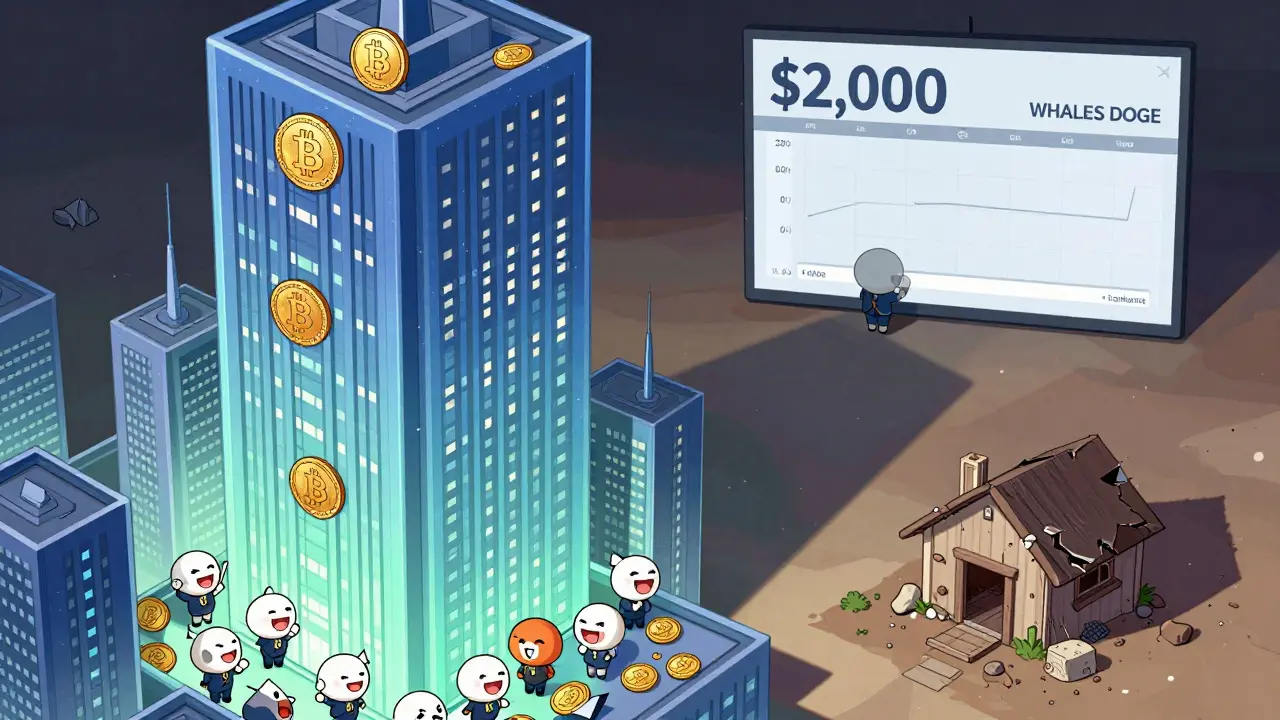
A market cap of roughly $2,000 is incredibly small. For context, if someone decided to sell $200 worth of these tokens, they would be dumping nearly 10% of the entire market value in one transaction. With zero trading volume reported in the last 24 hours, there is effectively no liquidity. This means you might be able to buy the token, but selling it could be impossible without crashing the price to zero.
Tokenomics: The 2% Burn Mechanism
The project claims to have a deflationary model. According to its listing, WHALES DOGE implements a 2% automatic burn tax on every transaction, meaning 2% of the transferred amount is permanently removed from circulation. The goal is to reduce supply over time, theoretically increasing scarcity.
While this sounds appealing compared to high-tax coins like SafeMoon (which had a 10% tax), the reality is different. Because there is almost no trading volume, the burn mechanism is barely active. Furthermore, the claim that "LP (Liquidity Pool) is locked forever" and "devs do not hold tokens" is self-reported. Without an independent audit or a verifiable contract address linked to a trusted locking service like Unicrypt, these are just words on a webpage. In the world of micro-cap memes, "locked forever" often turns out to mean "locked for 1 year" or, worse, never locked at all.
Security Risks and Anonymity
Who created WHALES DOGE? We don’t know. There is no whitepaper, no named team, and no GitHub repository linking to the code. This anonymity is standard for many meme coins, but it is also the primary red flag for investors.
- No Audit: There is no record of a security firm like CertiK or Hacken auditing the smart contract. This means hidden functions could exist-such as the ability for the owner to pause trading, blacklist your wallet, or change the tax rate to 100% at any moment.
- Rug Pull Potential: Despite the claim that LP is locked, if the lock is fake or expired, the developers could withdraw all the liquidity from the pool, leaving holders with worthless tokens. This is known as a "rug pull."
- Confusion Tactics: Using the ticker "DOGE" on some listings is a deliberate tactic to confuse users into thinking they are buying the major asset. Always check the contract address, not just the name.
How to Verify Before Buying
If you still want to explore this token despite the risks, you must do your own due diligence. Do not rely on the CoinMarketCap summary alone.
- Find the Contract Address: Locate the official smart contract address on the blockchain explorer (likely BscScan for BNB Chain or Etherscan for Ethereum). Never trust a link sent via DM or social media.
- Check Liquidity Locks: Go to services like Team.Finance or Unicrypt and search for the contract address. Verify if the LP tokens are actually locked and for how long. If it’s not listed there, the "locked forever" claim is likely false.
- Analyze Holder Distribution: Look at the top 10 holders. If one or two wallets hold more than 20-30% of the supply (excluding exchange wallets), the risk of a dump is extremely high.
- Test with Small Amounts: Never invest money you cannot afford to lose. Given the $0 volume, even a $10 trade could result in significant slippage.

Comparison: WHALES DOGE vs. Established Meme Coins
To put the scale of this token into perspective, let’s compare it to established players in the meme coin space.
| Feature | WHALES DOGE | Dogecoin (DOGE) | Shiba Inu (SHIB) |
|---|---|---|---|
| Market Cap | ~$2,090 | $10B - $15B+ | $5B - $10B+ |
| Launch Year | Unknown/Recent | 2013 | 2020 |
| Team Transparency | Anonymous | Public/Open Source | Semi-Anonymous (Ryoshi) |
| Liquidity | Near Zero | High (Major Exchanges) | High (Major Exchanges) |
| Risk Level | Extreme | Moderate-High | Moderate-High |
Dogecoin and Shiba Inu survived their early years because they built massive communities and gained listings on major exchanges like Binance and Coinbase. WHALES DOGE has neither. It sits in the "graveyard" zone of crypto, where thousands of tokens launch daily and fade away within weeks.
Conclusion: Is It Worth Your Time?
From a financial perspective, WHALES DOGE offers no utility, no revenue stream, and no credible path to adoption. It is a speculative instrument based entirely on hope and viral marketing tricks. The lack of trading volume means you may not be able to exit your position even if the price goes up.
If you are interested in the "whale" narrative, stick to analyzing on-chain data for major assets like Bitcoin, Ethereum, or the original Dogecoin. Tools like Santiment or Glassnode provide real insights into whale behavior for those established coins. Investing in micro-caps like WHALES DOGE is closer to gambling than investing, and the odds are heavily stacked against you.
Is WHALES DOGE the same as Dogecoin?
No. WHALES DOGE is a separate, unrelated token. Dogecoin (DOGE) is a major cryptocurrency launched in 2013. WHALES DOGE is a micro-cap meme token that uses a similar name and ticker to create confusion.
Why is the market cap so low?
The market cap is around $2,000 because very few people own the token, and there is almost no trading activity. It lacks the community support and exchange listings required to build significant value.
Can I buy WHALES DOGE on Binance or Coinbase?
Likely not. Major exchanges require high liquidity, security audits, and legal compliance. WHALES DOGE does not meet these criteria. You would likely have to buy it on a decentralized exchange (DEX) like PancakeSwap, which carries higher risk.
What does the 2% burn mean?
It means that for every transaction, 2% of the tokens being transferred are sent to a dead address and destroyed. This is intended to make the remaining tokens scarcer, but with low trading volume, this effect is minimal.
Is it safe to invest in WHALES DOGE?
It is highly risky. The token has an anonymous team, no audit, and near-zero liquidity. There is a significant chance of losing your entire investment due to rug pulls or inability to sell.